Relocating to Richmond VA from San Diego: Cost of Living, Neighborhoods & What to Expect
You will get a great deal more house – and you are giving up one of the best climates in the world
Moving to Richmond, Virginia from San Diego is one of the most lopsided trades in American relocation, and it is worth naming both sides honestly. On the gain side you get substantially more house for your money, a tree canopy instead of a hillside, four real seasons, a commute measured in minutes rather than freeway hours, and a much lower cost of housing. On the loss side you are giving up one of the best climates anywhere: dry, mild and stable, with year-round outdoor comfort and the Pacific at the end of the street. Richmond summers are hot and humid with afternoon thunderstorms, winters are short with occasional ice, and the humidity is the adjustment San Diego transplants tell us was hardest. The house itself changes too. San Diego stucco with tile roofs on slab foundations becomes Richmond brick and wood siding with pitched roofs over crawl spaces and basements, which means an entirely different inspection list including termites, moisture and humidity control. California and Virginia both levy income tax, Virginia adds an annual local vehicle personal property tax and requires an annual safety inspection. Buyers researching moving from San Diego to Richmond VA, Richmond vs San Diego cost of living and Richmond VA neighborhoods will find the practical detail below. The Mission Realty Team serves Richmond, Henrico, Chesterfield, Goochland, Hanover and Powhatan.
Table of Contents
- Why People Make the San Diego to Richmond Move
- Climate: The Honest Accounting
- Housing Stock: Stucco and Slab to Brick and Crawl Space
- Neighborhood Analogues: North Park to the Fan
- Commuting and Driving Culture: A Real Upgrade
- Taxes, Registration and Inspection
- The Richmond Job Market
- Food, Culture and the Outdoors
- What to Do First: A Practical Relocation Sequence
- Frequently Asked Questions
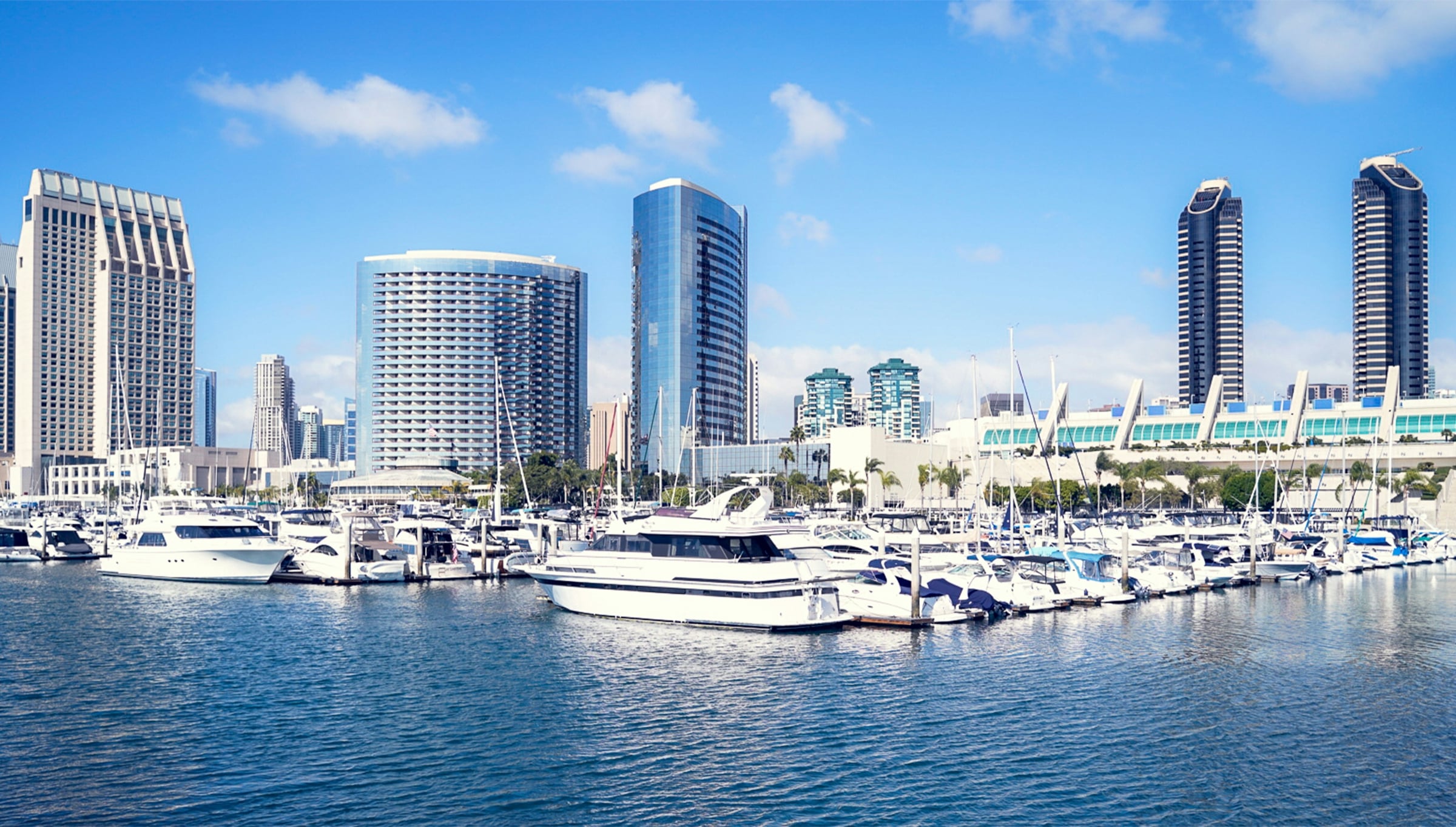
The San Diego waterfront, with the downtown towers rising above a marina full of white masts, is a hard image to leave behind. So let us be direct about this move rather than selling it. If you are relocating from San Diego to Richmond, you are almost certainly going to get a great deal more house, a much shorter commute and a meaningfully lower cost of living. You are also giving up a climate that is genuinely among the best in the world, and no amount of square footage fully compensates for that. Households that go in clear-eyed about both halves tend to be happy here. Households that only did the housing math sometimes are not.
Richmond sits on the James River where the Piedmont drops to the coastal plain, about two hours south of Washington, DC on I-95, two hours west of the Atlantic and two hours east of the Blue Ridge. It is green, historic, mid-size and humid, with a serious food scene, a river running whitewater through the middle of the city, and an enormous canopy of oak and maple over most of its neighborhoods.
We are a licensed brokerage, so you will not find median sale prices, cost-of-living percentages or market statistics in this article. Those figures change and we are not willing to publish them as fact. For a current picture of what your budget buys in any neighborhood below, call the Mission Realty Team at (804) 601-4960 and we will send you live listings.
Why Do People Move From San Diego to Richmond?
Housing cost is the reason almost everyone leads with, and it is the honest one. What a household can own in the Richmond region is substantially different from what the same household can own in coastal Southern California, and for many people that difference is the whole decision. It shows up as more bedrooms, a yard, a garage, and often the possibility of ownership at all rather than continued renting.
The second reason is time. San Diego commutes on the I-5, I-805 and I-15 corridors consume a large share of the day for a lot of households. Richmond’s in-town commutes are frequently under twenty minutes, and even the outer suburbs are a fraction of a Southern California drive. People consistently tell us this is the change they feel most immediately in daily life.
The third is family and East Coast proximity. Richmond puts Washington about two hours north, with Amtrak service from Staples Mill Road and Main Street Station continuing to Philadelphia and New York. If your family is on this coast, the difference between a cross-country flight and a two-hour drive reshapes your year.
Climate: The Honest Accounting
San Diego’s climate is dry, mild and remarkably stable. Temperatures stay in a narrow band, humidity is low, rain is concentrated in a short winter season, and outdoor plans are reliable almost every day of the year. Nothing in Richmond, or in most of the country, matches that.
Richmond has four real seasons. Spring arrives with dogwoods and azaleas and a substantial pollen load. Summer runs hot and humid from June into September, with frequent afternoon thunderstorms that arrive fast, bring heavy rain and lightning, and pass. Autumn is long and often the best season here, with real color and comfortable weeks stretching into November. Winter is short and mild by East Coast standards, with snow arriving occasionally rather than reliably, and freezing rain and sleet as the more characteristic hazard. Ice storms coat trees and power lines and bring down limbs, so plan for the possibility of a short outage.
The humidity deserves its own paragraph because it is the thing that surprises people. Richmond summer temperatures are not extreme by national standards, but moisture in the air prevents your body from shedding heat efficiently, so a humid afternoon in the upper eighties can feel heavier than a much hotter dry day. Shade helps less than you expect. Air conditioning here is structural rather than a comfort item.
The compensations are genuine. You get seasons, which many people discover they missed. You get afternoon storms that break the heat. You get a tree canopy that changes color, snow occasionally, and a spring that arrives all at once. And you get rain, which means everything is green without irrigation.
Housing Stock: Stucco and Slab to Brick and Crawl Space
This is a bigger change than most relocation guides admit, and it is not about style. It is a different kind of building with a different failure mode.
San Diego housing is dominated by stucco exteriors over frame, concrete or clay tile roofs and low-slope roofs, slab-on-grade foundations, Spanish and Mission Revival detailing, mid-century modest homes and large volumes of newer construction in the northern and inland suburbs. There are essentially no basements. Nothing rots. Termites exist but the moisture pressure is low.
Richmond housing is brick and wood siding, pitched asphalt shingle roofs, crawl space foundations with basements in the hillier neighborhoods, and a large inventory built before 1940. The characteristic types are the bungalow, the American Foursquare, the Colonial Revival, the attached brick rowhouse in the Fan and Church Hill, and the enormous postwar belt of brick ranches and Cape Cods across inner Henrico and Chesterfield. Newer construction in western Henrico, western Chesterfield, Hanover and Goochland will feel somewhat more familiar, though the materials and foundations still differ.
Your inspection priorities change completely. In San Diego you worried about roof underlayment, slab movement, seismic retrofitting and sun exposure. In Richmond you worry about termites and other wood-destroying insects, crawl space moisture and encapsulation, roof age, drainage and grading, HVAC humidity control, and electrical service capacity in older homes. A termite and moisture inspection is standard practice in a Richmond purchase and you should not treat it as optional. Multi-story living is also a real change if you are used to single-level California floor plans.
Neighborhood Analogues: Where San Diego Maps Onto Richmond
These are approximations, but they orient San Diego clients quickly.
If you love North Park or South Park – walkable, dense, older bungalows, good restaurants and coffee, close to the center – look at the Fan, the Museum District or Church Hill. The Fan is Richmond’s signature historic district, a large grid of Victorian and early-twentieth-century rowhouses beside VCU with restaurants and bars woven through it. The Museum District sits beside the Virginia Museum of Fine Arts with a slightly quieter version of the same. Church Hill is on a bluff above the James with Libby Hill Park and one of the best views in the city.
If you love Kensington or Point Loma – established, leafy, a strong sense of place, a mix of house sizes – look at Bellevue in Northside, Forest Hill on Southside, or Windsor Farms in the Near West End. Bellevue is a 1920s bungalow and Foursquare neighborhood with a compact commercial node on MacArthur Avenue. Forest Hill pairs modest houses with direct access to Forest Hill Park and the James River trails. Windsor Farms is the grander, more formal option.
If you live in Carmel Valley or Poway – newer construction, planned communities, homeowners associations, strong schools, retail convenience – look at Short Pump and the Wyndham area in western Henrico, or Midlothian in Chesterfield. Short Pump is the region’s main retail node with a corresponding supply of newer, larger homes. Midlothian offers a similar profile south of the James with its own school division and tax rate.
If you want land – the equivalent of moving inland for space – look at Goochland, Powhatan and western Hanover, where larger parcels, some well and septic properties, and a genuinely rural feel are available within a reasonable drive of the city.
Commuting and Driving Culture: A Real Upgrade
This is the category where Richmond wins outright. San Diego’s freeway network is extensive and heavily used, and long commutes are normal. Richmond is compact, and most in-town trips are short. Getting from Northside, the Fan or Forest Hill to downtown or the VCU Health campus is typically well under twenty minutes outside peak hours.
The road network is I-95 north to south, I-64 east to west, I-195 and the Downtown Expressway through the center, and I-295 arcing around the north and east. The one real constraint is the James River, because crossings are limited and traffic funnels onto a handful of bridges at peak times. That is the local version of a bottleneck, and it is mild by California standards.
Three practical notes. Richmond has toll roads, specifically the Downtown Expressway and the Powhite Parkway, so get an E-ZPass transponder in your first week. Rain changes driving here in a way it rarely does in San Diego, and the first hard summer downpour is an adjustment. And Virginia requires an annual vehicle safety inspection, which is a recurring errand California drivers have not had.
Transit is modest. GRTC operates the Pulse bus rapid transit line along Broad Street between Willow Lawn and Rocketts Landing plus a local bus network. Along the Pulse corridor it is genuinely useful; elsewhere plan on driving. Richmond’s close-in neighborhoods are, however, meaningfully walkable and bikeable, and the flat terrain along the fall line makes cycling easy for most of the year.
Taxes, Registration and Inspection
California and Virginia both levy a state income tax, so you are not adding a new category of tax. California’s top marginal rates are among the highest in the country, and Virginia’s structure is different, but rates and brackets change and we will not publish figures that could be stale by the time you read this. Verify current rates with the Virginia Department of Taxation or a tax professional, and have them model your actual take-home in Virginia before you accept an offer.
Property tax works differently in a way worth understanding. California’s Proposition 13 limits assessment increases on a property you continue to own, which produces long-term predictability. Virginia localities reassess property and set their own real estate tax rates, so your assessment can move with the market. Rates differ meaningfully across the City of Richmond, Henrico, Chesterfield, Goochland, Hanover and Powhatan, and that difference is a real part of your monthly payment. Compare them before you choose a jurisdiction.
The genuine surprise is Virginia’s local personal property tax on vehicles. Virginia cities and counties assess an annual tax on cars, trucks, motorcycles, boats and trailers based on assessed value, billed by the locality where the vehicle is normally kept. California charges a vehicle license fee through registration, so the concept is not entirely foreign, but the Virginia version is billed separately by your city or county and lands as its own bill. Rates, assessment methods and any available relief differ by locality and change year to year, so verify current rates directly with the commissioner of the revenue where you land.
Two procedural notes. Registering a vehicle with the Virginia DMV and registering it with your locality for personal property tax are two separate steps, and skipping the second produces penalties. And Virginia requires an annual safety inspection on registered vehicles, which is separate from emissions requirements that apply in some Northern Virginia localities.
The Richmond Job Market
Richmond’s economy is considerably smaller than San Diego’s but well diversified, which tends to make it steadier than its size suggests.
Healthcare is the largest sector. VCU Health operates an academic medical center and Level I trauma center downtown, and Bon Secours and HCA Virginia both run multiple hospitals across the region. If you came out of Scripps, Sharp or UC San Diego Health, this is a direct transfer and demand is consistent across clinical, administrative and research roles.
Finance and insurance is the second pillar. Richmond hosts a Federal Reserve Bank and has a substantial banking, insurance and asset management presence, which supports a deep layer of accounting, compliance, analytics and legal work.
State government is the third and it is distinctive. Richmond is Virginia’s capital, so the General Assembly, the executive agencies and the surrounding legal, policy and consulting ecosystem are based here.
Logistics and distribution rounds it out, driven by the I-95 and I-64 crossroads, the Port of Virginia’s inland connections and Richmond International Airport. Advanced manufacturing and pharmaceutical production have expanded as well. Be realistic about the gaps: Richmond does not have San Diego’s biotech and life sciences cluster at anything like that scale, nor its telecommunications and defense concentration. Virginia does have a very large defense and government contracting sector, but it is centered in Northern Virginia and Hampton Roads rather than in Richmond, and Hampton Roads with its Navy presence is about an hour and a half southeast.
Food, Culture and the Outdoors
Start with the loss, because it is the largest of any move we handle. You are giving up the Pacific, year-round surf, the specific quality of that light, and a coastal outdoor culture that runs every month of the year. You are giving up the beaches at Pacific Beach and La Jolla, Balboa Park, and a border-adjacent food culture that Richmond cannot replicate. That is a real loss and pretending otherwise does you no favors.
What you gain is water of a different kind. The James River runs through the middle of Richmond over the fall line, producing genuine whitewater rapids inside the city limits, up to Class IV at higher water. The James River Park System runs along both banks with hiking and mountain biking trails at Belle Isle, Pony Pasture and Buttermilk. Being able to paddle real rapids or ride singletrack fifteen minutes from downtown is unusual for a city this size. The Atlantic and Virginia Beach are roughly two hours east, with the Outer Banks a longer drive, and the Blue Ridge and Shenandoah National Park roughly two hours west. Both mountains and ocean become weekend trips rather than aspirations.
Culturally Richmond punches above its weight. The food scene is creative and neighborhood-based rather than concentrated in one district, and there is a serious craft brewery cluster in Scott’s Addition. The Virginia Museum of Fine Arts is free to enter and genuinely major. Lewis Ginter Botanical Garden, Maymont, the Institute for Contemporary Art at VCU and the Science Museum of Virginia fill out the institutional side. Richmond also carries a great deal of American history, including difficult history, in its streets, and it rewards engaging with that directly.
On professional sports, this is a downgrade. San Diego has the Padres and a major league soccer club. Richmond has the Flying Squirrels in baseball and the Kickers in soccer, plus college athletics at VCU and the University of Richmond. Washington, DC is roughly two hours north for major league games.
What to Do First: A Practical Relocation Sequence
Visit in late July or August. This is the single most useful thing a San Diego household can do. Spend three days here in deep summer, be outside in the afternoon, and find out how you feel about humidity before you commit rather than after.
Model the full cost, not just the mortgage. Include the local real estate tax rate, the annual vehicle personal property tax, homeowners insurance quoted by a Virginia agent, and a realistic exterior maintenance budget for lawn care, gutters and tree work. Then have a tax professional model your Virginia take-home, since the income tax structure differs from California’s.
Decide your jurisdiction before your neighborhood. The City of Richmond, Henrico, Chesterfield, Goochland, Hanover and Powhatan have separate school divisions, separate tax rates, separate park systems and different service levels. That is a bigger decision than choosing a street, and newcomers routinely rush it.
Rebuild your inspection checklist. Termite and wood-destroying insect inspection, crawl space moisture and encapsulation, roof age, drainage and grading, HVAC humidity performance, and electrical service capacity on older homes. Almost none of this was on your San Diego list, and seismic retrofitting is no longer a concern.
Handle the administrative block in your first month. Virginia driver’s license, DMV title and registration, locality registration for personal property tax, annual safety inspection, voter registration and an E-ZPass. Contact your school division directly about enrollment documentation rather than relying on a website summary.
| Factor | San Diego | Richmond | What it means for you |
|---|---|---|---|
| Climate stability | Dry, mild and remarkably consistent | Four distinct seasons | The largest loss; visit in July before deciding |
| Summer | Warm and dry, comfortable | Hot and humid with afternoon thunderstorms | AC is structural; judge it on humidity control |
| Winter | Mild with a short rainy season | Short and mild with occasional ice | Manageable, but plan for a possible outage |
| Housing cost | Among the highest in the country | Substantially lower | The main reason most people make this move |
| Exterior walls | Stucco over frame | Brick and wood siding | Different maintenance; mortar repointing on older brick |
| Roofs | Concrete or clay tile and low-slope | Pitched asphalt shingle | Roof age becomes a major purchase factor |
| Foundations | Slab on grade, no basements | Crawl spaces and some basements | Moisture, mold and termites move to the top of your inspection |
| Inspection focus | Slab, seismic, sun exposure | Termites, moisture, drainage, HVAC humidity | A completely different checklist |
| Commute | Long freeway commutes are normal | Most in-town trips under twenty minutes | A clear and immediate quality-of-life gain |
| Income tax | California levies one with high top rates | Virginia levies one with a different structure | Not a new category; verify current rates |
| Property tax | Assessment increases limited by Proposition 13 | Local reassessment and locally set rates | Less long-term predictability; compare localities |
| Vehicles | Vehicle license fee via registration | Separate annual local tax plus annual safety inspection | A new bill and a new yearly errand |
| Ocean and mountains | Pacific at the doorstep, year-round surf | Atlantic and Blue Ridge each about two hours | Weekend trips instead of daily access |
Frequently Asked Questions About Moving to Richmond VA from San Diego
Is moving from San Diego to Richmond VA worth it?
For most households the answer comes down to whether more house and more time are worth giving up an exceptional climate. Richmond offers substantially lower housing costs, much shorter commutes, a heavy tree canopy and four real seasons, plus an East Coast location within about two hours of Washington DC, the Atlantic and the Blue Ridge. What you give up is dry, mild, stable weather and year-round outdoor comfort, which is a genuine loss rather than a marketing footnote. The Mission Realty Team would rather help you decide with both halves in view than sell you only the upside.
Is Richmond VA cheaper than San Diego?
Housing costs in the Richmond region are substantially lower than in coastal Southern California, and that is the main reason most people make this move. We deliberately do not publish median prices or cost-of-living percentages because those figures shift and we are a licensed brokerage. What is worth budgeting for are costs that are new to you: an annual local vehicle personal property tax, an annual vehicle safety inspection, and a real exterior maintenance line for lawn care, gutters and tree work. Call the Mission Realty Team at (804) 601-4960 for current listings in the neighborhoods you are considering.
How bad is the humidity in Richmond compared to San Diego?
It is the hardest adjustment San Diego transplants report, more than temperature itself. Richmond summers run hot and humid from June into September, and because moisture prevents your body from shedding heat efficiently, an afternoon in the upper eighties can feel heavier than a much hotter dry day in California. Shade and evening cooling help less than you expect, and air conditioning becomes structural rather than optional. The compensation is that the hot season ends, and Richmond autumns are long and genuinely pleasant.
Does Richmond Virginia have four seasons?
Yes, and they are distinct in a way San Diego’s climate is not. Spring arrives quickly with dogwoods and azaleas and a heavy pollen load, summer is hot and humid with frequent afternoon thunderstorms, autumn is long with real color and often the best weather of the year, and winter is short and mild with snow arriving occasionally rather than reliably. The characteristic winter hazard is freezing rain and sleet, which coats trees and power lines and can bring down limbs. Many transplants find they enjoy having seasons more than they expected.
What is different about houses in Richmond VA compared to San Diego?
Almost everything structural, and the difference matters more than style. San Diego homes are typically stucco over frame with concrete or clay tile roofs on slab foundations, with no basements and Spanish or Mission Revival detailing. Richmond homes are typically brick or wood siding with pitched asphalt shingle roofs over crawl spaces or basements, with a large stock built before 1940 including bungalows, Foursquares, Colonial Revivals and attached rowhouses. Your inspection priorities shift entirely, from slab and seismic concerns to termites, crawl space moisture, roof age and drainage.
Do houses in Richmond VA have basements?
Some do, but crawl spaces are the regional norm. Full basements are more common in the hillier Southside neighborhoods like Woodland Heights and Forest Hill and less common in the flatter counties. Coming from slab-on-grade California construction, this is a genuinely new thing to evaluate, because a crawl space in Virginia’s climate holds moisture and moisture drives mold, wood rot and pest activity. Ask whether the crawl space is encapsulated, whether there is a working vapor barrier and dehumidifier, and how the exterior is graded.
Do I need a termite inspection when buying a house in Richmond?
Yes, and it is standard practice here rather than an optional extra. Virginia’s climate supports termites and other wood-destroying insects, and a termite and moisture inspection is a routine part of a Richmond purchase in a way it is not in coastal Southern California. Pair it with an honest crawl space assessment, because those two together cover the most common expensive surprises in this market. Your lender may also require documentation depending on the loan program.
Which Richmond neighborhood is most like North Park or South Park in San Diego?
The Fan, the Museum District and Church Hill are the closest analogues. The Fan is Richmond’s signature historic district, a large walkable grid of Victorian and early-twentieth-century rowhouses beside VCU with restaurants and bars woven through it. The Museum District sits beside the Virginia Museum of Fine Arts and offers a slightly quieter version of the same character. Church Hill is on a bluff above the James with Libby Hill Park and one of the best views in the city.
Which Richmond neighborhood is like Kensington or Point Loma?
Bellevue in Northside, Forest Hill on Southside and Windsor Farms in the Near West End are the usual answers. Bellevue is a 1920s bungalow and Foursquare neighborhood with mature trees and a compact commercial node on MacArthur Avenue. Forest Hill pairs modest houses with direct access to Forest Hill Park and the James River trail system, which is the closest thing to living near the water here. Windsor Farms is the grander and more formal option, a planned 1920s neighborhood of substantial Georgian and Colonial Revival homes.
Where should I live in the Richmond area if I am used to Carmel Valley or Poway?
Short Pump and the Wyndham area in western Henrico County, or Midlothian in Chesterfield County, are the closest fits. All offer newer construction, planned communities, homeowners associations in many subdivisions, county school divisions and convenient retail, which is the profile of San Diego’s northern suburbs. Short Pump is the region’s main retail node with correspondingly heavy traffic on Broad Street. Midlothian gives you a similar experience south of the James with a different school division and tax rate, so compare both.
How do Virginia taxes compare to California taxes?
Both states levy a state income tax, so you are not adding a new category, though the structures differ and California’s top marginal rates are among the highest in the country. Rates and brackets change, so verify current figures with the Virginia Department of Taxation or a tax professional and have them model your actual Virginia take-home before you accept an offer. Property tax also works differently, because California’s Proposition 13 limits assessment increases while Virginia localities reassess and set their own rates. Add the annual local vehicle personal property tax, which is new.
Do I have to pay a car tax in Virginia?
Yes. Virginia cities and counties levy an annual personal property tax on vehicles including cars, trucks, motorcycles, boats and trailers, assessed on value and billed by the locality where the vehicle is normally kept. California’s vehicle license fee is collected through registration, so the concept is not new, but the Virginia version arrives as a separate local bill and catches people off guard. Rates and assessment methods differ by locality and change year to year, so verify current rates with the commissioner of the revenue in the City of Richmond, Henrico, Chesterfield, Goochland, Hanover or Powhatan.
Does Virginia require a vehicle safety inspection?
Yes, Virginia requires an annual safety inspection on registered vehicles, which is a recurring errand California drivers have not had. It is separate from emissions requirements, which apply in some Northern Virginia localities rather than statewide. Remember also that registering your vehicle with the Virginia DMV and registering it with your city or county for personal property tax are two different steps. Skipping the local registration produces penalties, and it is one of the most common newcomer mistakes we see.
How is the commute in Richmond compared to San Diego?
Considerably better, and it is the change people feel most immediately. Most in-town Richmond trips are short, often well under twenty minutes from Northside, the Fan or Forest Hill to downtown or the VCU Health campus outside peak hours, and even the outer suburbs are a fraction of a Southern California freeway commute. The one local constraint is the James River, because crossings are limited and traffic funnels onto a handful of bridges at peak times. Get an E-ZPass in your first week for the tolled Downtown Expressway and Powhite Parkway.
What is the job market like in Richmond VA?
Richmond’s economy is smaller than San Diego’s but well diversified, with healthcare, finance and insurance, state government and logistics as the main pillars. VCU Health, Bon Secours and HCA Virginia make healthcare a direct transfer if you came out of Scripps, Sharp or UC San Diego Health, and Richmond hosts a Federal Reserve Bank alongside a substantial banking and insurance sector. As the state capital, Richmond also has a large and stable public sector and an associated legal and policy ecosystem. Be realistic about the gaps, since Richmond has nothing approaching San Diego’s biotech cluster or defense and telecommunications concentration, and Virginia’s defense contracting is centered in Northern Virginia and Hampton Roads instead.
Planning a Move From San Diego to Richmond?
The Mission Realty Team works with relocating buyers every week across Richmond, Henrico, Chesterfield, Goochland, Hanover and Powhatan, and we will tell you honestly which neighborhoods fit your commute and your budget and which do not. Call us at (804) 601-4960 or stop by 3701 Cox Rd, Richmond VA 23233 for a current list of homes in any neighborhood on this page.