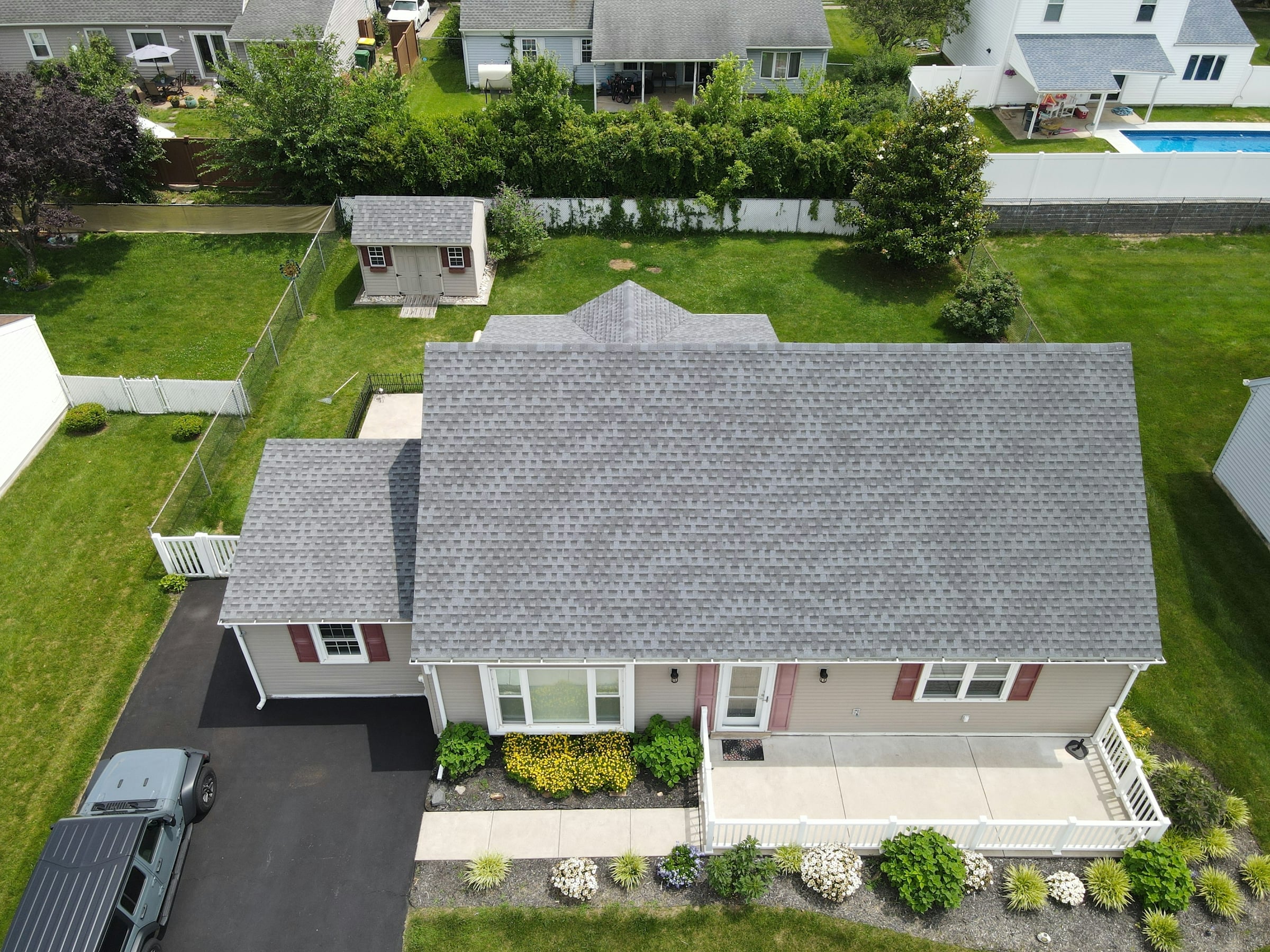
A roof does not have to leak to cost you money on a sale. It only has to be old. Past a certain age it changes three things at once: what an insurer will write on the house, what an appraiser will say about it, and what a buyer feels entitled to ask for after the inspection. Sellers usually meet all three in the same week, which is the worst possible time.
Insurers stop treating an old roof as a roof
Homeowners policies in Virginia are written around replacement cost, and replacement cost is what quietly disappears first. Carriers increasingly endorse older roofs down to actual cash value, meaning depreciated value rather than the cost of a new roof. A 19 year old three-tab roof settled that way can pay a fraction of the replacement bid, and the owner covers the rest.
There is a second layer that catches sellers off guard. The Virginia Homeowners Insurance Guide published by the State Corporation Commission explains the 80 percent replacement cost provision in most Virginia policies: unless your coverage at the time of loss is at least 80 percent of the replacement cost of the dwelling, you receive only partial payment even on small losses, and you are entitled to the larger of actual cash value or a proportional share. Roof claims are exactly where that provision bites.
Three practical things happen once a roof crosses roughly 15 to 20 years:
- Carriers decline to bind at all. Not a higher premium, no quote. A buyer under contract discovers this during the insurance shopping window, usually with ten days left.
- An inspection is ordered before binding. An exterior or four point inspection gets scheduled, and the carrier reads the result.
- The coverage silently converts. The policy issues, but the roof is scheduled at actual cash value and nobody reads the endorsement until there is a claim.
Nonrenewal is the related risk for owners not selling yet. Code of Virginia section 38.2-2114 sets the grounds and notice procedure an insurer must follow to cancel a policy on an owner-occupied dwelling, and the guide notes that companies review the size and frequency of losses when deciding whether you still fit their guidelines. Two hail claims in three years is a pattern in an underwriter’s file, not a coincidence.
What FHA and VA appraisers actually look for
Appraisers on government backed loans are not inspecting the roof. They answer a narrower question: does the property meet minimum standards, and does the roof have enough remaining life to protect the security for the loan term. Visible deterioration, active leaks or three layers of shingles will draw a condition comment and often a repair requirement before the loan can close.
For FHA, those property standards live in HUD’s Single Family Housing Policy Handbook 4000.1, the document every FHA appraiser and underwriter works from. For VA, the equivalent screen is Minimum Property Requirements, applied by appraisers assigned through VA’s appraiser and Staff Appraisal Reviewer program. The specifics differ; the practical effect is identical. An old roof that is sound and dry usually passes. An old roof that is failing becomes a condition of the loan, and conditions of the loan are not negotiable the way inspection requests are.
That matters for pricing. A cash buyer or a conventional buyer with a strong down payment can choose to accept a tired roof. An FHA or VA buyer frequently cannot, because the lender will not let them. Ruling out those buyers narrows your pool before anyone tours the house.
Why this is a Richmond problem right now
Two housing waves are hitting the same wall. The postwar and 1960s stock in places like Bon Air has been through two or three roof cycles already, and the last one is often further back than the owner remembers. Meanwhile the late 1990s and early 2000s subdivisions in Short Pump are now reaching 25 years on original architectural shingles, and a whole street can age out at once. City rehabs in Manchester add a third wrinkle, since a renovated interior says nothing about what was done above the ceiling.
Layer central Virginia weather on top. Summer convective storms and the remnants of tropical systems both track through this region, so hail and wind claims arrive in clusters rather than evenly. Carriers price and underwrite against that pattern, which is why roof age gets more attention here than it does in a drier market.
| Area | Median sold price | YoY | Median days on market | Months supply |
|---|---|---|---|---|
| Richmond Metro | $450,000 | +3.7% | 22 | 1.8 |
| Chesterfield County | $453,975 | +0.9% | 22 | 1.9 |
| Henrico County | $425,000 | +7.9% | 18 | 1.6 |
| Richmond City | $403,500 | -5.3% | 26 | 1.4 |
| Entire MLS | $430,000 | +5.0% | 28 | 2.4 |
| [DATA NEEDED: sourced Richmond area roof replacement cost ranges by material, square count and pitch] | ||||
| [DATA NEEDED: median price per square foot, August 2026, by area] | ||||
We are not printing a roof price, because anything we quoted would be a national average dressed up as a local one. What drives the range on a real bid: the number of squares, the pitch and whether staging or fall protection is needed, how many layers come off, the condition of the decking, whether valleys and flashing are replaced or reused, the shingle line, and the local building permit. Get two bids with those line items in writing and use those numbers.
The inspection finding and the three answers
A general home inspector reports remaining useful life, granule loss, cupping, exposed nail heads and prior repairs. None of that is a leak. It does give the buyer a document with the word roof in it, and from there you have three responses. Everything else is a variation.
The arithmetic below uses a $450,000 contract and a $15,000 roof bid. Both figures are assumptions for the illustration, not market estimates. Swap in your own contract price and your own contractor’s number.
| Response | Contract price | Seller proceeds before other costs | Appraisal must support | Who needs cash, and when |
|---|---|---|---|---|
| Replace before or during the contract | $450,000 | $435,000 | $450,000 | Seller, up front |
| Closing cost credit | $450,000 | $435,000 | $450,000 | Nobody up front, buyer pays after closing |
| Price reduction | $435,000 | $435,000 | $435,000 | Buyer, after closing, from savings |
All three land on the same $435,000, and they are not the same deal. Both the credit and the replacement require the appraisal to hold at $450,000. The price reduction lowers the bar the appraisal has to clear, which is the quiet reason it is often the safest of the three in a market where the metro median is $450,000 and comparable sales are getting scrutinized.
The credit has a trap. On most loan programs a seller credit cannot exceed the buyer’s actual closing costs and prepaids, so a $15,000 credit against a buyer with $9,000 of costs leaves $6,000 stranded and renegotiated at the last minute. There are also program ceilings: VA caps total seller concessions at 4 percent of the home’s reasonable value, which on a $450,000 value is $18,000.
Replacing is the strongest of the three when the roof is genuinely at end of life, because it removes the insurance problem, the appraisal problem and the negotiation problem in one move, and a new roof is one of the few improvements a buyer can verify from the street. It is the weakest when the roof has real life left and you are buying peace at full retail.
Before you decide which of the three to use, find out what the house is worth with the roof it has. Our free home valuation looks at your actual condition, your actual comparable sales and the buyer pool your roof age leaves you with, rather than an automated estimate that assumes everything is average. Request your free home valuation and we will walk the numbers with you.
What a roof certification is, and is not
A roof certification is a written statement from a licensed roofing contractor estimating remaining life, commonly two, three or five years, sometimes conditioned on minor repairs. It is not a warranty and not an inspection report. It gives an underwriter and a buyer something specific to hold instead of an inspector’s phrase about age. Order one when the roof is functionally fine but old enough to scare people, or when the buyer’s carrier wants documentation. Do not order one when the roof is failing, because it will say so in writing and you will then be disclosing it.
Which raises disclosure. Virginia is a buyer beware state. Under Code of Virginia section 55.1-703, the owner furnishes the residential property disclosure statement provided by the Real Estate Board, and that statement tells the buyer the owner makes no representations about the condition of the property and that the buyer should exercise due diligence. That is not permission to conceal a known defect. If you have a roofer’s report saying the roof is done, you cannot un-know it, and the cleanest handling is usually to put it on the table early and price accordingly. Our guides to selling as-is in Richmond and what a home inspector will not cover both go further on that.
Sequence this before you list, not after
Call your insurance agent and ask two questions: what year is the roof on record, and is it scheduled at replacement cost or actual cash value. That call tells you how a buyer’s carrier will react. Then get bids, decide which of the three responses you will make, and set the list price knowing the answer. A seller who has decided negotiates from a position; a seller surprised on day 12 negotiates against a deadline, and at a 22 day median in the metro that deadline arrives fast. If the number still is not working, our piece on when to cut a Richmond list price and by how much covers the next decision, and our recently sold properties show what has actually closed. The starting point is still the same one: get the free home valuation with the roof you have today, then decide what to do about it. When you are ready to list, our seller page is the next step.
Roof questions from Richmond sellers
Does a new roof add its full cost to the appraised value?
Almost never. An appraiser treats a new roof as curing depreciation rather than as an improvement that earns a premium, so the contribution to value is usually less than the invoice. The return on replacing is not appraisal value. It is a wider buyer pool, an insurable house, and the removal of a line item the other side would otherwise use to reopen price.
My inspector says five years left and my roofer says ten. Whose number counts?
Whichever one is in writing on the buyer’s side of the table. A general inspector estimates from the ground and the attic; a roofing contractor estimates from the roof. If the spread matters, pay for a roof certification from a licensed roofer and put that document in front of the buyer and the underwriter. Two opinions with no document is an argument. One document is a position.
Can I file an insurance claim and use the proceeds instead of paying out of pocket?
Only if the damage came from a covered event, and the timing rarely works in a sale. Where a policy pays actual cash value first, the depreciation is often recoverable only after the work is complete and documented, so selling before the roof is replaced can forfeit the second check. Talk to your carrier before you list, not after you are under contract.
Does a home warranty cover the roof?
Usually not in any meaningful way. Most residential service contracts exclude the roof outright or offer a narrow leak repair rider with a low dollar cap, and none of them fund a replacement. A warranty is a reasonable comfort item for mechanical systems in an older house. It is not an answer to a roof question, and offering one instead reads to a buyer exactly as it sounds.
What does a second layer of shingles do to the bid and to the sale?
It raises both the cost and the risk. A tear off of two layers means more labor, more disposal and a real chance of finding decking that also needs replacing, which is the line item most likely to blow past the original bid. On the sale side, layered roofs draw appraiser comments on government backed loans and make some carriers unwilling to write the policy at all.
My roof is 12 years old and fine. Do I need to do anything before listing?
No replacement, yes paperwork. Find the permit or invoice from the last replacement and document the install year, because an undocumented roof gets estimated and estimates skew old. Then confirm with your insurer whether it is scheduled at replacement cost or actual cash value. Twelve years with proof is a non-issue. Twelve years with no record turns into a negotiation.