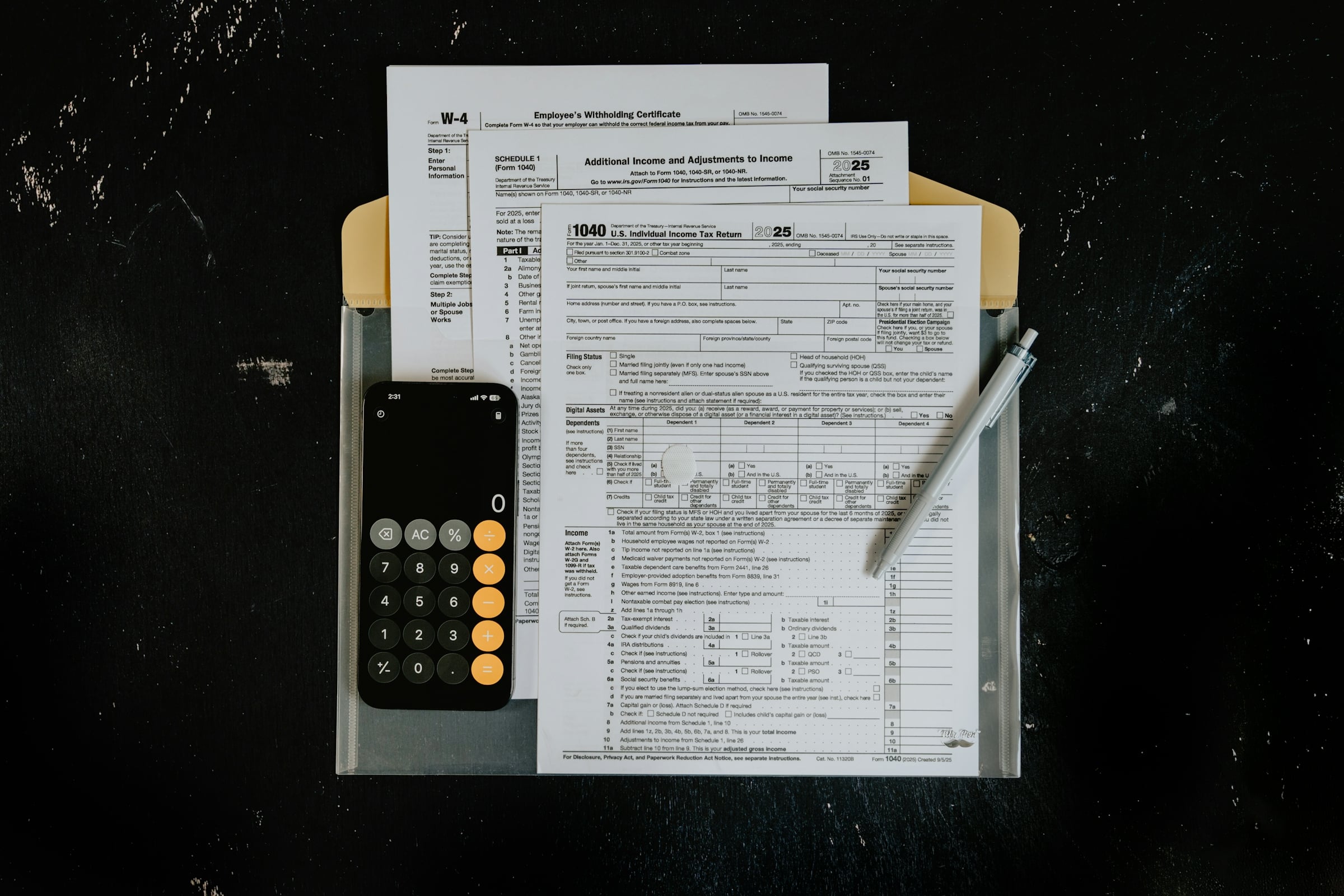
Most Richmond sellers who ask about capital gains tax do not owe any. A smaller group owes a great deal and finds out when their accountant calls in March. The difference is rarely income. It is how long they owned the house, who is on the deed, whether it was ever rented, and whether anyone kept the receipts.
This guide works the arithmetic against real Richmond numbers, explains the two tests that decide whether the exclusion applies, and flags the situations where people lose it. Every threshold is attributed to its source, because tax figures move and a blog post is not a substitute for your own return.
The number you are taxed on is not the sale price
Gain is not what the house sold for. It is what you netted minus what the house cost you, adjusted. Three figures go into it.
Amount realized is the contract price less selling costs: agent compensation, seller-paid closing costs, transfer taxes and concessions you paid on the buyer’s behalf. They come off the settlement statement, not off memory. The CFPB explainer on the Closing Disclosure describes that document. If you gave money toward the buyer’s costs, our breakdown of seller concessions in Richmond shows how those land on it.
Adjusted basis is what you paid, plus closing costs capitalised at purchase, plus every capital improvement, minus any depreciation claimed. This is the figure people get wrong, and getting it wrong costs real money.
Gain is amount realized minus adjusted basis. The exclusion is then applied against that gain, not against the sale price. IRS Topic no. 701, Sale of your home, states the exclusion as up to $250,000 of gain, or up to $500,000 on a joint return.
Two Richmond examples, worked all the way through
The first is an ordinary Chesterfield County sale at the July 2026 Richmond Metro median. The second is a long-held house in the Fan, which is where this stops being theoretical.
The prices used below – July 2026, single family. Richmond Metro median $460,000, up 2.2% year over year, 19 days on market, 1.8 months of supply. Richmond City median $450,000, down 3.4%, on 218 closings. Chesterfield County median $440,000, down 3.3%, county level. Henrico County median $475,000, up 11.8%, county level. [DATA NEEDED: median price per square foot, July 2026, by area]
Source: Central Virginia Regional MLS, published by the Richmond Association of REALTORS. July 2026, current as of 10 August 2026; August 2026 was not yet published. The $915,000 figure in Example 2 is an illustrative sale price for a long-held Fan house, not a published median.
Example 1: sold at the $460,000 Richmond Metro median, bought in 2017
| Sale price (July 2026 Richmond Metro median) | $460,000 |
| Less selling costs at 7% | – $32,200 |
| Amount realized | $427,800 |
| Purchase price, 2017, plus $3,000 capitalised closing costs | $265,000 |
| Capital improvements: HVAC $9,500, kitchen $38,000, roof $14,000 | + $61,500 |
| Adjusted basis | $326,500 |
| Gain | $101,300 |
| Married filing jointly exclusion | – up to $500,000 |
| Taxable gain | $0 |
Nine years of ownership at the metro median produces no taxable gain for a married couple. This is the ordinary case, and why most sellers can stop worrying.
Example 2: a Fan house bought in 1996, sold in 2026 for $915,000
| With improvement records | Without records | |
|---|---|---|
| Sale price | $915,000 | $915,000 |
| Less selling costs at 7% | – $64,050 | – $64,050 |
| Amount realized | $850,950 | $850,950 |
| 1996 purchase plus capitalised closing costs | $120,500 | $120,500 |
| Documented capital improvements over 30 years | + $165,000 | + $0 |
| Adjusted basis | $285,500 | $120,500 |
| Gain | $565,450 | $730,450 |
| Less $500,000 joint exclusion | $65,450 taxable | $230,450 taxable |
| Federal at a 15% long-term rate | $9,818 | $34,568 |
| Virginia at 5.75% | $3,763 | $13,251 |
| Combined | $13,581 | $47,819 |
A box of receipts is worth roughly $34,238 in this example. Nothing else in a home sale returns that kind of money for that little effort.
Now change one thing. If the same Fan seller is single rather than married filing jointly, the exclusion halves to $250,000, the taxable gain becomes $315,450, and the combined federal and Virginia bill on the same house rises to roughly $65,456. Same house, same price, same receipts, about $51,875 more tax because of who is on the return. That is the single biggest variable in this entire post.
You cannot work out your gain without knowing what the house is worth now
Every line above starts with a sale price. If you are deciding whether to sell this year, next year, or after an estate settles, the first number you need is a defensible current value, not a portal estimate. We will put together a written valuation from actual comparable Richmond-area sales, at no cost and no obligation to list.
Request your free home valuation, or look through our recently sold properties to see what is actually closing.
The ownership test and the use test
The exclusion is not automatic. Topic no. 701 sets out two tests and you must meet both. Ownership: you or your spouse owned the home at least 24 months out of the five years ending on the sale date. Use: you used it as a residence at least 24 months of that same five years. On a joint return, either spouse can satisfy ownership, but both must satisfy use individually.
Three details matter more than people expect. The 24 months need not be continuous, so a year away and a year back still counts. The two tests can be met in different 24-month windows, as long as both sit inside the same five-year period ending at the sale. And you are generally not eligible if you already excluded gain on another home sale in the two years before this one.
The partial exclusion when the move was not your idea
Fail the two-year rule and you are not automatically out. A reduced exclusion is available if the primary reason for the sale was a work-related move, a health reason or an unforeseeable event. The amount is prorated rather than lost, and IRS Publication 523, Selling Your Home carries the worksheet. The 2025 edition was current when this was written.
Publication 523 sets out safe harbours rather than leaving it to argument. For a work-related move, the new work location generally has to be at least 50 miles farther from the home than the old one. For health, the sale must be primarily to obtain, provide or facilitate diagnosis, care or treatment. Unforeseeable events cover a defined list including death, divorce, multiple births from one pregnancy and certain involuntary conversions. Read that list before assuming you qualify, and do not rely on an agent’s summary of it, including this one.
What adds to basis, and what does not
This is where the $34,238 in Example 2 came from, so it is worth being exact. A capital improvement adds to basis. A repair does not.
| Adds to basis | Does not add to basis |
|---|---|
| New roof, HVAC system, windows, siding | Repairing three shingles or servicing the existing HVAC |
| Kitchen or bathroom renovation | Repainting, re-caulking, replacing a faucet washer |
| Addition, finished basement, deck, permanent landscaping | Lawn care, gutter cleaning, pressure washing |
| New electrical service, plumbing replacement, septic system | Unclogging a drain, replacing a light fixture |
| Capitalised purchase closing costs such as title and recording fees | Homeowners insurance, property taxes, utilities |
The test is roughly whether the work adds value, prolongs useful life or adapts the house to a new use, rather than keeping it in the condition it was already in. Publication 523 has the authoritative list. Keep invoices, permits and cancelled cheques for as long as you own the house plus the period the return stays open. A spreadsheet backed by paper is the whole exercise.
Note on what gets rolled into the same conversation. Capital gains tax is federal and state income tax on a sale. It has nothing to do with your annual real estate tax bill, which is set by whichever locality you are in. Those differ sharply across the region, as we showed in the same house, six different tax bills. Do not conflate them when you are budgeting.
An inherited house starts over at the date-of-death value
The most misunderstood item in the subject, and it usually works in the family’s favour. When you inherit property, your basis is generally the fair market value on the date of death rather than what the decedent paid. That is the step-up, and on a house held in Church Hill or anywhere in the city since the 1970s it can erase most of a very large paper gain.
Two consequences. Get a qualified appraisal as of the date of death, not a guess, because that appraisal is what defends your basis. And a house sold soon after death often produces a small gain or even a small loss after selling costs, because the basis was reset so recently. Virginia is not a community property state, so when one spouse dies, generally only the decedent’s share of a jointly held house steps up. See our guide to selling an inherited house in Richmond.
A rental you moved into does not get the full exclusion
Converting a rental into your primary residence and living there two years does not wash the rental period away. Two rules apply.
First, periods of nonqualified use after 31 December 2008 – time the property was not your principal residence – create a ratio, and the gain allocated to that period cannot be excluded. Second, depreciation claimed while it was a rental is recaptured and cannot be sheltered by the exclusion at all. That amount is taxed as unrecaptured section 1250 gain at up to 25%, higher than the long-term rate most sellers expect.
The upshot: if the house was ever a rental, the exclusion covers less than you think, and a CPA should run the allocation before you sign a listing agreement, not after you close. The same applies in reverse to a residence you are thinking of renting for a couple of years before selling.
What Virginia does with the same gain
Virginia does not run a separate capital gains system. The Virginia Department of Taxation states it plainly: the starting point for computing Virginia taxable income is federal adjusted gross income. Gain you legitimately exclude under the federal rules never enters federal adjusted gross income in the first place, so it does not reach your Virginia return either.
Gain you cannot exclude does flow through, and Virginia taxes it as ordinary income at the individual rates, topping out at 5.75% on Virginia taxable income above $17,000. That is the rate used in Example 2; there is no preferential Virginia rate for long-term gains the way there is federally. Virginia’s resources for individual taxpayers carry the current rate schedule and a calculator, and you should check both against the year you sell.
One federal item catches higher-income sellers: the 3.8% net investment income tax can apply to taxable gain once modified adjusted gross income passes $200,000 for a single filer or $250,000 on a joint return. It applies only to the taxable portion, not to excluded gain.
Frequently asked questions
Do I have to report the sale if the whole gain is excluded?
Sometimes. Topic no. 701 says that if you receive Form 1099-S, Proceeds From Real Estate Transactions, you must report the sale even if the gain is fully excludable, and also if you cannot exclude all of it. Reporting is on Schedule D and Form 8949. Ask your settlement agent at closing whether a 1099-S will be issued.
My spouse died last year. Can I still use the $500,000 exclusion?
There is a window. A surviving spouse who has not remarried may generally use the $500,000 amount if the sale occurs within two years of the date of death and the couple met the tests immediately before it. Miss it and the exclusion drops to $250,000 – roughly $51,875 of difference on the house in Example 2.
Can I do a 1031 exchange on my house to defer the tax?
Not on a personal residence. Section 1031 applies to property held for productive use in a trade or business or for investment. A home you live in does not qualify. A property you genuinely held as a rental may, which is another reason conversions deserve professional attention.
We are moving 60 miles for work after only 14 months. What do we get?
A partial exclusion, not nothing. The reduced amount is prorated by the qualifying period over 24 months, so 14 months of a $500,000 joint exclusion is roughly $291,667 of gain still excludable. Publication 523 has the worksheet, and the work-related safe harbour is generally a new work location 50 miles farther than the old one.
We have a house in Richmond and a place at the lake. Which is the main home?
The one you live in most of the time. Where it is close, the IRS looks at your address on tax returns, voter and vehicle registration, where you bank and where your family lives. You cannot simply nominate whichever has the larger gain, and you cannot exclude gain on two homes in the same two-year period.
Does a home office deduction come back to bite me?
The depreciation part does. Depreciation claimed for business use cannot be sheltered by the exclusion and is recaptured as unrecaptured section 1250 gain at up to 25%. The rest of the gain is usually still excludable if the office was inside the home rather than a separate structure. Have a CPA total the depreciation before you list.
Does paying off the mortgage affect my gain?
No, and it is the most common misconception we hear. Gain is amount realized minus adjusted basis; the loan balance is irrelevant. Someone who owes nothing and leaves with a $400,000 cheque and someone who owes $300,000 and leaves with $100,000 have the same gain on the same purchase price. The size of the cheque is not the taxable number.
What to do before you list
Four things, in order. Reconstruct your basis from purchase documents and improvement receipts. Confirm you meet the 24-month ownership and use tests, or work out which partial exclusion applies. Flag any period the house was rented or depreciated and take that to a CPA. Then get a current, defensible value, because none of the arithmetic above starts without it. For the rest of the sale-side picture see repairs, staging and seller closing costs explained, and talk to us about selling with Mission Realty.
Request your free home valuation and we will send a written estimate built on real comparable sales in your part of the region. It is the first line of every calculation on this page, and it costs nothing.