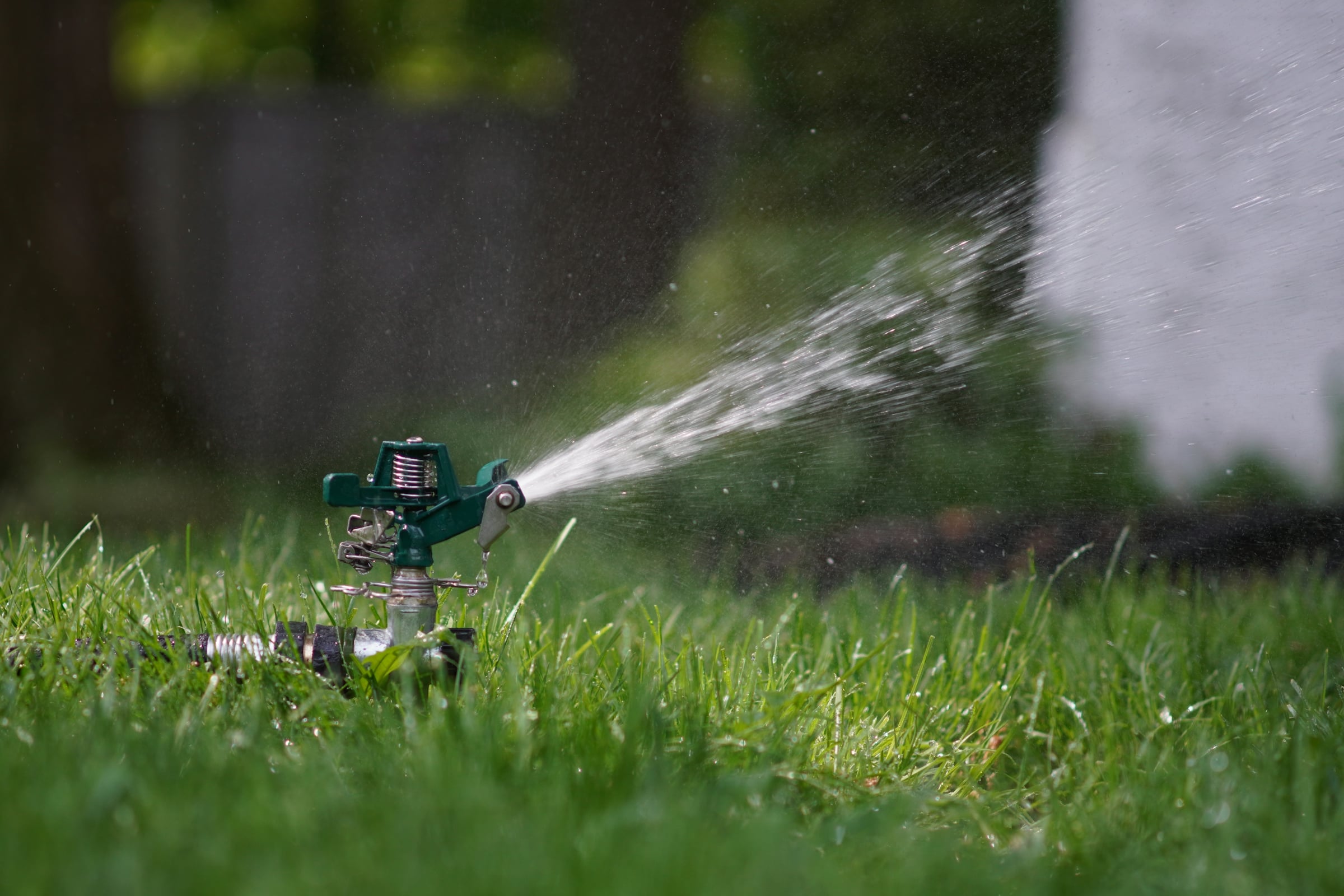
If a house has a sprinkler system, four questions decide whether it is an asset or a repair bill: does it run and cover the yard, is there a backflow preventer with a current test on file, has it been winterized, and does it draw from public water or a well? This is general information to help you ask the right questions, not a substitute for a licensed irrigation or plumbing professional.
The advice below applies across the City of Richmond, Henrico, Chesterfield, Hanover, Goochland and Powhatan. Backflow rules differ by utility. The table covers the City of Richmond and Henrico, so confirm your own utility’s rules for the other four.
The backflow preventer and the annual test
A backflow preventer is a valve assembly that keeps water in the sprinkler pipes from flowing backward into the drinking water supply. Sprinkler lines can pick up fertilizer, soil and pests, so utilities care about this device.
Here is what two local utilities say, per the pages linked below.
| Item | City of Richmond (Public Utilities) | Henrico (Public Utilities) |
|---|---|---|
| Test frequency | Annual, plus after installation, repair or relocation | Annual on all field-testable assemblies |
| Who tests | A certified backflow assembly tester, certified by the State of Virginia | A tester holding a Virginia DPOR Backflow Prevention Device Worker certification |
| Report goes to | The utility, using its test form | The county Cross Connection Control Coordinator, within 30 days of the test |
| Single-family homes | Most are not required to have a service-line device; commercial, industrial and some multifamily properties are | Test form applies to field-testable assemblies, which a home’s irrigation line may have |
Sources: the City of Richmond Backflow and Cross Connection Program FAQs and the Henrico Backflow Prevention Assembly Test Report.
What this means for you: do not assume a house needs no test because the City of Richmond says most single-family homes are not required to have a service-line device. Ask whether this house has a device on its irrigation line, where it sits and when it was last tested. Ask for the last test report. A report from the past 12 months is a good sign. A blank is a question for the seller and, if needed, the utility.
What to check at the showing
You can learn a lot in ten minutes with the system running. Ask the seller or listing agent to turn it on, or to show you the controller and explain the zones.
- Every zone runs. Walk the yard. Look for heads that do not pop up, heads that spray the sidewalk or the house, and soggy ground around a head.
- Visible leaks. Puddles that stay after the zone stops, geysers from a broken head and unusually green stripes can point to broken lines.
- The controller. Is it a basic timer or a smart controller? Does it have a rain sensor? Ask who set the schedule and whether the settings change by season.
- The valve boxes. The green or black lids in the lawn hold the zone valves. Lift one and look for standing water, rust and cracked pipe.
- The backflow assembly. It is usually a group of pipes with handles near the house or meter. Look for a tag or sticker with a test date.
- Coverage. Are the beds and the lawn watered separately? Are there zones you will never use?
The U.S. EPA’s WaterSense program, in its tech sheet on using a certified irrigation professional, says a good system has no breaks or leaks, water that reaches its intended target and each zone programmed correctly. Those are the same things you are checking by eye.
A saved search that keeps the irrigation questions with the listing
Pick the areas you are weighing across the City of Richmond, Henrico, Chesterfield, Hanover, Goochland and Powhatan. We will set up a saved search, and when a listing mentions a sprinkler system, we will send the questions in this guide to ask before you tour.
Winterizing: what it is and what to ask
Winterizing means clearing water out of the lines and the backflow assembly before hard freezes so pipes and valves do not crack. Many systems are drained or blown out with compressed air in the fall and restarted in spring. Timing varies by system, so ask the seller what they do and when.
If you are touring in late fall or winter, the system may be shut off for the season. That is normal, and it means you cannot see it run. In that case, ask for the last service invoice, ask when it was last winterized and last started up, and consider making the first spring start-up part of your offer terms. If a broken pipe or cracked valve shows up at start-up, you will want to know who pays. That is a contract question, so put it in writing.
Also look at the assembly itself. If it sits above ground and has no insulating cover in cold weather, ask whether it has been drained. The City of Richmond FAQs say a test is also required after installation, repair or relocation of a device.
Public water or a well: why it changes the system
If the home is on a well, the sprinklers may draw from the same well that supplies the house, or from a separate pump or tank. Ask which, and ask how long the well runs when all zones are on. A well that serves the kitchen and the lawn at the same time may behave differently than a municipal line. We cover the well side in our guide to buying a home with a septic system or a well.
If the home is on public water, find out whether irrigation is metered on the same meter as the house or a separate one, and ask for a year of utility bills, including a summer month. The bill is the best number you will see for what the system costs to run, and it comes from the seller.
Who owns the system at closing
A sprinkler system installed in the ground is usually considered part of the property, but “usually” is not a promise. Controllers, rain sensors, smart controller hardware and app accounts can be treated differently. Your contract should say what conveys. Ask your agent to list the controller, any smart accounts, the backflow assembly and the winterizing records as items that convey with the home. Also ask whether any parts are leased or on a service contract, because a monthly plan is a cost that follows the house or ends at closing depending on the contract.
The inspection: who looks at what
A general home inspector may not test an irrigation system, so ask before you hire whether it is in scope and, if it is not, whether to bring in a specialist. The EPA tech sheet says certified irrigation professionals work as system designers, installers and maintenance specialists, or auditors, and lists a Find a Pro tool on the WaterSense site for locating them. An audit checks that the system is efficient and that heads and zones work as intended.
Also look at how water leaves the yard. Irrigation adds water to the ground, and heavy watering near a foundation can cause trouble. Our guide to gutters, downspouts and lot grading covers what to look for around the house. Your lender will not ask about sprinklers, but a repair credit negotiated after inspection changes your closing numbers, and the mortgage calculator helps you see that.
Questions to put in writing
- When was the system installed, and by whom?
- Where is the backflow assembly, and when was it last tested?
- Can you share the last test report and the last two service invoices?
- Public water or well? Is irrigation on a separate meter?
- When was it last winterized and started up?
- What conveys at closing, including the controller and any accounts?
- Any known leaks, broken lines or zones that do not run?
Browse homes with outdoor space on our property search. For a feel of different parts of the region, see Midlothian and Glen Allen. Yard size, lot layout and water source vary house by house, so the questions above matter more than the address.
Start with a saved search
We will set up a saved search for the areas you pick and send the irrigation questions with any listing that mentions a sprinkler system.
Frequently asked questions
Who files the backflow test report in the City of Richmond?
The tester does. The City of Richmond FAQs say the certified tester completes the Department of Public Utilities test form and emails it to the department.
Where does a Henrico backflow test report go?
Henrico’s test report says to keep a copy and send one to the county’s Cross Connection Control Coordinator no later than 30 days after the test, by email or by mail. The form lists the details.
Is a backflow device on a boiler enough?
Not for properties that must have one. The City of Richmond FAQs say that even if a device is already on a boiler or other equipment, a device is still required right after the service line meter, before any wyes, tees or taps. That rule applies to the properties the FAQs say must have a device, which are commercial, industrial and some multifamily buildings.
What kinds of backflow assemblies are common?
The City of Richmond FAQs name two: the Reduced Pressure Zone device and the Double Check Valve Assembly. They are usually installed just past the water meter.
What does WaterSense say a certified irrigation professional does?
According to the EPA tech sheet, certified professionals can work as system designers, as installers and maintenance specialists, or as auditors, after passing exams on irrigation and water efficiency. WaterSense lists a Find a Pro tool to check credentials.
Should I keep the seller’s watering schedule?
Not necessarily. The EPA tech sheet recommends a schedule that you can adjust easily by season, so ask the seller for the current settings, then plan to adjust them after you move in.
Does the home inspection cover the sprinkler system?
Ask your inspector before you book. Scope varies by inspector, and an irrigation specialist or WaterSense audit may be a separate visit.