Moving to Richmond VA from Wilmington NC: What to Know Before You Relocate
You give up the beach at the end of the road – and you gain a much larger city
Moving to Richmond, Virginia from Wilmington, North Carolina is a coastal-to-inland move inside the same broad region, so the culture and the climate will feel familiar while the practical details change substantially. The honest headline is that you are giving up daily beach access. Wrightsville, Carolina and Kure are minutes from most of Wilmington, and nothing in Richmond replaces that; Virginia Beach and the Atlantic are roughly two hours east. What you gain is scale: a considerably larger and more diversified job market, a much deeper inventory of pre-1940 housing, and a location within about two hours of both the Blue Ridge and Washington, DC. Storm exposure drops meaningfully when you move inland, and your insurance picture changes, though Richmond has its own James River floodplain areas and you should verify the flood zone on any specific property. The houses themselves change from coastal cottages, raised construction and heavy new-build supply to brick bungalows, Foursquares and colonials with crawl spaces, which shifts your inspection list away from salt-air corrosion and toward moisture and older systems. North Carolina and Virginia both levy an income tax and both tax vehicles, with different mechanisms worth understanding. Buyers researching moving from Wilmington to Richmond VA, Richmond vs Wilmington cost of living and Richmond VA neighborhoods will find the detail below. The Mission Realty Team serves Richmond, Henrico, Chesterfield, Goochland, Hanover and Powhatan.
Table of Contents
- Why People Make the Wilmington to Richmond Move
- Coast to Fall Line: Climate, Storms and Geography
- Housing Stock: Coastal Cottages to Brick and Crawl Spaces
- Neighborhood Analogues: Forest Hills to the Museum District
- Commuting and Driving Culture
- Taxes, Registration and Inspection
- The Richmond Job Market
- Food, Culture and the Outdoors
- What to Do First: A Practical Relocation Sequence
- Frequently Asked Questions
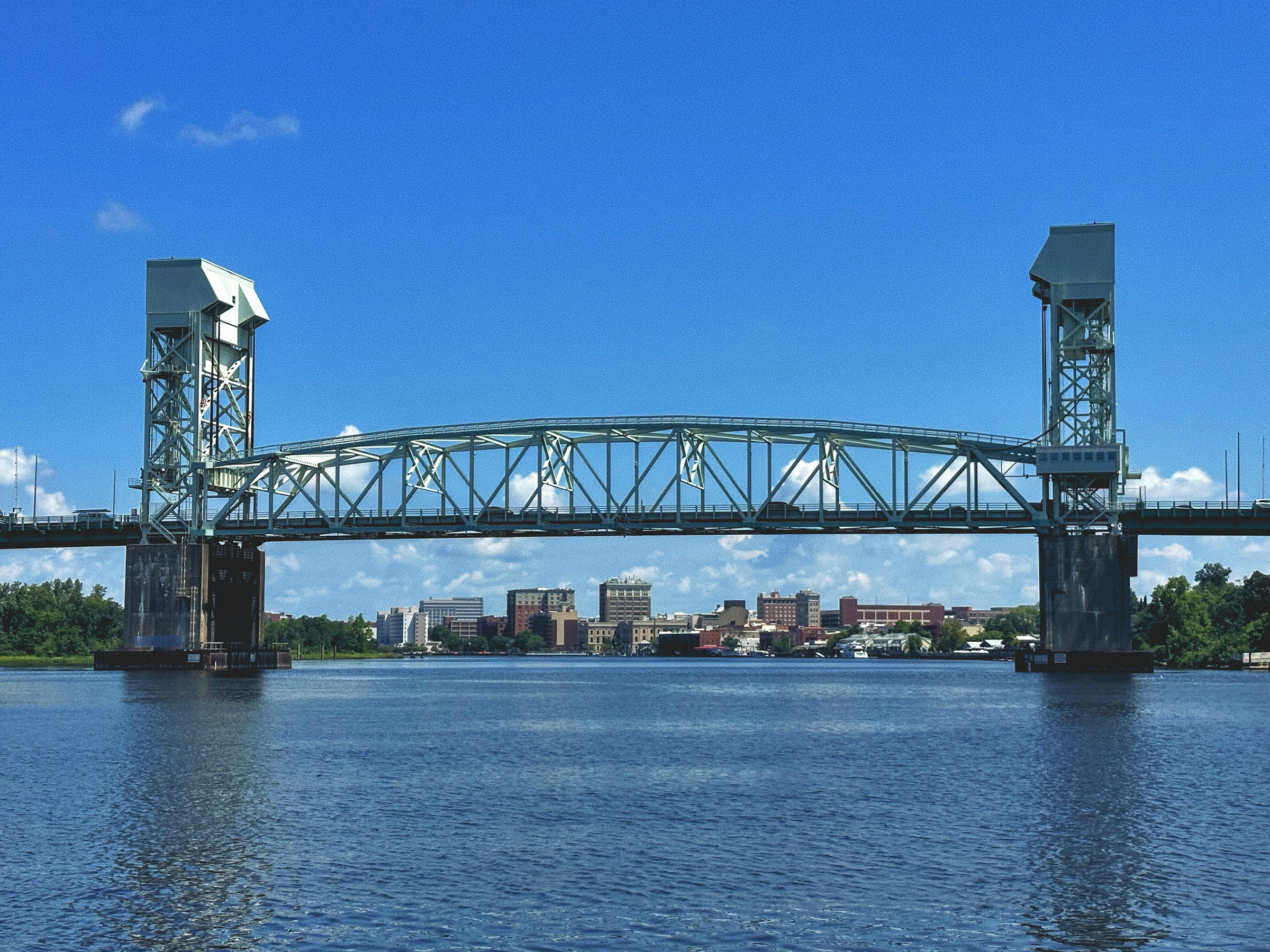
The Cape Fear Memorial Bridge rising over the river with the Wilmington waterfront behind it is a good picture of what makes that city work: a real historic downtown on a working river, a few minutes from the ocean. If you are leaving it, we are not going to pretend the beach does not matter. It does, and it is the single largest thing you are giving up. What you get in exchange is a bigger city with a deeper economy and a great deal more old housing to choose from.
Richmond sits inland on the James River at the fall line, the seam where the hard rock of the Piedmont drops to the sandy coastal plain. That geology is why there are rapids in the middle of the city and why the railroads and warehouses concentrated here. Washington, DC is roughly two hours north on I-95, Virginia Beach and the Atlantic roughly two hours east, and the Blue Ridge roughly two hours west.
We are a licensed brokerage, so you will not find median sale prices, days-on-market figures or cost-of-living percentages here. Those numbers move and we will not publish them as current fact. For a real picture of what your budget buys in any neighborhood below, call the Mission Realty Team at (804) 601-4960.
Why Do People Move From Wilmington to Richmond?
Career depth is the most common reason. Wilmington’s economy has real strengths in healthcare, higher education, pharmaceutical research services, banking, the port and film production, but it is a comparatively small market and specific fields can hit a ceiling quickly. Richmond is a considerably larger metro and the state capital, with healthcare, finance and insurance, government, corporate headquarters, logistics and a large professional services layer. More sectors means more room to change jobs without changing cities.
The second reason is housing choice. Wilmington has a beautiful historic downtown and some lovely early-twentieth-century neighborhoods, but the volume of the market is newer construction spreading north and toward Leland. Richmond has an enormous stock of pre-1940 housing across whole neighborhoods rather than a few districts, so if you want a brick bungalow or a rowhouse with original detail there is far more to choose from.
The third is that Richmond points in more directions. From here the mountains and Washington are each about two hours away, and the coast is still reachable for a weekend. Wilmington is wonderful if the beach is the whole plan and limiting if it is not.
Coast to Fall Line: Climate, Storms and Geography
Both cities are humid and Southern, so the broad pattern is familiar: hot summers, long pleasant autumns, short winters and an early spring with heavy pollen. The differences come from losing the ocean’s moderating influence. Richmond sits farther north and inland, so its winter runs slightly cooler with a few more freezing nights, and its summer afternoons lack the sea breeze that takes the edge off a Wilmington July. Snow arrives occasionally rather than reliably here, and the characteristic winter hazard is freezing rain and sleet, which coats trees and power lines and brings down limbs. Plan for the possibility of a short outage in an ice event.
Storm exposure is the meaningful change and it moves in your favor. Moving inland substantially reduces direct coastal hurricane and storm surge exposure. Richmond still gets the remnants of tropical systems, which arrive as heavy rain and wind rather than surge, and inland flooding from those rain events is a real consideration. Do not assume you are done with flood risk: the James River has floodplain areas, and low-lying pockets across the region flood in heavy rain. Verify the flood zone designation on any specific property before you write an offer, because it changes both your insurance requirement and your long-term cost of ownership.
The geography trade is straightforward. You lose the barrier islands, the marshes and the inlets. You gain a fall-line river with genuine whitewater in the middle of the city, the Blue Ridge and Shenandoah National Park about two hours west, and the Chesapeake Bay and the Northern Neck rivers as a closer alternative to the ocean.
Housing Stock: Coastal Cottages to Brick and Crawl Spaces
Wilmington’s inventory is dominated by coastal construction and newer building. You know the vocabulary: raised foundations and pilings near the water, vinyl and fiber-cement siding chosen for salt-air durability, hurricane straps and impact-rated glazing, metal roofs in some pockets, and a large volume of homes built in the last thirty years in planned communities.
Richmond is a different building tradition. Brick is the default exterior, both for the historic stock and for the enormous postwar belt of brick ranches and Cape Cods across inner Henrico and Chesterfield. The characteristic older types are the bungalow, the American Foursquare, the Colonial Revival and the attached brick rowhouse of the Fan and Church Hill. Ventilated crawl spaces are the norm rather than raised pilings or slab, and full basements exist in the hillier neighborhoods.
Your inspection list changes accordingly. Salt-air corrosion on fasteners, condensers and railings largely disappears as a concern, as does wind-uplift detailing. In its place come crawl space moisture and encapsulation, termites and other wood-destroying insects, roof age on asphalt shingles, drainage and grading, and the systems issues that come with houses built before 1940: electrical service capacity, remaining knob-and-tube wiring and original supply plumbing. A termite and wood-destroying insect inspection is standard practice in a Richmond purchase and should not be treated as optional. If you want something closer to what you know, western Henrico around Short Pump and Wyndham, western Chesterfield along the Route 288 corridor and the edges of Hanover and Goochland all offer newer construction in planned subdivisions.
Neighborhood Analogues: Where Wilmington Maps Onto Richmond
If you love downtown Wilmington or Forest Hills – historic, walkable, mature trees, real architecture, restaurants within reach – look at the Fan, Church Hill or the Museum District. The Fan is Richmond’s signature historic district, a large grid of Victorian and early-twentieth-century rowhouses beside VCU with bars and restaurants woven through it. Church Hill sits on a bluff above the James with Libby Hill Park and one of the best views in the city, and it holds the oldest housing in Richmond. The Museum District, beside the Virginia Museum of Fine Arts, is the quieter and more family-oriented version of the same architecture.
If you live in Landfall or Porters Neck – gated or semi-private, established, larger homes, golf and club amenities, strong schools – look at Wyndham in western Henrico, Windsor Farms in the Near West End, or Midlothian in Chesterfield. Wyndham is the closest structural match, a large planned community with newer construction and association governance. Windsor Farms is the older and more formal option, close to the city and the river. Midlothian offers a comparable suburban profile south of the James with its own school division and tax rate.
If you want the water without the ocean, look at Forest Hill, Westover Hills, Woodland Heights or Stratford Hills on the south bank, where houses sit within walking distance of the James River Park System trails. If you want acreage, look at Goochland, Powhatan and western Hanover, where larger parcels and some well and septic properties sit within a reasonable drive of the city.
Commuting and Driving Culture
Richmond is a larger metro than Wilmington, so there is more traffic, but it remains an easy driving city and most trips are short. Getting from Northside, the Fan or Forest Hill to downtown or the VCU Health campus is typically well under twenty minutes outside peak hours.
The road network is a genuine change. Wilmington is served primarily by I-40 terminating in town plus US 17 and US 74, and the city has long dealt with being at the end of the interstate rather than on a corridor. Richmond sits at a crossroads: I-95 runs north to south, I-64 east to west, I-195 and the Downtown Expressway cut through the center, and I-295 arcs around the north and east as a bypass. Being on a major corridor is convenient and it also means real interstate traffic through the metro.
Two practical notes. Richmond has toll roads, specifically the Downtown Expressway and the Powhite Parkway, so get an E-ZPass transponder in your first week. And the James River is the local constraint, because crossings are limited and peak traffic funnels onto a handful of bridges. If your home and your office end up on opposite banks, that will shape your day more than mileage does.
Transit is modest but better than Wilmington’s. GRTC operates the Pulse bus rapid transit line along Broad Street between Willow Lawn and Rocketts Landing plus a local bus network, genuinely useful along that corridor. Amtrak serves Staples Mill Road and Main Street Station with service north to Washington, Philadelphia and New York, which is a real gain over flying out of a small regional airport. The Virginia Capital Trail runs from downtown Richmond to Jamestown for cycling.
Taxes, Registration and Inspection
North Carolina and Virginia both levy a state income tax, so this is not a new category. The structures differ: North Carolina applies a single flat rate to taxable income, while Virginia uses graduated brackets. Which one leaves you better off depends entirely on your income and deductions, and both states adjust their rules over time, so verify current rates with the Virginia Department of Taxation and have a tax professional model your actual Virginia take-home before you accept an offer.
Real estate tax works on a familiar model of local assessment and locally set rates. The important detail is that rates differ meaningfully across the City of Richmond, Henrico, Chesterfield, Goochland, Hanover and Powhatan, and that spread is a real part of your monthly payment. Compare jurisdictions before you compare houses.
On vehicles, you are already familiar with the concept even though the mechanism changes. North Carolina taxes vehicles as property and collects it alongside your registration renewal in a combined bill, so you have been paying a vehicle property tax. Virginia cities and counties assess an annual personal property tax on vehicles, including cars, trucks, motorcycles, boats and trailers, based on assessed value, but they bill it separately from your DMV registration. That means registering with the Virginia DMV and registering with your locality for personal property tax are two distinct steps, and skipping the second produces penalties even when your DMV registration is perfectly current. Rates, assessment methods and any relief programs differ by locality and change year to year, so verify current rates directly with the commissioner of the revenue where you land.
Vehicle inspection will feel familiar too. Virginia requires an annual safety inspection, and North Carolina also requires annual inspections, so this is a continuing errand rather than a new one. The emissions component differs: Virginia’s emissions program applies in certain Northern Virginia localities rather than in the Richmond area.
The Richmond Job Market
Healthcare is the largest sector. VCU Health operates an academic medical center and Level I trauma center downtown, and Bon Secours and HCA Virginia both run multiple hospitals across the region. If you came out of the Wilmington hospital system or its physician network, this is a direct transfer with considerably more employers to choose from.
Finance and insurance is the second pillar. Capital One has a very large presence in the western suburbs, the Federal Reserve Bank of Richmond is headquartered downtown, and a deep layer of banking, insurance, asset management, compliance and analytics work surrounds them. If your background is in Wilmington’s banking sector, the ladder here is longer.
State government is the third pillar and it is distinctive. Richmond is Virginia’s capital, so the General Assembly, the executive agencies and the surrounding legal, policy and consulting ecosystem are all based here. Logistics and distribution round it out, driven by the I-95 and I-64 crossroads, the Port of Virginia’s inland connections and Richmond International Airport, and there is meaningful pharmaceutical and advanced manufacturing activity in the region as well, which may matter if your background is in clinical research services.
Be honest about the gaps. Richmond has nothing resembling Wilmington’s standing film and television production infrastructure, and there is no equivalent to living in a university town of UNCW’s relative prominence, though VCU and the University of Richmond are both substantial. Tourism and hospitality work also looks different in a city without beaches. If your career is specifically in film production or coastal tourism, this move narrows your options.
Food, Culture and the Outdoors
Start with the loss, because it is the biggest one in this move. You are giving up Wrightsville, Carolina and Kure beaches, the inlets and marshes, boating out of the Cape Fear, Masonboro Island, and an outdoor culture organized entirely around salt water. Nothing in Richmond replaces that. Virginia Beach and the Atlantic are roughly two hours east and the Outer Banks are a longer drive, so the ocean becomes an occasion.
What you gain is a different kind of water. Because Richmond sits on the fall line, the James runs genuine whitewater inside the city limits, up to Class IV at higher water, and people paddle it on ordinary weekday evenings. The James River Park System runs along both banks with hiking and mountain biking at Belle Isle, Pony Pasture, Buttermilk and North Bank. Being able to get on real rapids or ride singletrack fifteen minutes from downtown is unusual for a city this size. Add the Blue Ridge about two hours west and the Chesapeake Bay and Northern Neck rivers to the east, and the range of outdoor options is broader even as the beach-specific ones disappear.
On food and culture, Richmond is a clear step up in volume and variety. The restaurant scene is creative and distributed across neighborhoods rather than concentrated in one district, with Church Hill, the Fan, Carytown, Scott’s Addition, Jackson Ward and Forest Hill each running their own cluster, and there is a dense craft brewery presence in Scott’s Addition. The Virginia Museum of Fine Arts is free to enter and genuinely major, and Lewis Ginter Botanical Garden, Maymont, the Institute for Contemporary Art at VCU and the Science Museum of Virginia round out the institutions. Both cities take their history seriously; Richmond’s is deeper and includes difficult history that the city has been actively reckoning with.
On spectator sports, neither city has major league teams. Richmond has the Flying Squirrels in baseball and the Kickers in soccer plus Division I athletics at VCU and the University of Richmond, and Washington is about two hours north for major league games.
What to Do First: A Practical Relocation Sequence
Be honest about the beach. Before anything else, have the conversation in your household about what daily ocean access is actually worth to you. This is the decision that determines whether the move works, and it is easier to have before you list your Wilmington house than after.
Decide your jurisdiction before your neighborhood. The City of Richmond, Henrico, Chesterfield, Goochland, Hanover and Powhatan have separate school divisions, separate real estate tax rates, separate vehicle tax rates and different service levels. Coming from a single county, this is the structural difference North Carolina households most underestimate.
Rebuild your inspection checklist. Termite and wood-destroying insect inspection, crawl space moisture and encapsulation, roof age, drainage and grading, HVAC humidity performance, and electrical service capacity on anything pre-1940. Salt-air corrosion and wind-uplift detailing come off the list; moisture and age go on it.
Check the flood zone and re-quote your insurance. Your premium picture changes when you move inland, usually favorably, but the specifics depend on the property. Get a Virginia agent to quote the actual address rather than assuming the coastal number simply drops.
Handle the paperwork block in your first month. Virginia driver’s license, DMV title and registration, separate locality registration for personal property tax, annual safety inspection, voter registration and an E-ZPass. Contact your school division directly about enrollment documentation rather than relying on a website summary.
| Factor | Wilmington, NC | Richmond, VA | What it means for you |
|---|---|---|---|
| Beach access | Wrightsville, Carolina and Kure minutes away | Atlantic about two hours east | The clearest loss in this move |
| Metro scale | Small coastal city | Larger metro and state capital | More employers, more traffic |
| Summer | Hot and humid with a sea breeze | Hot and humid without one | Afternoons feel heavier inland |
| Winter | Very mild | Short and mild, occasional ice | A few more freezing nights |
| Hurricane exposure | Direct coastal and surge risk | Remnant rain and wind, no surge | A meaningful reduction in risk |
| Flood risk | Coastal and storm-driven | James River floodplain and heavy-rain pockets | Still verify flood zone on every property |
| Exterior materials | Vinyl and fiber cement for salt air | Brick is the default | Repointing replaces corrosion checks |
| Foundations | Raised construction, pilings, slab | Ventilated crawl spaces, some basements | Moisture and termites top your inspection list |
| Housing age | Historic downtown plus heavy new build | Deep pre-1940 stock plus a postwar belt | Far more old-house choice, older systems |
| Income tax | North Carolina levies a flat rate | Virginia levies graduated brackets | Not a new category; model your own numbers |
| Vehicle tax | Taxed with registration in one bill | Taxed separately by the locality | Familiar concept, two separate steps |
| Vehicle inspection | Annual inspection required | Annual safety inspection required | A continuing errand, not a new one |
| Interstate access | End of I-40, plus US 17 and US 74 | I-95 and I-64 crossroads, I-295 bypass | Better connections, more through traffic |
| Rail and air | Small regional airport | Amtrak to the Northeast plus RIC | Easier travel in most directions |
| Mountains and DC | A long drive to either | Each about two hours | New weekend options |
Frequently Asked Questions About Moving to Richmond VA from Wilmington NC
Is Richmond VA a good place to live compared to Wilmington NC?
Richmond is the better fit if you want a larger job market, deeper historic housing stock and access to both mountains and Washington, while Wilmington wins outright on daily beach access and small-city ease. The two cities share a humid Southern climate and a serious appreciation for their own history, so the cultural adjustment is small. What changes is scale and orientation: Richmond is a state capital with more employers, more restaurants and more traffic, and its outdoor life is organized around a whitewater river rather than the ocean. The Mission Realty Team helps coastal transplants think through that tradeoff honestly before they commit.
How far is Richmond VA from the beach?
Virginia Beach and the Atlantic are roughly two hours east of Richmond, which makes the ocean a weekend trip rather than an after-work option. The Outer Banks are a longer drive, generally three to four hours depending on which village you are heading for and how the summer traffic runs. Closer water options include the Chesapeake Bay, the Northern Neck rivers and the Eastern Shore, which many Richmond households use as their default coastal getaway. If daily ocean access is central to how you live, this is the part of the move to think hardest about.
How far is Richmond VA from Wilmington NC?
Richmond is roughly a four to five hour drive north of Wilmington, typically routed up US 17 and I-95 or across to I-95 through eastern North Carolina. That makes it an easy single-day move and a manageable drive for visits back. Richmond International Airport offers considerably more service than Wilmington’s regional airport, and Amtrak from Staples Mill Road and Main Street Station adds rail options north to Washington, Philadelphia and New York. Most families making this move drive it and then find travel easier in both directions afterward.
Is Richmond VA cheaper than Wilmington NC?
We will not publish a cost-of-living percentage, because those figures shift and we are a licensed brokerage that will not present stale numbers as current fact. What we can say is which costs change in structure. Homeowners insurance usually looks different moving inland because coastal wind and storm exposure drops, though the specifics depend on the property and you should have a Virginia agent quote the actual address. Real estate tax rates differ meaningfully across the City of Richmond, Henrico, Chesterfield, Goochland, Hanover and Powhatan, and housing prices in both markets depend heavily on neighborhood and building era. Call the Mission Realty Team at (804) 601-4960 for current pricing in a specific neighborhood.
Does Richmond VA get hurricanes?
Richmond gets the remnants of tropical systems rather than direct coastal hurricane strikes, which is a meaningful reduction in exposure compared with Wilmington. What arrives here is heavy rain and wind, sometimes enough to bring down trees and cause power outages, but there is no storm surge risk this far inland. Inland flooding from those rain events is the real concern, particularly in low-lying areas and near creeks. Richmond’s heavy tree canopy also means wind events tend to produce limb and tree damage, so tree condition near the house is worth attention during your inspection.
Does Richmond VA flood?
Parts of the Richmond region do flood, so you should not assume that moving inland removes flood considerations entirely. The James River has designated floodplain areas, and low-lying pockets near the region’s smaller creeks can flood during heavy rain events. The practical answer is the same discipline you already use on the coast: verify the FEMA flood zone designation for the specific property before you write an offer, because it affects both whether flood insurance is required and what the house costs to own long term. The Mission Realty Team checks this routinely for buyers, especially on anything near the James.
Does Virginia have a vehicle property tax like North Carolina?
Yes, and you are already familiar with the concept, though the mechanism differs. North Carolina taxes vehicles as property and collects it together with your registration renewal in a single combined bill. Virginia cities and counties assess an annual personal property tax on vehicles, including cars, trucks, motorcycles, boats and trailers, based on assessed value, but bill it separately from DMV registration. That means registering with the Virginia DMV and registering with your locality for personal property tax are two distinct steps, and skipping the second produces penalties even when your DMV registration is current. Verify current rates and any relief programs with the commissioner of the revenue in your locality, since they change year to year.
Is Virginia income tax different from North Carolina?
Yes, in structure rather than in kind, since both states levy a state income tax. North Carolina applies a single flat rate to taxable income, while Virginia uses graduated brackets. Which arrangement leaves your household better off depends entirely on your income level and your deductions, and both states adjust their rules over time. Verify current rates with the Virginia Department of Taxation and have a tax professional model your actual Virginia take-home before you accept a job offer rather than relying on any article, including this one.
What are the best Richmond VA neighborhoods for someone moving from Wilmington?
It depends on which part of Wilmington you are leaving. If you love downtown Wilmington or Forest Hills, look at the Fan, Church Hill or the Museum District for historic architecture, mature trees and walkability. If Landfall or Porters Neck is your reference point, look at Wyndham in western Henrico, Windsor Farms in the Near West End or Midlothian in Chesterfield for established larger homes and association governance. If proximity to water matters most, look at Forest Hill, Westover Hills, Woodland Heights or Stratford Hills on the south bank, where houses sit within walking distance of the James River Park System. For acreage, look at Goochland, Powhatan or western Hanover.
What is the weather like in Richmond VA compared to the North Carolina coast?
The broad pattern is similar, with hot humid summers, long pleasant autumns, short winters and a heavy pollen season, but Richmond loses the ocean’s moderating effect. Summer afternoons here lack the sea breeze that takes the edge off a Wilmington July, so the heat can feel heavier even at similar temperatures. Winter runs slightly cooler with a few more freezing nights, snow arrives occasionally rather than reliably, and freezing rain and sleet are the characteristic hazard, which means planning for the possibility of a short power outage during an ice event.
What kind of houses are in Richmond VA?
Richmond’s characteristic types are the bungalow, the American Foursquare, the Colonial Revival, the attached brick rowhouse of the Fan and Church Hill, and an enormous postwar belt of brick ranches and Cape Cods across inner Henrico and Chesterfield. Brick is the default exterior here rather than the vinyl and fiber cement chosen for salt-air durability on the coast. Ventilated crawl spaces are the norm instead of raised construction or slab, with full basements in some of the hillier neighborhoods. If you want something closer to what you know, western Henrico around Short Pump and Wyndham and western Chesterfield along the Route 288 corridor offer newer construction in planned subdivisions.
What should I inspect differently when buying inland instead of on the coast?
Swap your salt-air and wind checklist for a moisture and age checklist. Corrosion on fasteners, condensers and railings and wind-uplift detailing largely stop being concerns, while crawl space moisture and encapsulation, termites and other wood-destroying insects, roof age on asphalt shingles, and drainage and grading move to the top. Anything built before 1940 also warrants close attention to electrical service capacity, remaining knob-and-tube wiring and original supply plumbing. A termite and wood-destroying insect inspection is standard practice in a Richmond purchase and should not be treated as optional.
What is the Richmond VA job market like compared to Wilmington?
Richmond’s market is considerably larger and more diversified, which is the main professional reason people make this move. Healthcare is the biggest sector, with VCU Health, Bon Secours and HCA Virginia all operating multiple facilities, and finance and insurance is second, anchored by Capital One and the Federal Reserve Bank of Richmond. Being the state capital adds a substantial government, legal and policy layer, and logistics benefits from the I-95 and I-64 crossroads. The honest gaps run the other way: Richmond has nothing resembling Wilmington’s standing film and television production infrastructure, and coastal tourism and hospitality work looks very different in a city without beaches.
Is there much to do outdoors in Richmond VA without the beach?
Yes, and the river is the reason. Because Richmond sits on the fall line, the James produces genuine whitewater rapids inside the city limits, up to Class IV at higher water, and people paddle it on ordinary weekday evenings. The James River Park System runs along both banks with hiking and mountain biking trails at Belle Isle, Pony Pasture, Buttermilk and North Bank, which is unusual for a city this size. Add the Blue Ridge and Shenandoah National Park about two hours west, the Chesapeake Bay and Northern Neck rivers to the east, and the Virginia Capital Trail running from downtown to Jamestown, and the range of outdoor options is broader even though the beach-specific ones are gone.
What should I do first when moving to Richmond VA from Wilmington?
Have an honest household conversation about what daily beach access is actually worth to you, because that is the decision that determines whether this move works. Then decide your jurisdiction before your neighborhood, since the City of Richmond, Henrico, Chesterfield, Goochland, Hanover and Powhatan have separate school divisions and separate tax rates. Next, rebuild your inspection checklist around moisture and building age rather than salt air, and have a Virginia insurance agent quote the specific address rather than assuming your coastal premium simply drops. Finally, handle the license, DMV, separate locality registration for personal property tax, safety inspection and E-ZPass block in your first month, and the Mission Realty Team can help you sequence all of it.
Planning a Move From Wilmington to Richmond?
The Mission Realty Team works with relocating buyers every week across Richmond, Henrico, Chesterfield, Goochland, Hanover and Powhatan, and we will tell you honestly which neighborhoods fit your commute and your budget and which do not. Call us at (804) 601-4960 or stop by 3701 Cox Rd, Richmond VA 23233 for a current list of homes in any neighborhood on this page.