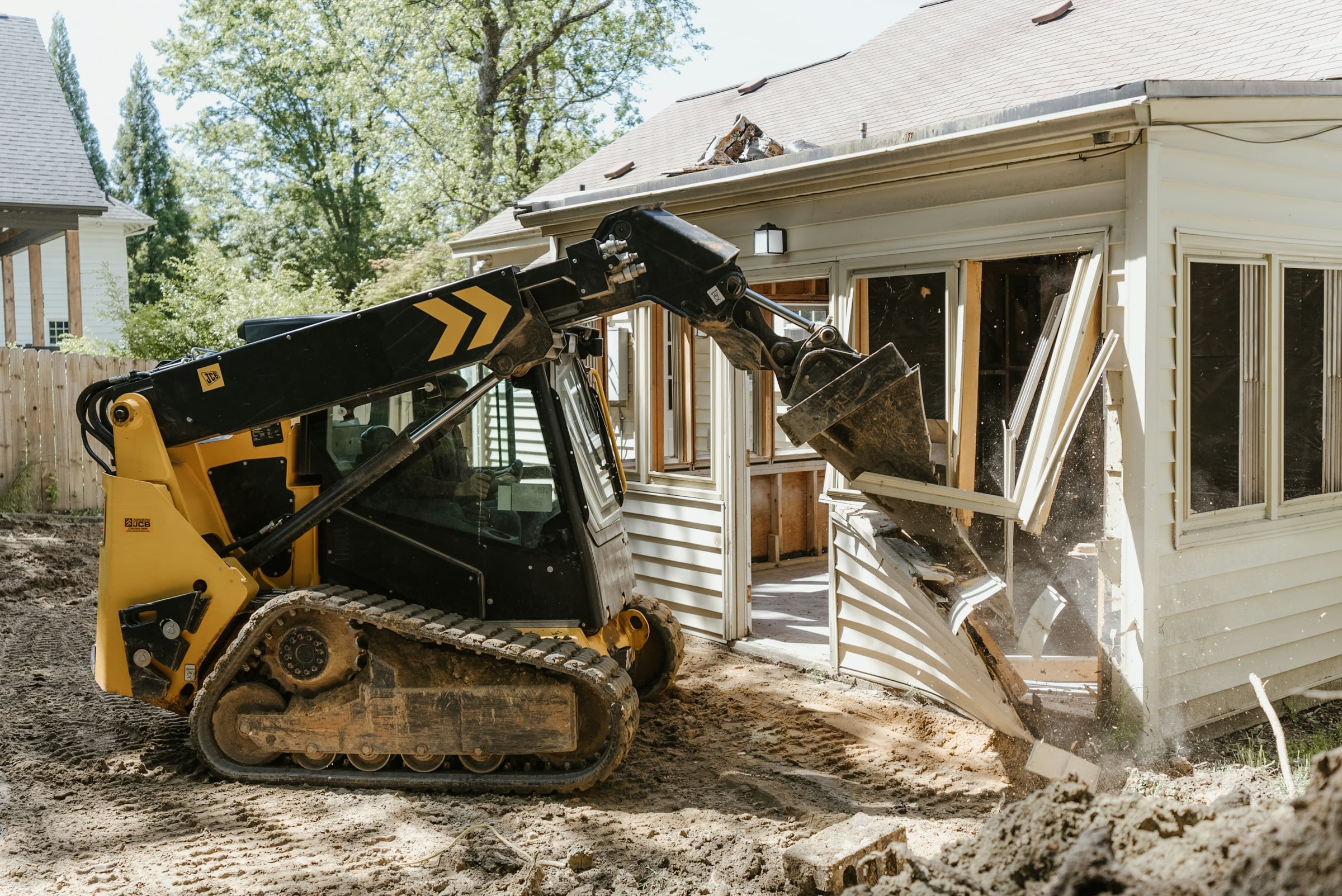
Before you make an offer on a house you plan to demolish, check five things in this order: what the zoning allows you to build on that lot, whether the lot touches a Chesapeake Bay protection area or a floodplain, whether the address is in a historic district, how water and sewer (or a well and septic system) are set up, and how you will pay for the purchase and the build. The City of Richmond, Henrico County and Chesterfield County each run their own demolition permit and use their own wording, so one locality’s checklist does not carry over to the next.
You are buying a lot, and the rules that govern the lot decide whether your plan is possible. If you are weighing a teardown against a finished home, our new construction search shows what is already built and for sale.
Start with zoning and setbacks, not the house
Zoning sets what can be built on a parcel and how far the building must sit from each lot line (the setbacks). Each locality publishes those minimums by zoning district in its zoning ordinance, and the minimums for a new house are the ones in force when you apply, not the ones the old house was built under. An older house can sit closer to a lot line than a new one is allowed to. Ask the planning office, in writing, whether a new house can use the same footprint as the old one.
Henrico County’s zoning districts page explains that overlay districts add standards on top of the base district and override it. Henrico uses the term provisional use permit for uses that are not automatically allowed in a district. Chesterfield’s own term for a similar step is conditional use permit. If your plan involves anything beyond a single house on the lot, ask which of these applies before you offer.
If the lot is narrow, oddly shaped or has a slope, ask each planning office whether an exception route exists and how often it is granted. Exceptions are decisions made by the locality, not rights, so do not buy a lot counting on one. If you want a second dwelling on the property, read our guide to accessory dwelling unit rules in Richmond, Henrico and Chesterfield first, because those rules differ by locality.
Chesapeake Bay Preservation Act areas and floodplains
Under Virginia’s Chesapeake Bay Preservation Area rules, a Resource Protection Area (RPA) includes a buffer of at least 100 feet on land beside perennial water bodies (streams that flow year-round), along with tidal and connected nontidal wetlands. The state regulation says the buffer is not reduced in width, and that existing vegetation must be kept and missing vegetation established. You can read the wording in 9VAC25-830-140, part of the Virginia Administrative Code.
Here is why that matters for a teardown. The same regulation says redevelopment inside an RPA is allowed outside intensely developed areas only if it adds no impervious cover and does not encroach further into the RPA. A rebuild that is bigger than the old house, or that adds a driveway or patio on the buffer side, can run into that.
The City of Richmond’s own demolition permit application has check boxes for the 100-year flood plain and for Chesapeake Bay Protection/Management Areas, so the city looks at both when you apply. Ask the locality for an RPA determination on the parcel before you remove any contingency. Seller disclosure forms do not settle this: the disclosure statement in Code of Virginia section 55.1-703 says the owner makes no representation about resource protection areas and tells buyers to check the locality’s official map.
Historic district review in the City of Richmond
In the City of Richmond, the Commission of Architectural Review (CAR) reviews exterior changes, including demolitions, inside the city’s Old and Historic Districts. If the lot you are eyeing is in Jackson Ward, Church Hill or Shockoe Slip, ask city staff whether the specific address falls inside a district, because a community name alone does not tell you.
The city’s proposed demolition checklist is demanding. It tells applicants to contact staff early, review Section 30.930.7(d) of the City Code, and file the checklist with the certificate of appropriateness (COA) application. It asks for labeled photographs, elevations of every side, a legal plat of survey, evidence that you considered alternative uses, relocation or resale, itemized rehabilitation cost estimates, a structural engineer’s report on whether rehabilitation is feasible, a material reuse plan, and complete plans for what you will build on the site. The city wants the replacement design before it considers the demolition.
In Henrico and Chesterfield, ask each planning office whether any overlay district applies to your address, since overlays can add standards on top of the base zoning.
Send us the address before you write an offer
Found a teardown candidate in the City of Richmond, Henrico or Chesterfield? Send us the address and we will go through the public zoning, permit and map records for it with you, and look up what those records show nearby. We can also set up a saved search of lots and new-construction listings in the areas you choose.
Water, sewer, wells and septic
Find out how the lot is served before you plan the house. Some lots are on public water and sewer, and some are on a private well and septic system, and the status changes your design and permits. Our guide to public water and sewer versus well in Richmond-area neighborhoods explains how to check, and our well and septic guide for Virginia buyers covers the buyer side of private systems.
The demolition paperwork asks about this directly. The City of Richmond’s application asks whether the structure has wells, underground tanks or a septic system. Henrico requires the Planning Office and the Department of Public Utilities to approve the demolition before a permit is issued. Chesterfield’s demolition certification form says the owner must get a release from every utility with service connections to the building, stating that connections and related equipment have been removed or safely sealed or plugged. Those releases come from other offices, so start them early.
The demolition and building permit steps, locality by locality
Each locality’s own page or form names different steps. Here is what each one says, using its wording.
| Locality | Where the application starts | What the locality names | Fee as listed |
|---|---|---|---|
| City of Richmond | Demolition permit application (city form) | Contractor state and business license on file, or a Building Permit Owner Statement; an Asbestos Certification; zoning and site boxes for historic district, violations, delinquent taxes, 100-year flood plain, Chesapeake Bay areas | $184.00 for one- and two-family residential, plus a 2 percent state surcharge |
| Henrico County | Build Henrico customer portal, Permits, then Demolition | Owner’s Statement of Responsibility, DPW Erosion and Sediment Control Plan, Certification of Asbestos Inspection, Demolition Certification Form (complete demolitions), plot or site plan | $100 for the first $5,000 of estimated cost, plus $6 per additional $1,000 or fraction, plus a 2 percent state levy |
| Chesterfield County | Building permit application with the Asbestos and Demolition Certification Form | Utility release from each utility with a service connection; written notice to adjoining lot owners; one asbestos certification box checked | Not stated on the form |
The Richmond form states plainly that it is an application only and not authorization to start work, and that no work may start until a permit is posted on the job site. Read the City of Richmond demolition permit application itself, because the fee and the forms can change. Henrico’s demolition permit page walks through the online steps, and its demolition requirements sheet adds that all utilities and gas lines to the job location must be disconnected before the permit is issued, and that an electrical and mechanical inspector visits to confirm that electric and gas service is off. Chesterfield’s Asbestos and Demolition Certification Form is the county document for that step. It ties the certification to the Virginia Uniform Statewide Building Code.
A demolition permit is separate from the building permit for the new house. Our Chesterfield County, Henrico County and City of Richmond community pages help you narrow where to look.
Financing a purchase you plan to tear down
Two loan families matter here, and they work differently. Freddie Mac’s homebuyer pages describe a construction-only loan as a short-term, one-time loan that pays for building costs, with interest-only payments during construction and the full balance due when construction ends. A construction-to-permanent loan is one loan that covers the build and then converts to a standard mortgage with no extra application, with interest-only payments during construction and principal and interest after conversion. Freddie Mac notes these loans can cost more than traditional mortgages and that not every lender offers them. Read the details on Freddie Mac’s loan options for building your home.
The renovation route has a catch for true teardowns. The FHA 203(k) program from HUD combines a purchase and repair funds in one loan, with repair money held in escrow and released as work is completed. HUD says a structure can be demolished and rebuilt under the program only if the complete existing foundation system is not affected and will still be used. If your plan includes a new foundation, a 203(k) loan is not the tool. See HUD’s 203(k) program page.
Ask lenders how they treat a purchase of a house you intend to demolish before you write an offer, since the answer shapes your contingency dates. Our preferred lenders page is a starting point, and the mortgage calculator lets you test the purchase side of the numbers.
If the lot has a water problem
Our companion guide on wet crawl spaces, standing water and drainage in older Richmond-area homes covers what inspectors flag and what the Virginia disclosure law says.
Bring us the address and we will check it with you
Before you offer on a lot you plan to clear, send us the address. We will go through the public zoning, permit and map records with you and look up what those records show nearby, so you know what you are buying before the contingency clock starts. You can also browse current listings.
Frequently asked questions
Can I pull a demolition permit myself as the owner?
Both Richmond and Henrico describe an owner route. The City of Richmond’s application asks owners to complete a Building Permit Owner Statement and submit it with the application. Henrico lists an Owner’s Statement of Responsibility for owners or owner’s agents who are exempt from contractor licensing. Chesterfield’s form is signed by the owner or the owner’s authorized agent. Check each locality’s page for who qualifies.
What happens to the permit fee if I change my mind in Henrico?
Henrico’s demolition page says that if the permit has not been issued, you can withdraw the application in the customer portal and receive a 100 percent refund. If the permit is already issued, you select Amend Permit and request cancellation, and a 75 percent refund applies. A cancellation reason is required, and you should state that you want a refund.
Do I have to tell the neighbors about a demolition?
In Chesterfield, the demolition certification form says the owner must give written notice to owners of adjoining lots, and to owners of other lots affected by temporary removal of utility wires or other facilities, as applicable. Ask Richmond and Henrico staff whether they require a similar notice.
What is a water quality impact assessment?
Under Virginia’s Chesapeake Bay Preservation Area regulation, any proposed land disturbance in a Resource Protection Area requires a water quality impact assessment. If your lot touches an RPA, ask the locality what format it wants and who reviews it. The rule is in 9VAC25-830-140 of the Virginia Administrative Code.
Can an old lot ever build inside the 100-foot buffer?
The regulation describes an administrative encroachment process for lots recorded before October 1, 1989, and for lots recorded between October 1, 1989, and March 1, 2002, when the buffer would eliminate a buildable area. The encroachment must be the minimum needed for a principal structure and necessary utilities, and it cannot reach into the seaward 50 feet of the buffer. Ask the locality which category your lot falls in.
What if I cannot pay off a construction-only loan when the house is finished?
Freddie Mac says you would apply for a mortgage before construction ends and give the lender your certificate of occupancy, and you would pay two sets of closing costs, one for the construction loan and one for the mortgage. A construction-to-permanent loan avoids the second closing by converting automatically.