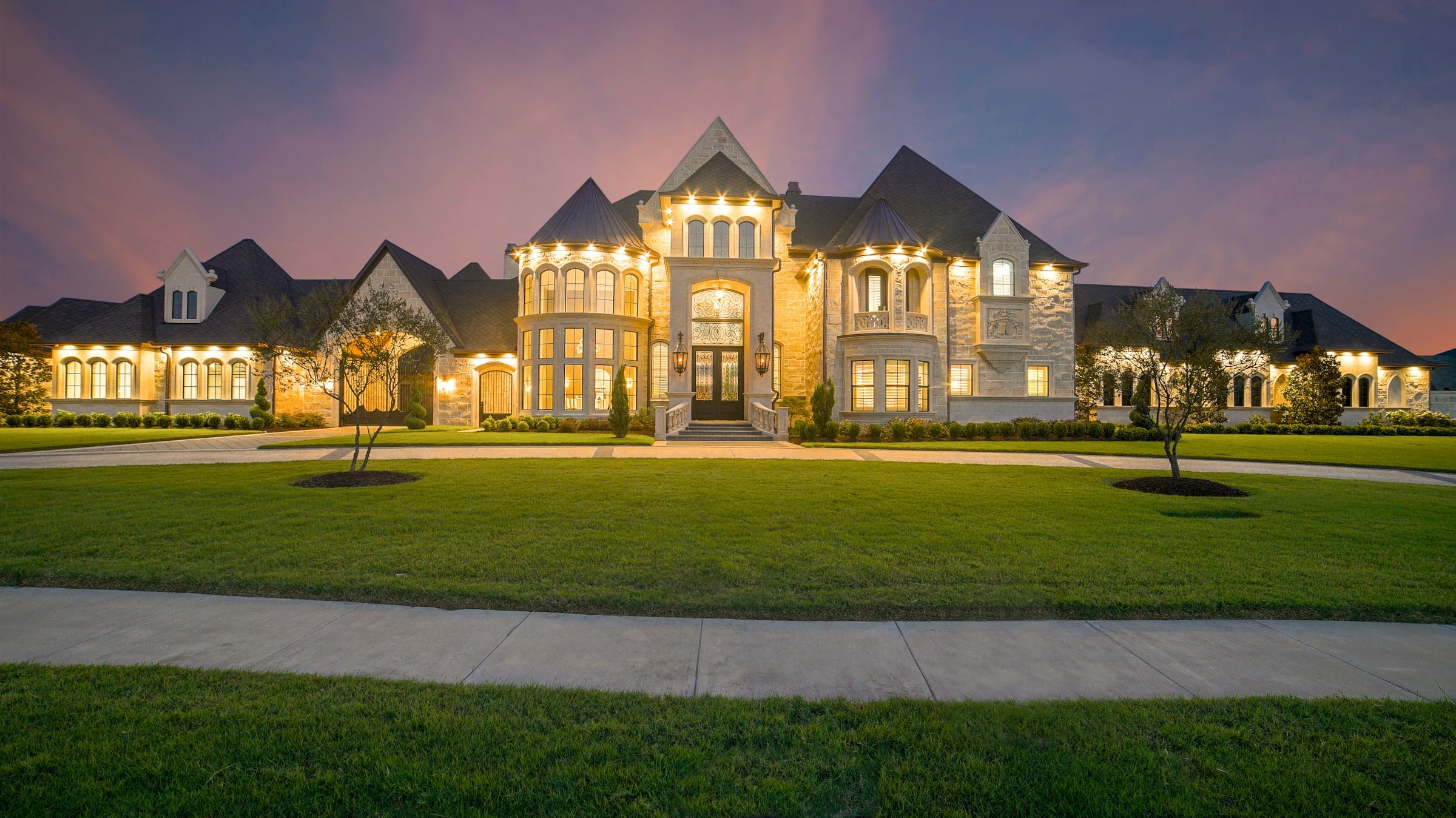
A 17-acre estate in Hanover County went on the market on Aug. 24 for just under $8 million. Hanover County assessed the same property this year at $2.3 million. Both numbers are real, both are current, and they are almost $5.7 million apart.
That gap is the most useful thing in the story, and it is not a Hanover problem or a luxury problem. It is the ordinary relationship between an assessment and a market price, blown up to a scale where you can actually see it.
What Richmond BizSense reported
The listing was reported on September 4, 2026 by Jonathan Spiers of Richmond BizSense, and every fact in this section comes from Spiers’ reporting rather than from us.
The house sits at 13259 Greenwood Church Road in Hanover County. It is 9,000 square feet across two stories, built in 2019 by Ashland-based Premier Structures, with five bedrooms, four bathrooms and two half-baths, on a wooded 17-acre lot. It is called “Ivy Knoll.” The sellers are Dustin and Holly Ferrara. Dustin Ferrara is president and owner of Ferrara Equipment Co., an Ashland-based construction equipment supplier; Holly Ferrara owns Ivy Knoll Designs and designed the house with landscape architect Steven Koprowski. It is listed with Daniel Heider of TTR Sotheby’s International Realty and Laura Peery of The Steele Group.
The feature list is genuinely unusual: two turrets, one holding an upstairs piano room with a built-in bench; a “Jungle Room” painted floor to ceiling with hand-painted tropical murals around an octagonal bar; an Italian marble fireplace in a two-story living room; a hidden pantry with a sliding library ladder; a walk-up third-level attic; a smart home system; a heated screened porch; a putting green with LED-illuminated cups; a three-car garage; and a saltwater heated pool with a hot tub set between fire bowls.
Peery told BizSense the Ferraras are making a Florida second home their primary residence, and that since the listing went up the house has drawn several thousand virtual showings but no in-person showings yet, with a broker’s open house held the week before. Spiers also reported the two numbers that matter most here: the Ferraras bought the land in 2016 for $130,750, and the county assessed the property this year at $2.3 million.
The three numbers attached to one address
- $130,750 – what the land cost in 2016, per Hanover property records cited by Richmond BizSense.
- $2.3 million – this year’s county assessment of the improved property.
- Just under $8 million – the asking price as of Aug. 24, 2026. Not a sale price. Nobody has bought it.
Assessed value and market value are two different instruments
An assessment exists to divide a tax burden. A locality places a value on every parcel inside its boundary on the same schedule using the same method, largely from recorded sales, permits, square footage and characteristics on file. It is a mass appraisal. It is not an offer, and no one is standing behind it with money.
A market price is a single negotiated outcome between one seller and one buyer on one day, and it carries everything a mass appraisal cannot: how the finishes actually feel, how badly the seller wants to move to Florida, who else is bidding, and whether a buyer with $8 million happens to want a Jungle Room.
So the honest framing of this gap is not “the county got it wrong.” The two numbers were never answering the same question. The entire Richmond, Chesterfield and Henrico assessment appeal process exists because assessments and market evidence routinely disagree, in both directions.
Why the gap gets widest on one-of-a-kind houses
Mass appraisal works best where there are lots of similar sales. In a neighborhood of 400 houses built from six floor plans, an assessor has plenty of recent evidence and the assessment usually lands somewhere defensible.
A custom 9,000-square-foot house on 17 acres in Hanover has almost no comparable sales, so an assessment has to be built out of components rather than read off a market. Hand-painted murals, LED putting cups and an Italian marble fireplace do not have a per-square-foot line item. The scarcer the comparables, the wider the honest range of defensible values, and the more a single motivated buyer can move the number.
That cuts in both directions, which is the part that gets lost. A low assessment is not evidence a house is worth less, and a high assessment is not evidence it is worth more. Neither one is a valuation of your house to a buyer. Anyone shopping the Richmond luxury market already knows this instinctively; the useful move is to apply it to a $450,000 house too.
If your own assessment and your own market value look nothing alike
That is normal, and it is worth knowing which of the two numbers is out of line before you do anything about it. Ask us for a free market valuation on your address and we will tell you what current comparable sales support, separately from whatever your locality has on file.
The rest of the metro’s multimillion-dollar board
Spiers reported the Greenwood Church listing against the rest of a busy year at the top of the market. That context is worth keeping straight, because listings and sales blur together fast.
Only one of these is a completed transaction: Hill Crest, the Tudor Revival house at 5103 Cary Street Road, sold last month for over $9 million against a $10 million list price, a city record. That address sits in the West End corridor that also takes in Windsor Farms and the Near West End, which is where most of Richmond City’s genuine eight-figure inventory has historically been.
The rest are still open questions. The Lansing mansion at 214 S. Wilton Road was listed in May at $8.5 million, came off the market, and has been re-entered as coming soon at $7.5 million. NBA player Ben Wallace’s Manakin-Sabot house went under contract last month after listing in June at $6.9 million. And Historic Tuckahoe, the roughly 300-year-old house on 560 acres in Goochland County, remains for sale at $17 million after listing in July, making it the priciest listing of the year so far.
Four of the five properties above are asking prices, and an asking price is a question, not an answer. We do not know what Greenwood Church Road will sell for, whether it will sell, or what a buyer will conclude about the gap between $2.3 million and $8 million. We will know when it closes. Until then, the only figure in the story with a transaction behind it is Hill Crest’s, and our walk through Richmond homes at $1.2 million and up is the better guide to what actually trades at the top of this market than any list price is.
More reporting on how the metro is changing, address by address, sits in our Richmond area news archive.
Questions people ask about assessments and asking prices
Does a county assessment change because a house gets listed for sale?
No. A listing is not a transaction, and localities reassess on their own cycle using recorded sales and property characteristics. A house can sit on the market at three times its assessed value for a year and the assessment does not move until the next reassessment for that locality.
If Greenwood Church Road sells near $8 million, will the assessment jump to match?
A recorded sale is exactly the kind of evidence a mass appraisal is built from, so a large arm’s-length sale is likely to influence the next assessment of that parcel. But a single sale of a genuinely unique property does not automatically become the new assessed value, and we are not going to predict a number. As of Richmond BizSense’s September 4, 2026 report the house had not had an in-person showing, so there is no sale to reassess from yet.
Can I use a listing price as a data point when I price my own house?
Only as a very weak one. An asking price tells you what a seller hoped for on the day the listing went live. Closed sales tell you what buyers actually paid. When the two diverge, the closed sales are the evidence. Days on market is the tell: Richmond Metro’s median was 19 days in July 2026, down 13.6% year over year, per Central Virginia Regional MLS, so a metro listing sitting far past that is usually a pricing signal rather than a market signal.
What did an ordinary Hanover County house actually sell for in July 2026?
Hanover County’s median single-family sales price was $525,000 in July 2026, up 1.0% year over year, on 137 closed sales, with a median 21 days on market and 2.4 months of supply. Those are county-level figures from Central Virginia Regional MLS, current as of August 10, 2026, and they are not neighborhood figures. July 2026 is the freshest published month; the August 2026 report was not yet published when this was written.
How do I look up my own assessed value?
Through your locality, not through a national website. Hanover County publishes its own real estate and assessment information, and Henrico County publishes both its assessed values and its real estate assessment appeal process. Each locality in the metro runs its own cycle and its own appeal window, which is the single most common thing homeowners here get wrong.
A high assessment means a higher tax bill. Does a low one mean I am getting away with something?
Your bill is the assessed value multiplied by your locality’s rate, so a below-market assessment does lower a bill. It also does nothing for you when you sell, because a buyer’s lender orders an appraisal against market evidence and never looks at your assessment. The rates themselves differ meaningfully by locality across the metro, which we break down separately in our guide to 2026 real estate tax rates by locality.