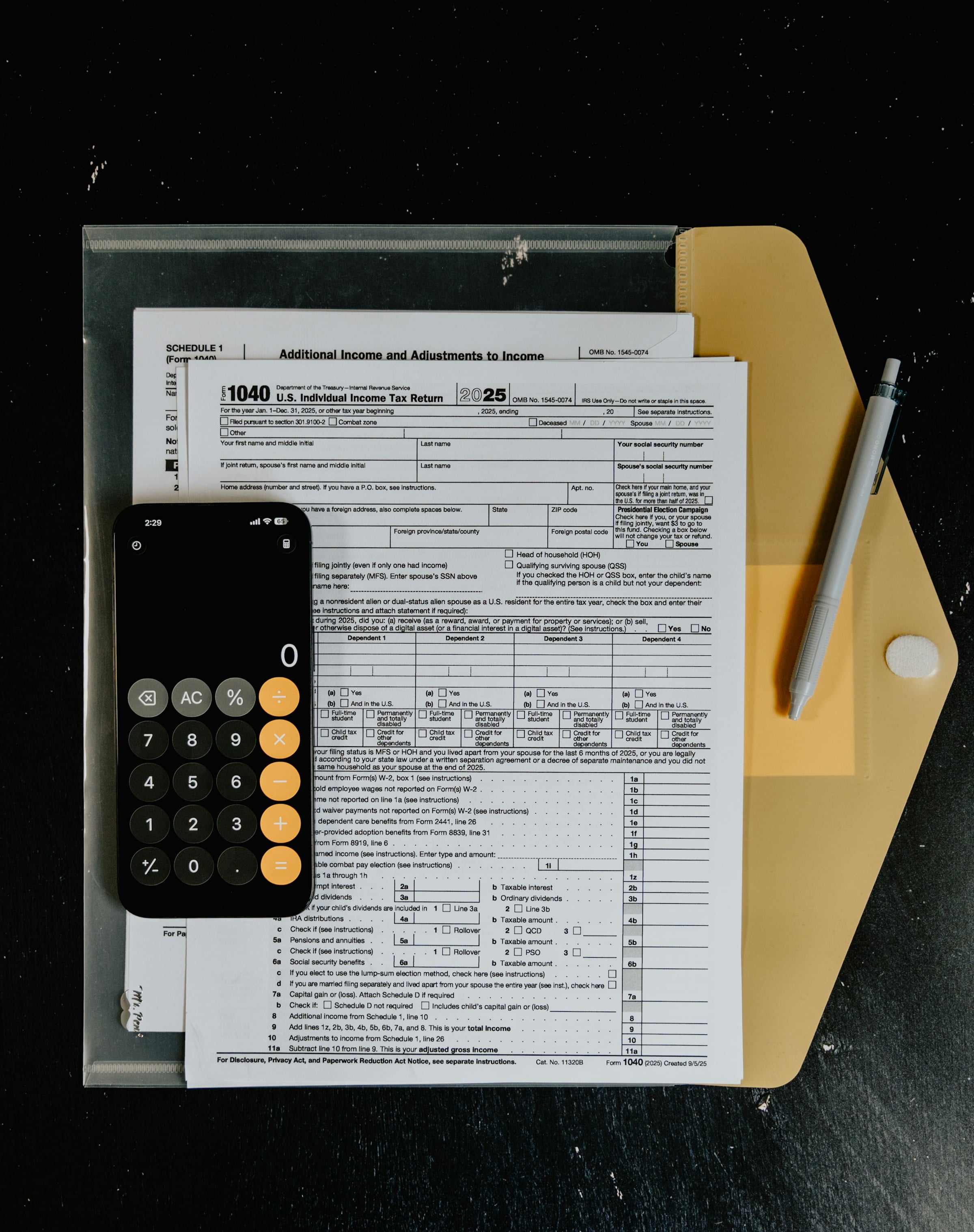
For 2026, the federal cap on the state and local tax (SALT) deduction is $40,400 for most filers, up from the $10,000 limit that applied before 2025. For Richmond-area homeowners, that raises a practical question: does the bigger cap change whether you itemize, and by how much? The answer depends less on the cap than on how your real estate tax, Virginia income tax and mortgage interest add up against a $32,200 standard deduction for married couples. Below we run the numbers for a typical house in each of the three core localities, using August 2026 sale prices and each locality’s published tax rate.
The 2026 federal numbers that matter to homeowners
Everything in this table comes from IRS Publication 505 for 2026, except the 2025 SALT figures, which appear in the IRS instructions for the 2025 Schedule A, and the mortgage limits, which appear in IRS Publication 936.
| Item | 2026 figure | What it replaced |
|---|---|---|
| SALT deduction cap (income, sales and property taxes combined) | $40,400 ($20,200 married filing separately) | $40,000 for 2025; $10,000 before that |
| Income level where the SALT cap starts shrinking (modified AGI) | $505,000 ($252,500 married filing separately) | $500,000 for 2025 |
| Lowest the reduced SALT cap can go | $10,000 ($5,000 married filing separately) | Same floor for 2025 |
| Standard deduction, married filing jointly | $32,200 | n/a |
| Standard deduction, single or married filing separately | $16,100 | n/a |
| Standard deduction, head of household | $24,150 | n/a |
| Mortgage debt eligible for interest deduction (loans after Dec. 15, 2017) | $750,000 ($375,000 married filing separately) | Older loans can keep a $1,000,000 limit |
Two other 2026 changes are worth knowing. First, Publication 505 says the election to deduct qualified mortgage insurance premiums on home acquisition debt has been made permanent beginning in 2026, for insurance contracts issued after December 31, 2006. That matters to buyers who put down less than 20%; it did not apply to 2025 returns. Second, very high earners face a new overall trim: for 2026, itemized deductions can be reduced by 5.4% of the lesser of total itemized deductions or taxable income above $768,700 for joint filers ($640,600 single). Most readers of this post will never hit that threshold.
We have not stated what happens to the SALT cap after 2026, because we could not confirm those later-year figures on IRS.gov. Check the current year’s Schedule A instructions before relying on any projection.
The house prices and tax rates we used
Real estate tax is the piece of the SALT deduction that depends on where you buy. We used the August 2026 median single-family sale price for each locality as a stand-in for an assessed value, which it is not; assessments are set by each locality’s assessor and can sit well above or below a recent sale price. Our post on how the same house gets six different tax bills explains why.
August 2026 single-family market data, locality-wide (not neighborhood figures)
| Locality | Median sold price | 1-yr change | Days on market | Months of supply | Closed sales |
|---|---|---|---|---|---|
| City of Richmond | $403,500 | -5.3% | 26 | 1.4 | 163 |
| Henrico County-wide | $425,000 | +7.9% | 18 | 1.6 | 229 |
| Chesterfield County-wide | $453,975 | +0.9% | 22 | 1.9 | 372 |
| [DATA NEEDED: median price per square foot, August 2026, by area] | |||||
Source: CVR MLS via Richmond Association of REALTORS sortable monthly statistics, single family, August 2026.
Tax rates come from each locality’s own site: the City of Richmond lists $1.20 per $100 of assessed value, Henrico County’s approved tax rates page lists $0.83 per $100, and Chesterfield County lists a 2026 rate of $0.89 per $100. You may see $0.85 quoted for Henrico elsewhere; we used the $0.83 on Henrico’s own page. Our 2026 guide to real estate tax rates across the Richmond metro covers the rest of the metro too.
Worked examples: one household, three localities
Assumptions. Married couple filing jointly. They buy at the locality median with 20% down and a 30-year fixed loan at a hypothetical 6.25% rate; that rate is for illustration only, not a quote. First-year mortgage interest comes from a standard amortization schedule. Virginia income tax uses the state rate schedule (2% up to $3,000, 3% to $5,000, 5% to $17,000, then 5.75% above $17,000) applied to three levels of Virginia taxable income: $80,000, $130,000 and $250,000. We assume no other itemized deductions, such as charitable gifts, and we treat the full year’s Virginia tax as paid in the year. Real life will differ, so treat these as a map of where the lines fall, not as a return.
City of Richmond: $403,500 house
Real estate tax: $4,842. Loan: $322,800. First-year interest: about $20,068.
| Virginia taxable income | Virginia tax | SALT total | Itemized, 2026 cap | Itemized, old $10,000 cap | Better choice in 2026 |
|---|---|---|---|---|---|
| $80,000 | $4,342.50 | $9,184.50 | $29,252 | $29,252 | Standard ($32,200) |
| $130,000 | $7,217.50 | $12,059.50 | $32,127 | $30,068 | Standard, by $73 |
| $250,000 | $14,117.50 | $18,959.50 | $39,027 | $30,068 | Itemize, by $6,827 |
The City has the highest rate of the three, so the household crosses the old $10,000 cap at a lower income. At $130,000 of Virginia taxable income it is $73 short of the standard deduction; a modest charitable gift would tip it. At $250,000, the higher cap turns a standard-deduction household into an itemizer.
Henrico County: $425,000 house
Real estate tax: $3,527.50. Loan: $340,000. First-year interest: about $21,137.
| Virginia taxable income | Virginia tax | SALT total | Itemized, 2026 cap | Itemized, old $10,000 cap | Better choice in 2026 |
|---|---|---|---|---|---|
| $80,000 | $4,342.50 | $7,870.00 | $29,007 | $29,007 | Standard ($32,200) |
| $130,000 | $7,217.50 | $10,745.00 | $31,882 | $31,137 | Standard, by $318 |
| $250,000 | $14,117.50 | $17,645.00 | $38,782 | $31,137 | Itemize, by $6,582 |
Henrico’s lower rate means a smaller property tax bill, so the SALT total at $130,000 barely clears the old cap. The pattern is the same as in the City: the cap increase changes the answer only once state income tax grows large.
Chesterfield County: $453,975 house
Real estate tax: $4,040.38. Loan: $363,180. First-year interest: about $22,578.
| Virginia taxable income | Virginia tax | SALT total | Itemized, 2026 cap | Itemized, old $10,000 cap | Better choice in 2026 |
|---|---|---|---|---|---|
| $80,000 | $4,342.50 | $8,382.88 | $30,961 | $30,961 | Standard ($32,200) |
| $130,000 | $7,217.50 | $11,257.88 | $33,836 | $32,578 | Itemize, by $1,636 |
| $250,000 | $14,117.50 | $18,157.88 | $40,736 | $32,578 | Itemize, by $8,536 |
The larger median loan does most of the work here. At $130,000 this household would have itemized even under the old cap, by $378; the higher cap adds another $1,258 of deductions.
What the three examples say together
For a married couple with 20% down, the higher SALT cap rarely decides the question at moderate incomes, because real estate tax plus Virginia income tax often sits near or below $10,000 anyway. It matters most for households with larger state income tax bills, for anyone with a bigger loan or a higher assessment, and for single filers. A single filer faces a $16,100 standard deduction, so the same City house at $130,000 of Virginia taxable income itemizes easily, and the new cap adds $2,059.50 of deductions that the old limit would have cut off. Interest also falls a little every year as the loan amortizes, so a household that itemizes in year one may not in year five.
Run your own payment, taxes included
Our examples use one hypothetical rate and a median price. Plug in the house you are actually looking at, with the locality’s tax rate, on the Mission Realty mortgage calculator to see the monthly payment with real estate tax built in.
How the Virginia return treats the same deductions
Virginia follows your federal choice. According to Virginia Tax, if you itemize on your federal return you must itemize on your Virginia return, and if you take the federal standard deduction you must take Virginia’s, which Virginia Tax lists as $8,750 for single filers and $17,500 for married couples filing jointly. On the Virginia Schedule A, the state income tax you deducted federally comes back out, so on the state return it is mainly real estate tax, mortgage interest and your other itemized deductions that count.
Virginia also moved on the cap itself. In May 2026, Virginia Tax announced that the General Assembly had conformed the state to federal tax law as of December 31, 2025, including the federal SALT cap amounts used in the Virginia Schedule A computation. Taxpayers who filed a 2025 Virginia return using the old $10,000 cap and did not receive an adjustment notice may want to look at an amended return with their preparer.
Details that change the math for Richmond owners
Assessment, not price. The deduction follows the tax you actually pay, which follows the assessment. If your assessment looks high, our guide to appealing an assessment in Richmond, Chesterfield and Henrico walks through the process.
Tax relief programs. If you qualify for a locality’s relief program for older or disabled owners, you deduct only what you pay after the relief. See real estate tax relief for older and disabled homeowners.
Points in the purchase year. Points can add to first-year interest and may tip a close year toward itemizing. Our guide to how mortgage points work covers when buying down the rate pays off.
Selling later. Deductions you take while you own do not affect the home sale exclusion; see capital gains and the home sale exclusion.
Loan structure. Down payment size affects both the interest deduction and whether mortgage insurance premiums enter the picture from 2026. A lender from our preferred lenders list can give you a first-year interest and mortgage insurance estimate on a specific loan.
Whether you are comparing the City of Richmond, Henrico County or Chesterfield County, the tax rate is only one line in the total cost. You can search homes across the Richmond area and check each listing’s assessed value against its asking price.
See your real payment before you pick a locality
Before you compare a City house with a Henrico or Chesterfield one, run both through the mortgage calculator with each locality’s tax rate, then take the numbers to your tax preparer.
More questions about 2026 homeowner deductions
Can I deduct real estate taxes that my lender pays from escrow?
Yes, you deduct the amount the lender actually paid to the locality during the calendar year, not the amount you deposited into escrow. Your lender’s year-end mortgage interest statement or escrow statement usually shows the property tax disbursements. Use that figure rather than twelve times your monthly escrow payment.
We bought our house partway through the year. Who deducts that year’s real estate tax?
The tax is generally split between buyer and seller based on the days each owned the home, and the proration appears on the closing statement. Keep that statement with your tax records, because your deductible share may not match what the lender’s escrow statement shows for the first year.
Does the Virginia car tax count toward the SALT cap?
Personal property taxes are part of the same combined state and local tax limit as income and real estate taxes, as long as they are based on the value of the property. That means the car tax on a household’s vehicles can push a SALT total closer to the cap. Your preparer can tell you how much of your bill qualifies.
What happens to the SALT cap if our income is above $505,000?
For 2026 the $40,400 cap starts shrinking once modified adjusted gross income passes $505,000 ($252,500 married filing separately), and it cannot fall below $10,000 ($5,000 married filing separately). Tax software applies the reduction, but high earners should run the numbers before assuming the full cap applies.
Is interest on a HELOC deductible under these rules?
Only to the extent the loan proceeds were used to buy, build or substantially improve the home that secures the loan, and within the overall mortgage debt limit. Interest on home equity borrowing used for other purposes, such as paying off a car or credit cards, is not deductible.
Can we deduct mortgage insurance premiums on our 2025 return?
No. The IRS says the itemized deduction for mortgage insurance premiums had expired for 2025. The election to deduct qualified mortgage insurance premiums returns beginning with 2026, for contracts issued after December 31, 2006, on acquisition debt for a first or second home.
Should we change our paycheck withholding because of the higher cap?
If the higher cap moves you from the standard deduction to itemizing, you may be over-withholding. The IRS says its Tax Withholding Estimator was updated to reflect the 2025 law changes, so running it with your expected deductions is a reasonable first step before talking to your preparer.
If we file separately, do we each get the full $40,400?
No. For 2026 a married person filing separately has a $20,200 SALT cap, and the mortgage interest limit for loans taken out after December 15, 2017 is $375,000 of debt per spouse. Filing separately rarely helps a homeowning couple, but it is worth asking your preparer in unusual situations.