Moving to Richmond VA from Annapolis: What to Know Before You Relocate
One historic capital city to another: water, weather, housing, taxes, traffic and where Annapolis transplants tend to land
Moving from Annapolis to Richmond means trading one historic capital city for a larger one about 140 miles south. Both have colonial-era cores, working state governments and deep water histories, so the cultural adjustment is smaller than the distance suggests. The genuine differences are these: your water life shifts from Chesapeake Bay sailing and the Naval Academy to the James River, including Class III and IV whitewater running through the middle of the city, with the Bay still reachable for a day trip. The climate is similar with Richmond a bit hotter and more humid in summer. Housing shifts from Annapolis colonial and waterfront to Richmond bungalows, American Foursquares, brick ranches and Fan rowhouses, and a Richmond budget generally buys more interior space. You leave Maryland’s tax structure for Virginia’s, including Virginia’s local personal property tax on vehicles. You leave the DC and Baltimore commuting corridor entirely. Anyone searching moving to Richmond VA from Annapolis, Richmond vs Annapolis, relocating to Richmond Virginia, Richmond VA neighborhoods for transplants, or Virginia personal property tax should verify current tax rates with the relevant locality, and the Mission Realty Team can connect you with local resources.
Table of Contents
- Two Historic Capital Cities: The Honest Parallel
- Water Culture: From the Bay to the James
- Climate and the Shape of the Year
- Housing Stock and What Your Budget Buys
- Maryland Versus Virginia Taxes
- Commuting and Traffic Without the DC Corridor
- The Job Market: Navy and Government to VCU Health and Corporate
- Neighborhood Analogues for Annapolis Transplants
- Frequently Asked Questions
People moving from Annapolis to Richmond usually arrive with an accurate instinct and one wrong assumption. The accurate instinct is that these two cities have something in common. The wrong assumption is that Richmond will feel like a bigger Annapolis. It does not, and understanding why makes the move much easier.
Both cities are state capitals with colonial-era street grids, working legislatures, historic brick architecture and a strong sense of their own past. Both sit on water that shaped their economies. Both have a small-city walkability that residents defend fiercely. But Annapolis is a compact city of roughly 40,000 within a wealthy county in the Baltimore and Washington orbit, and Richmond is the center of a metropolitan region of well over a million people, with its own economy, its own suburbs in four directions and no larger city pulling on it. Richmond is not a suburb of anywhere, and that independence is the first thing transplants notice.
This guide covers what actually changes: water, weather, housing, taxes, traffic, work and where Annapolis people tend to feel at home. The Mission Realty Team relocates buyers into Richmond, Henrico, Chesterfield, Goochland, Hanover and Powhatan regularly, and we have written this to be useful rather than promotional. Where numbers change, we tell you to verify them rather than guessing.
Two Historic Capital Cities: What Actually Carries Over
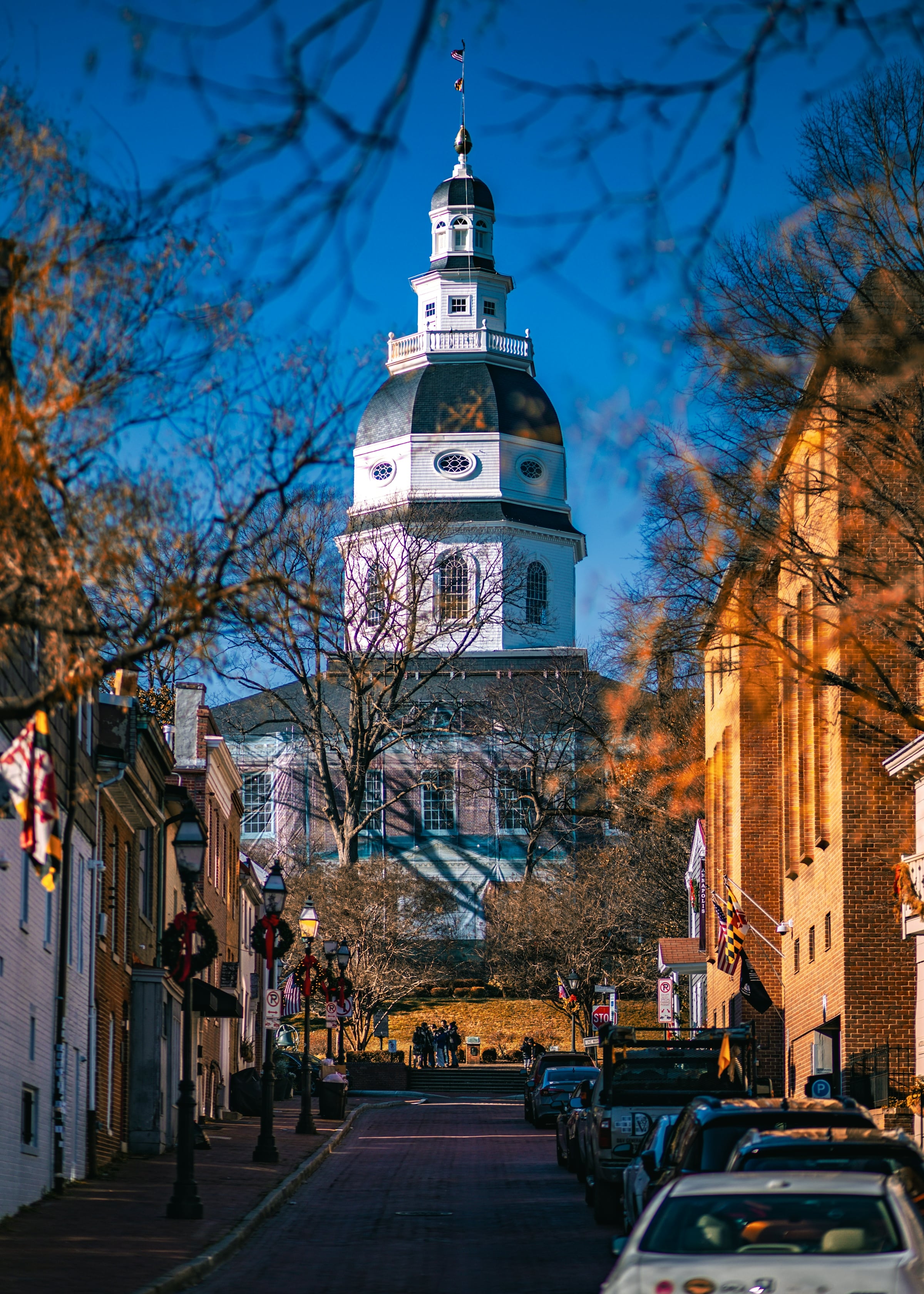
The parallel is real. Annapolis was laid out in the late 17th century with its distinctive baroque plan of radiating streets around State Circle and Church Circle, and the Maryland State House is the oldest state capitol in continuous legislative use in the country. Richmond became Virginia’s capital in 1780, and the Virginia State Capitol was designed by Thomas Jefferson, drawing on a Roman temple, and sits on Shockoe Hill above the city. If you enjoy living somewhere where the legislature is a visible part of civic life, where session brings a seasonal rhythm to downtown, and where 18th and 19th century buildings are ordinary rather than remarkable, Richmond will satisfy that.
Richmond’s historic districts are extensive. The Fan District is one of the largest intact Victorian neighborhoods in the country, with blocks of Italianate and Colonial Revival rowhouses west of downtown. Church Hill holds Richmond’s oldest surviving neighborhood fabric on a bluff east of the center, including St. John’s Church. Jackson Ward, Monument Avenue, Shockoe Bottom and Shockoe Slip, Manchester’s warehouse district, and the Court End area near the Virginia Museum of History and Culture and the White House of the Confederacy all offer different eras and different textures.
What does not carry over is scale and pace. Richmond has a genuine restaurant scene with national attention, an art museum with a substantial collection at the Virginia Museum of Fine Arts, professional and college sports, a large university in VCU shaping the middle of the city, and a metropolitan traffic pattern. It is busier and more spread out than Annapolis, and the trade for that is more choice in almost every category.
Water Culture: From Chesapeake Sailing to the James River
This is the biggest genuine lifestyle change, and it is worth being clear-eyed about it. Annapolis is a sailing town in a way few American cities are. The Severn River and the Chesapeake Bay, the Naval Academy and its sailing program, the boat shows, the yacht clubs, the racing calendar, the ability to walk to a slip. That specific culture does not exist in Richmond, and if sailing is central to your identity you should know that before you move.
What Richmond offers instead is unusual and in its own way more dramatic. The James River runs through the middle of the city and drops over the fall line right at downtown, producing genuine whitewater within the city limits. Depending on water level, the rapids through Richmond include Class III and Class IV sections, which makes Richmond one of the only major American cities where you can raft or kayak serious whitewater between office buildings. Belle Isle, Brown’s Island, the pipeline walkway, Pony Pasture, Texas Beach and the Huguenot Flatwater are all part of the James River Park System, a linear park along both banks with trails, rock outcrops and swimming holes.
The river culture here is flatwater paddling, whitewater kayaking and rafting, tubing, fly fishing for smallmouth bass, trail running and mountain biking on riverside singletrack, and simply sitting on a rock in the middle of the river on a Saturday. It is more casual than sailing culture, less club-based, and free to access. Rockett’s Landing and the downtown riverfront have some boating, and the Virginia Capital Trail runs 50-plus miles from Richmond to Jamestown along the river.
And the Bay is still there. Richmond sits at the head of navigation on the James, and the Chesapeake is reachable for a day trip or a weekend, with the Northern Neck, Deltaville, Urbanna, Yorktown and the Middle Peninsula all within a comfortable drive. Many Richmond families keep a boat at a marina downriver or on the Bay, and plenty keep a small second place in the Northern Neck. If sailing matters to you, that is the practical answer: live in Richmond, keep the boat closer to the water.
Climate and the Shape of the Year
Richmond and Annapolis share a humid subtropical climate with four real seasons, so this is a modest adjustment rather than a dramatic one. Richmond runs somewhat warmer, particularly in summer, and its summers are longer and more humid. Expect a stretch from roughly late June through early September of consistently hot, sticky days with afternoon thunderstorms, and expect air conditioning to be a genuine necessity rather than a convenience.
Winters are milder than Annapolis winters and considerably milder than anything further north. Richmond gets some snow most years, though amounts vary widely and a significant snowfall tends to close the region for a day or two because the infrastructure is not built for it. Ice storms are the more consequential winter risk here, and they matter for tree limbs and power lines.
Spring and fall are the reward. Richmond springs are long and spectacular, with dogwoods, azaleas and redbuds through April, and Lewis Ginter Botanical Garden and Bryan Park’s azalea gardens are worth planning around. The cost of that spring is pollen, and Richmond’s is heavy: the yellow pine pollen in April and May coats cars, porches and windowsills, and the region ranks poorly on allergy indexes. If anyone in your household has significant allergies, factor that in honestly.
One practical difference from coastal Maryland: Richmond is inland, roughly 100 miles from the Atlantic, which changes your hurricane exposure. The region does see the remnants of tropical systems, and the risk here is inland flooding, heavy rain and wind rather than storm surge. Flood insurance considerations depend on the specific parcel and its proximity to the James or a creek, not on being near the coast.
Housing Stock and What Your Budget Buys Differently
Annapolis housing is dominated by colonial and colonial revival architecture, waterfront and water-view properties, and a historic district with strict oversight. Waterfront and water access are the dominant price drivers, and much of the inventory is either historic small-lot housing in the city or newer construction in Anne Arundel County.
Richmond’s inventory is organized by building era rather than by water. The city’s streetcar suburbs, built roughly between 1910 and 1940, produced thousands of bungalows and American Foursquares in Northside neighborhoods like Bellevue and Ginter Park, and in Southside neighborhoods like Woodland Heights, Westover Hills and Forest Hill. The Fan District and Church Hill hold rowhouses and townhouses, Victorian and earlier. Postwar Henrico and Chesterfield are full of brick ranches and Cape Cods from the 1940s through the 1960s. Western Henrico and western Chesterfield hold the newer, larger construction: Short Pump, the Wyndham area, Midlothian and points west.
What that means practically is a different set of tradeoffs. Instead of paying for water frontage, you are choosing between character and updated systems, between walkability and square footage, between the city’s older housing and the counties’ newer housing. Most Annapolis transplants find that a Richmond budget buys noticeably more interior space and more yard than the equivalent in Anne Arundel County, and that the premium categories here are different: Windsor Farms, Westhampton, the Wyndham area and the closest-in historic blocks rather than waterfront.
Two Virginia-specific points. First, if you buy in a historic district such as the Fan, Church Hill, Monument Avenue or Ginter Park, exterior changes may require review by the city’s Commission of Architectural Review, so confirm what applies to a specific address. Second, older Richmond homes commonly have crawl spaces rather than basements, original plaster, knob-and-tube remnants in pre-1940 stock, and unconditioned attics, all of which shape your inspection strategy.
Maryland Versus Virginia Taxes: What Changes
Tax structures differ meaningfully between the two states, and because rates change every year we are going to describe categories rather than quote numbers. Verify current rates with the Virginia Department of Taxation and with the specific city or county before you make decisions.
Income tax: both states levy a state income tax. The important structural difference is that Maryland counties and Baltimore City impose a local income tax on top of the state rate, which Virginia localities do not. That single difference changes the arithmetic for many households, and it is worth having your tax advisor model your actual situation rather than comparing headline rates.
Real estate tax: both states tax real property locally. Rates in Virginia are set annually by each city or county, and they differ between the City of Richmond, Henrico County, Chesterfield County, Hanover County, Goochland County and Powhatan County. When comparing two homes across a jurisdiction line, ask for the actual annual tax figure for each rather than assuming they are similar.
Personal property tax on vehicles: this is the one that genuinely surprises people moving into Virginia. Virginia localities levy an annual personal property tax on vehicles, assessed on the value of each car, truck, motorcycle, trailer, boat and in some cases recreational vehicle you own. It is a real annual bill, separate from registration, and rates and assessment methods vary by locality. Virginia provides a partial relief program that offsets part of the tax on qualifying personal-use vehicles, but you should expect a bill. You are also required to register your vehicles with the locality after you move, and there are deadlines. If you own multiple vehicles or a boat, budget for this before you finalize a housing number.
Sales tax: Virginia’s sales tax is levied at a combined state and local rate that varies somewhat by region, with a lower rate applied to groceries. Vehicle titling in Virginia carries its own tax when you title a car in the state.
Commuting and Traffic Without the DC Corridor
If you have been living in Annapolis, you have been living inside one of the most congested corridors in the country. Route 50 to the Bay Bridge or west toward Washington, the Beltway, I-97 toward Baltimore, and the general gravitational pull of two large metro areas define daily life. Leaving that behind is, for many transplants, the single most immediate quality-of-life improvement.
Richmond’s traffic is real but it is regional rather than megaregional. Interstate 95 runs north and south through the city and carries heavy through traffic between Washington and the southeast, and it is the main source of congestion. Interstate 64 runs east and west, toward Charlottesville in one direction and Williamsburg, Newport News and Virginia Beach in the other. The two braid together north of downtown at an interchange that is the metro’s most reliable bottleneck. Interstate 295 loops around the east and north, and Chippenham Parkway and the Powhite Parkway serve the south and west.
Two features are worth knowing. First, the Powhite Parkway and the Downtown Expressway are toll facilities, so a Southside commute into downtown often means paying tolls twice a day. Second, the James River is crossed by a limited number of bridges, which makes bridge conditions a bigger factor in Richmond commute times than raw distance.
For travel, Richmond International Airport sits east of the city near Sandston and is genuinely convenient, roughly a fifteen to twenty minute drive from downtown depending on traffic. Amtrak serves Richmond at Staples Mill Road in Henrico and at Main Street Station downtown, with service north toward Washington and beyond and south and east toward Newport News and Norfolk. Washington is a comfortable drive or train ride for a day trip, and Annapolis itself is about a two and a half to three hour drive depending on traffic and route, which keeps family visits practical.
The Job Market: A Different Employment Base
Annapolis employment leans heavily on the United States Naval Academy, Navy and other federal activity, Maryland state government, the marine and hospitality economy, and the professional services that surround them, with many residents commuting to Washington or Baltimore for federal, defense and biotech work.
Richmond’s base is broader and more corporate. Virginia state government is a major employer, with agencies concentrated downtown and around Capitol Square. VCU and VCU Health form one of the region’s largest employers and anchor a substantial academic medical presence downtown, alongside Bon Secours and HCA Virginia hospital systems. The Federal Reserve Bank of Richmond is headquartered here, one of twelve district banks. Capital One has a large operation in western Henrico near the Goochland line. CarMax is headquartered in the Richmond area. Dominion Energy is headquartered downtown. Altria has a major presence. Markel, Genworth, Performance Food Group, Owens and Minor and a number of law and accounting firms round out a diversified white-collar base, and the region has a real advertising and creative sector with several well-known agencies.
Practically, this means Richmond is less dependent on any single federal or military employer than Annapolis is, and it has a genuine private-sector professional market. It also means networking works differently: Richmond is a relationship city where the professional community is large enough to be interesting and small enough that people know each other. Transplants who join organizations, volunteer or get involved in a neighborhood association tend to build a network faster than those who wait for it to happen.
If you currently hold a federal position, note that Richmond has federal presence but nothing like the density of the Washington and Baltimore corridor. Some transplants keep a federal role remotely or transfer to a Richmond-area facility. Verify what is possible with your agency before you commit to the move.
Neighborhood Analogues for Annapolis Transplants
If what you loved about Annapolis was historic walkability, look at the Fan District first. It is dense, tree-lined, architecturally consistent, and you can walk to restaurants, coffee, Carytown and the Virginia Museum of Fine Arts. The Museum District immediately west is slightly quieter with the same walkability. Church Hill is the closest thing Richmond has to Annapolis in feel: an older, hilly, human-scaled historic neighborhood with views over the river and the city from Libby Hill Park, a genuine sense of age, and a small commercial node. Jackson Ward and Monument Avenue offer other historic textures.
If what you loved was being near water, look south of the river. Westover Hills, Forest Hill, Stratford Hills and the Huguenot area put you close to the James River Park System, with trail access and river frontage nearby. Rockett’s Landing on the eastern riverfront offers newer condominium and townhome living directly on the water with a marina. Further out, the Huguenot corridor in western Henrico and Chesterfield has neighborhoods along the river with larger lots.
If you want a small-town feel with a historic core, consider the older sections of Ashland in Hanover County, a railroad town with a college and a genuine main street, or the historic village center of Chester in Chesterfield. Mechanicsville’s older sections and the Hanover courthouse area offer a slower pace.
If you are moving with school-age children and want established suburban schools and newer housing, western Henrico around Short Pump and the Wyndham area, and western Chesterfield around Midlothian, are where most relocating families look. Verify current attendance zones with Henrico County Public Schools or Chesterfield County Public Schools directly, since boundaries change and a listing is not an authoritative source.
The Mission Realty Team spends a lot of time on this specific question with transplants, because the right Richmond neighborhood for someone leaving Annapolis depends less on price than on which part of Annapolis life they are trying to keep. Tell us that, and the list gets short quickly.
| Category | Annapolis, MD | Richmond, VA |
|---|---|---|
| Historic core | Late 17th century baroque plan, oldest capitol in continuous use | Capital since 1780, Jefferson-designed State Capitol, extensive historic districts |
| Water life | Chesapeake Bay and Severn River sailing, Naval Academy | James River whitewater and flatwater in the city, Bay reachable by car |
| Summer climate | Hot and humid, coastal moderation | Hotter, longer, more humid; heavy spring pollen |
| Typical housing | Colonial and colonial revival, waterfront premium | Bungalows, Foursquares, brick ranches, Fan rowhouses |
| Local income tax | County-level local income tax applies | No local income tax on top of the state rate |
| Vehicle tax | No annual local personal property tax on cars | Annual local personal property tax on vehicles |
| Traffic context | Route 50, Bay Bridge, DC and Baltimore corridors | Regional I-95 and I-64, tolled expressways, limited river bridges |
| Major employers | Naval Academy, Navy, federal and state government | State government, VCU Health, Capital One, CarMax, Dominion Energy, Federal Reserve |
Frequently Asked Questions About Moving From Annapolis to Richmond VA
How far is Richmond VA from Annapolis MD?
Richmond sits roughly 140 miles south of Annapolis, generally a two and a half to three hour drive depending on route and traffic. Most people travel via US 50 and I-97 to the Baltimore-Washington corridor and then south on I-95, which is the variable part of the trip. Amtrak serves Richmond at Staples Mill Road in Henrico and Main Street Station downtown, with connections north toward Washington and Baltimore. The distance is short enough that family visits both directions stay practical.
Is Richmond VA similar to Annapolis?
They share more than the distance suggests, and less than you might assume. Both are state capitals with colonial-era cores, working legislatures, extensive historic architecture and a strong local identity. The difference is scale and orientation: Annapolis is a compact city within the Baltimore and Washington orbit, while Richmond anchors its own metropolitan region of over a million people with suburbs in four directions and no larger city pulling on it. Richmond is busier, more spread out, and offers more choice in restaurants, arts and employment.
Can you still sail if you move from Annapolis to Richmond?
Yes, but not in the same way, and this is the honest sticking point for many Annapolis transplants. Richmond sits at the fall line of the James River, above navigation for sailboats, so the city itself is a paddling and whitewater town rather than a sailing town. Many Richmond boaters keep a vessel at a marina downriver or on the Chesapeake, in places like Deltaville, Urbanna, the Northern Neck or Yorktown, all within a comfortable drive. If sailing is central to your life, plan for that arrangement from the start.
What is the James River like in Richmond?
It is one of Richmond’s defining features and genuinely unusual for an American city. The James drops over the fall line right at downtown, producing whitewater rapids that reach Class III and Class IV depending on water level, which means you can raft or kayak serious water within the city limits. The James River Park System runs along both banks with trails, rock outcrops, swimming areas and mountain biking at spots like Belle Isle, Pony Pasture, Texas Beach and the Huguenot Flatwater. Access is free and casual rather than club-based.
Is Richmond VA hotter than Annapolis?
Yes, somewhat, with longer and more humid summers. Both cities have a humid subtropical climate with four distinct seasons, but Richmond is inland and further south, so expect a longer stretch of hot sticky weather from roughly late June through early September, with afternoon thunderstorms. Winters are milder than Annapolis winters, with some snow most years and ice storms as the more consequential risk. Spring and fall are long and pleasant, though Richmond’s spring pollen is heavy.
Does Virginia have a personal property tax on cars?
Yes, and it is the tax that most often surprises people moving into Virginia. Virginia localities levy an annual personal property tax assessed on the value of each vehicle you own, including cars, trucks, motorcycles, trailers and boats in many jurisdictions, separate from your registration fees. Rates and assessment methods are set locally, and Virginia offers a partial relief program for qualifying personal-use vehicles. You also must register vehicles with your new locality after moving, with deadlines. Verify current rates and requirements with the Commissioner of the Revenue for your specific city or county.
Are taxes lower in Virginia than Maryland?
It depends entirely on your household, so have a tax advisor model your actual situation rather than comparing headline rates. The most significant structural difference is that Maryland counties impose a local income tax on top of the state income tax, while Virginia localities do not. On the other side, Virginia localities levy an annual personal property tax on vehicles that Maryland does not. Real estate tax rates are set locally in both states and vary considerably by jurisdiction, so compare actual annual bills for specific properties.
What kind of houses are common in Richmond VA?
Richmond’s inventory is organized by building era rather than by waterfront. The streetcar suburbs of Northside and Southside, built roughly 1910 to 1940, produced thousands of bungalows and American Foursquares in areas like Bellevue, Ginter Park, Woodland Heights and Westover Hills. The Fan District and Church Hill hold Victorian and earlier rowhouses. Postwar Henrico and Chesterfield are full of brick ranches and Cape Cods. Western Henrico and Chesterfield hold newer, larger construction around Short Pump, the Wyndham area and Midlothian.
Does a housing budget go further in Richmond than in Annapolis?
Most transplants find it buys more interior space and more yard, though we do not publish comparative percentages because those figures move and are easy to misuse. The structural reason is that Annapolis pricing is driven heavily by water frontage and water views within a wealthy county, while Richmond pricing is driven by building era, neighborhood and school division. Richmond’s premium areas are different in kind, including Windsor Farms, Westhampton, the Wyndham area and the closest historic blocks. Ask the Mission Realty Team for current pricing in any specific Richmond neighborhood.
What are the best Richmond neighborhoods for people moving from Annapolis?
It depends on which part of Annapolis life you are trying to keep. For historic walkability, look at the Fan District, the Museum District, Church Hill and Jackson Ward. For proximity to water, look at Westover Hills, Forest Hill, Stratford Hills, the Huguenot corridor and Rockett’s Landing. For a small-town historic core, consider the older sections of Ashland in Hanover or the village of Chester in Chesterfield. For established suburban schools and newer housing, western Henrico around Short Pump and western Chesterfield around Midlothian.
Who are the biggest employers in Richmond VA?
Richmond has a diversified base rather than dependence on a single sector. Virginia state government is a major employer, and VCU with VCU Health anchors a large academic medical presence downtown, alongside the Bon Secours and HCA Virginia hospital systems. The Federal Reserve Bank of Richmond is headquartered here, and Dominion Energy and Altria have major downtown presences. Capital One operates a large campus in western Henrico, and CarMax, Markel, Genworth, Performance Food Group and Owens and Minor are all part of the corporate base.
Is the traffic better in Richmond than the Annapolis and DC area?
Substantially, and most transplants name it as the most immediate improvement. Richmond has regional congestion rather than the megaregional congestion of the Route 50, Bay Bridge, Beltway and I-95 corridor around Washington and Baltimore. The main pressure points here are I-95 through the city, the I-95 and I-64 interchange north of downtown, and the limited number of James River bridges. Be aware that the Powhite Parkway and Downtown Expressway are toll roads, so a Southside commute downtown usually involves tolls.
How is the Chesapeake Bay accessible from Richmond?
By car, comfortably, for day trips and weekends. Richmond sits at the head of navigation on the James, and the Bay and its rivers are reachable within a drive that puts the Northern Neck, Deltaville, Urbanna, the Middle Peninsula and Yorktown all in range. Many Richmond families keep a boat at a downriver or Bay marina, and a fair number own a modest second place in the Northern Neck. If Bay access matters to you, plan the marina before you plan the house.
What should I know about schools when relocating to the Richmond area?
The metro has several separate school divisions and they are not interchangeable, so identify the division before you narrow neighborhoods. Richmond Public Schools serves the city, and Henrico County, Chesterfield County, Hanover County, Goochland County and Powhatan County each operate their own division. Henrico in particular runs an extensive magnet and specialty center program that operates alongside neighborhood assignment. Always verify current attendance zones directly with the county or city division, because boundaries change and listing information is not authoritative.
Should I rent first when moving to Richmond from out of state?
If your timeline allows it, yes, and we say that even though we sell houses. Richmond’s neighborhoods change character within a few blocks more than most cities its size, and living here for six to twelve months tells you things no amount of research will. If renting is not practical, spend several days in the area visiting your shortlist at different times of day, drive your prospective commute at the real hour, and lean on local knowledge. The Mission Realty Team works with relocating buyers throughout Richmond, Henrico, Chesterfield, Goochland, Hanover and Powhatan. Call us at (804) 601-4960.
Planning a Move From Annapolis to Richmond?
The Mission Realty Team helps relocating buyers learn the Richmond region neighborhood by neighborhood, from historic walkable districts to river-adjacent Southside to the western suburbs. Call us at (804) 601-4960 or visit us at 3701 Cox Rd, Richmond VA 23233, and we will build you a shortlist based on the life you are trying to keep.