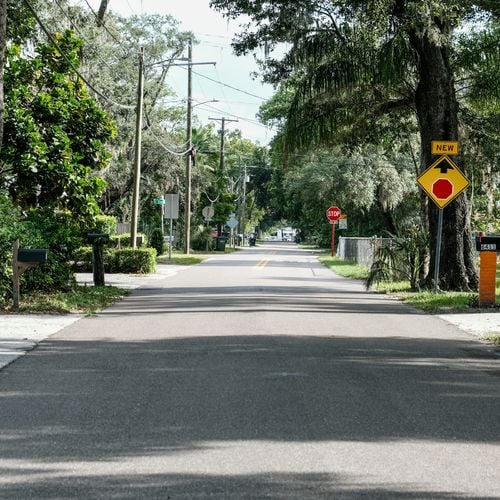
Between the last state route sign and the front door, plenty of Richmond area listings stop being anybody’s official responsibility. It is common in Powhatan, Goochland, western Hanover and the rural western edge of Chesterfield, and it is one of the few things that kills a loan two weeks before closing on a house that inspected perfectly.
A state road and a private road are different legal animals
Virginia is unusual: outside a handful of localities, the Commonwealth rather than the county maintains local roads, through the secondary state highway system. A new street does not join it automatically. Under Virginia Code section 33.2-334, the county governing body requests by resolution that the Commonwealth Transportation Board take a street in, and the Board may do so only if the street was built to its secondary street acceptance requirements.
Those requirements are published by VDOT as the Secondary Street Acceptance Requirements, or SSAR. The statute directs the Board to include connectivity with the existing and future highway and pedestrian network, provisions minimising stormwater runoff and impervious surface, and performance bonding with cost recovery fees. VDOT’s page records the history: the older Subdivision Street Requirements governed until 9 March 2009, the 2011 SSAR ran until 18 December 2024, and the current version took effect that day.
The short version: a road VDOT maintains was engineered, inspected, bonded and accepted. A private road was not necessarily any of those, and nobody is obliged to make it so later.
| Road in the secondary state system | Private road | |
|---|---|---|
| Who pays to repave it | VDOT, from state funds | The owners who use it, in shares set by an agreement if one exists |
| Built to a standard | Yes, to the SSAR in force when it was platted | Not necessarily, and no minimum applies retroactively |
| Snow clearing | VDOT, by priority route | Owners arrange and pay for it privately |
| Lender treatment | Routine | Conventional financing needs a recorded maintenance agreement, or the lender indemnifies Fannie Mae |
| Who you call about a washout | VDOT | Your neighbours |
The recorded maintenance agreement, and why your lender cares more than you do
Start with the baseline. Fannie Mae’s B2-3-01, General Property Eligibility, requires a mortgaged property to be readily accessible by roads that meet local standards, and lists properties that are not among the ineligible ones. That is the sentence a private road must get past.
The specifics live in B4-1.3-04, Site Section of the Appraisal Report, under Community-Owned or Privately Maintained Streets: where a property sits on such a street, Fannie Mae requires an adequate, legally enforceable maintenance agreement or covenant, recorded in the land records.
- responsibility for payment of repairs, including each party’s representative share
- default remedies if a party to the agreement fails to comply with their obligations
- the effective term, which in most cases should be perpetual and binding on any future owners
Two escape hatches sit alongside it. Where a state has statutory provisions defining owners’ responsibilities for maintaining a private street, no separate agreement is needed. And where there is no agreement, or one failing the three tests above, the lender may still sell the loan but must indemnify Fannie Mae against all losses from the street’s physical condition or from establishing or retaining access.
That indemnity clause is the reason deals die. A lender asked to carry exposure on a gravel lane it has never seen often declines rather than prices it, and you find out at underwriting rather than at contract. The same topic adds that a property should front a publicly dedicated and maintained street meeting community standards, and that the appraiser must address the marketability effect if it does not.
Raise the road on the first call with a lender, not the last. Our preferred lenders page lists people who have underwritten rural Central Virginia files and will tell you on day one.
When there is no agreement and five neighbours have to agree about a washout
This is the ordinary case. A 1970s subdivision of five or six lots was platted with a shared gravel lane, the deeds granted everyone a right to use it, and nobody wrote down who pays. Twenty years later a storm cuts a channel through the base course and crushes the culvert at the low end.
Without a recorded agreement there is no mechanism: no obligation to contribute, no way to compel a neighbour who never uses the lower half of the lane, no enforcement if someone agrees in April and does not pay in June. What happens is that the two households who cannot get their cars out pay for the whole repair, and the next buyer inherits the arrangement plus the grudge.
The fix is a recorded agreement signed by every benefited owner, with shares, a default remedy and a perpetual term. That is attorney work and takes weeks, not days, which is why you want to know before you are under contract on a thirty day close.
A right to drive on it is not the same as owning it
Two different things get called the road. An easement of access is a recorded right to cross someone else’s land to reach yours. Ownership of the roadbed is title to the strip of dirt, which on many older rural plats runs to the centreline for each abutting owner and on others sits entirely with one lot.
The distinction decides who may widen it, who may gate it, whether a neighbour can object to your contractor’s trucks, and whether a lender sees a permanent access right or an informal arrangement. An easement granting use without stating maintenance obligations grants exactly that. Read the recorded language, not what the seller believes; we set out how to find it in how to find easements on a Richmond property and what they limit.
Width matters. A twelve foot travelway with no turnaround is legal, and also means a fire engine, a moving truck and a propane delivery each become a negotiation. Buying land rather than a house, the road belongs in the same due diligence pass as soils and perc testing, covered in what to check before you build on acreage and our step by step guide to building rural. These properties almost always come with well and septic too, and the drainfield and the road often want the same ground.
Snow, school buses and the trash truck
VDOT does not plough a road it does not maintain. In a normal Richmond winter that is a shrug. In the winter that drops eleven inches on a Sunday, whoever owns the tractor decides when you get out, and if nobody owns one, a contractor already booked four days deep does.
School transport is the question people forget. County school divisions generally will not send a bus down a road that is not in the state system or lacks a safe turnaround, which can mean a pickup point at the state road and a walk in the dark in February. Ask the division about the specific address, in writing, before you write the offer. Refuse collection, propane deliveries and septic pump-out trucks raise the same weight and turnaround question.
What to check before you write the offer
- Is the road in the state secondary system? Get it in writing and verify with VDOT’s residency office for the county.
- Is there a recorded road maintenance agreement? Ask for the instrument with deed book and page number, not a description of one. If everybody just chips in, there is no agreement.
- Does it meet the three lender tests? Shares, default remedy, perpetual term binding future owners.
- Who owns the roadbed? Read the plat and the deed. Centreline ownership, a single owner with rights of way, and an association parcel are three different futures.
- How many doors use it, and how far in are you? The last house pays most and has least leverage.
- What has been spent in five years? Ask for invoices. A lane with no repair bill is either new or overdue.
- What do the culverts look like after rain? Visit in weather. Drainage tells you more than surface does.
- Will your lender finance it? Ask before the financing contingency runs out.
Get the Richmond closing timeline checklist
All of it has to happen inside a contingency window of usually thirty days or less, and an agreement pulled from the clerk’s office on day twenty-five is one you have no time to fix. Our downloadable Richmond closing timeline checklist maps the sequence day by day, from ratified contract through title work, survey, appraisal and the financing contingency, so the road questions land while you can still act. Ask on our contact page with “closing timeline checklist” in the message. Still looking? Our Richmond homes with acreage search is where most of these turn up.
Questions buyers ask about private roads
Can a private road be taken into the state system later?
Only if it is brought up to the Secondary Street Acceptance Requirements in force and the county passes a resolution asking the Commonwealth Transportation Board to accept it, under Virginia Code section 33.2-334. On a gravel lane that means regrading, drainage, base and surface work at the owners’ expense. Possible, rarely cheap, never quick.
Does a private road lower the sale price?
We have no published Central Virginia figure isolating that and will not estimate one. The mechanism is observable: it narrows the buyer pool to those whose lender will finance it, and Fannie Mae tells appraisers to address the marketability effect where a property does not front a publicly maintained street.
Is a homeowners association better than a road maintenance agreement?
Usually simpler, because an association already has assessment authority, a collection mechanism and a budget, which maps onto the shares, default remedy and perpetual term a lender wants. It also means dues. Read the declaration to confirm the road is association property and that maintenance sits in the budget rather than a future special assessment.
Can I be made to pay for repairs I never agreed to?
That depends on the recorded instruments touching your parcel, which is a question for a Virginia real estate attorney rather than a blog post. The answer lives in the recorded easement, covenant or declaration, not in what the neighbours believe, so get copies and have them read before you remove contingencies.
The title commitment says access is insured. Is that the same thing?
No. Insured legal access means you have a right to reach the property. It says nothing about who maintains the surface, in what shares, or what happens when someone refuses to pay. That is why Fannie Mae asks for a recorded maintenance agreement on top of access.
What is the difference between a shared driveway and a private road?
Largely how many doors it serves and how the records describe it. A two-owner shared driveway and a nine-lot lane raise the same legal questions, but the lane is likelier to need a formal agreement with shares, and likelier to have a culvert and a turnaround somebody must maintain.
Can the seller just record an agreement before closing?
Only with every benefited owner’s signature, which is the hard part; one holdout among five stops it. If the road is why your financing is in doubt, raise it in week one so there is time to collect signatures or walk away inside your contingency.
Ask the road questions first
In the right sequence none of this is dramatic. Use our downloadable Richmond closing timeline checklist so the maintenance agreement, the plat and the lender’s answer arrive while your contingencies are open. Request it on our contact page with “closing timeline checklist” in the message.