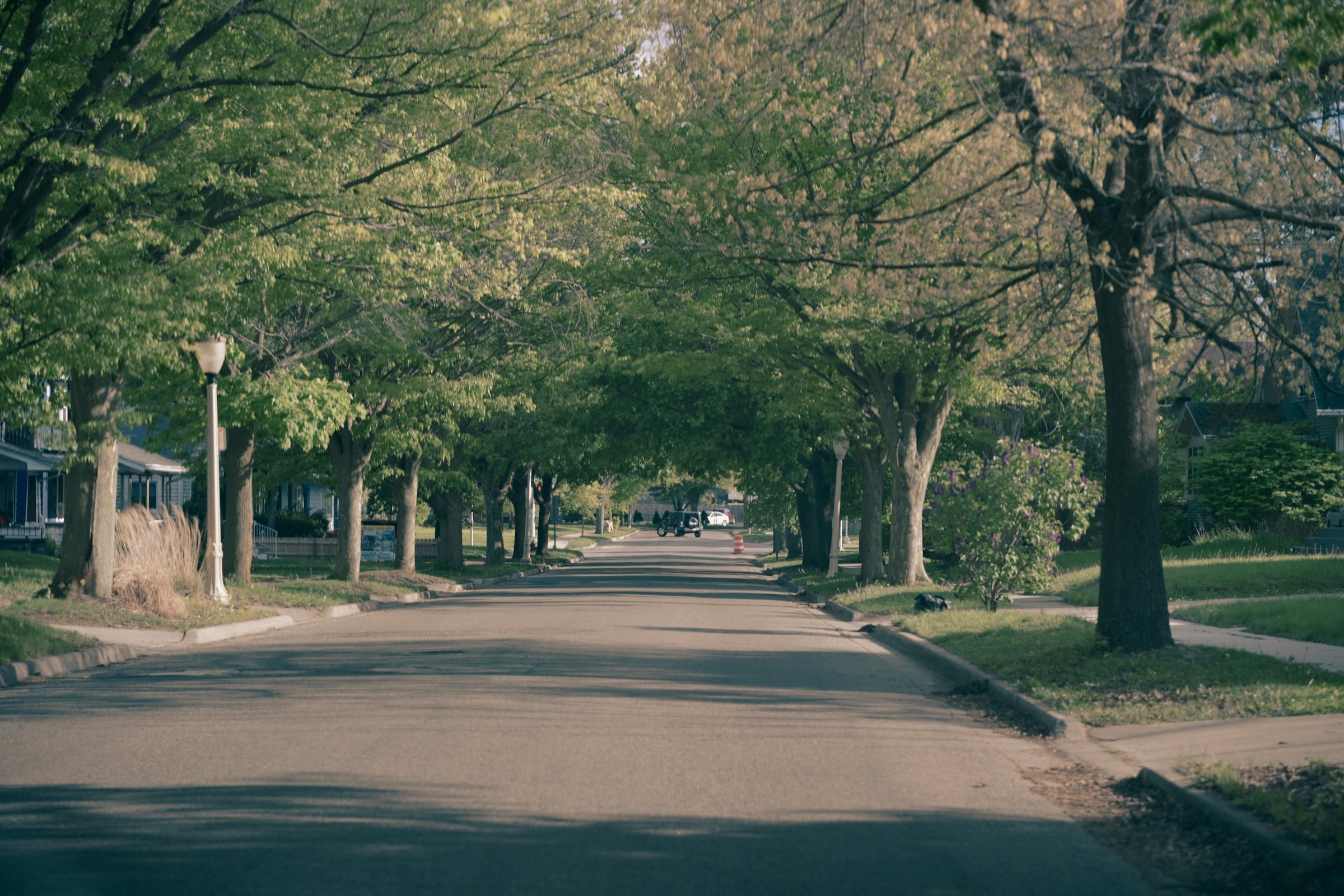
Richmond in late August is a fair test of a street. Two neighborhoods a mile apart, the same house, the same price, and one of them is ten degrees more pleasant to stand on at three in the afternoon because somebody planted willow oaks along it ninety years ago.
Buyers ask for this constantly and it is one of the hardest things to search for, because no portal has a filter for it. There is also no public street-by-street canopy map for the Richmond region that we can hand you. So this list does not pretend to measure canopy. It uses three things you can verify yourself: when the streets were platted, which park the neighborhood touches, and how big the lots are. Old streets, park edges and deep lots are where the grown-in trees are, every time.
They are grouped by side of the river rather than ranked, because ranking shade is not a thing anyone can do honestly.
Windsor Farms, Richmond
Developed from the 1920s on the old Windsor estate, Windsor Farms has the deepest canopy in the city, and it is not an accident: the plan put large lots along curving streets and the street trees went in with the houses. The neighborhood runs down to the James River bluff beside the Agecroft and Virginia House grounds, which adds a block of mature hardwood that will never be built on. Wrong for anyone with a budget under roughly $800,000, anyone who wants a house built this century, and anyone who wants to walk to a coffee shop.
Ginter Park and the rest of North Side, Richmond
Laid out from the 1890s as one of Richmond’s first streetcar suburbs, Ginter Park was built with avenue-width streets and a deliberate planting plan, and Seminary and Hawthorne Avenues still show it. The wider North Side benefits from Joseph Bryan Park at its northern edge, one of the larger properties in the City of Richmond parks system. This is the best value on the list by a distance. Wrong for buyers who want restaurants and bars within a five-minute walk; it is residential and it is quiet, which is the point.
Forest Hill and Westover Hills, Richmond
Forest Hill is named for the park, and the park is the reason: a large block of mature hardwood on the south bank that anchors the whole neighborhood. Next door, Westover Hills was laid out in the 1920s and 1930s with generous setbacks that let the street trees get large. Both sit against the James River Park System, which is the single biggest reason south-bank Richmond reads greener than its lot sizes suggest. Wrong for buyers who need level ground, a two-car garage, or a short drive to the Short Pump job cluster.
Stratford Hills, Richmond
Mid-century, wooded, and built on lots that were cut into the trees rather than cleared of them. Stratford Hills backs onto the Huguenot Flatwater end of the river park, and the housing stock is the kind of brick ranch and split-level that sits low under a tall canopy. Wrong for anyone who wants walkability or a neighborhood center; you will drive for everything.
The Museum District, Richmond
Narrow lots, but the street trees on Hanover, Park and Grove Avenues are old and continuous, which is a different kind of shade: you get it on the sidewalk and the front rooms rather than over a back garden. The Museum District is the pick for someone who wants canopy and walkability in the same ZIP code. Wrong for anyone who needs off-street parking or a real yard, and for anyone allergic to street-tree root heave in an old sidewalk.
Bon Air, Chesterfield County
Bon Air started in the 1870s as a resort village reached by rail, and the old core off Buford Road still carries original pines and oaks on lots far bigger than anything Chesterfield County plats today. It is the only genuinely mature-canopy neighborhood on the Chesterfield side at a normal family price. Bon Air is also the clearest illustration of a trade-off: much of the old section has no sidewalks and no streetlights, which we covered in our post on which Richmond-area neighborhoods actually have sidewalks and streetlights. Wrong for buyers with young children who want to walk to a bus stop on a lit sidewalk.
Lakeside, Henrico County
Older Henrico at its best: 1940s and 1950s houses on deep lots, with the botanical garden and a run of county parkland close by through the Henrico Recreation and Parks system. Lakeside gives you grown-in trees and a garage, which almost nothing else on this list does. Wrong for buyers who want open-plan interiors without renovating, and for anyone expecting Short Pump-grade retail.
We will set a saved search across exactly these seven
There is no canopy filter on any search portal, so the practical move is a saved search across these specific areas with your price band and bed count on it, and then we look at the trees. Tell us the budget and we will build it for Windsor Farms, North Side, Forest Hill, Westover Hills, Stratford Hills, the Museum District, Bon Air and Lakeside, and send you new listings the morning they hit. Start here, or browse everything currently on the market first.
What these areas cost right now
Closed single-family sales, August 2026
| Locality | Median sold price | Year over year | Days on market | Months of supply |
|---|---|---|---|---|
| Richmond City | $403,500 | down 5.3% | 26 | 1.4 |
| Chesterfield County | $453,975 | up 0.9% | 22 | 1.9 |
| Henrico County | $425,000 | up 7.9% | 18 | 1.6 |
| Richmond Metro | $450,000 | up 3.7% | 22 | 1.8 |
| Median price per square foot | [DATA NEEDED: median price per square foot, August 2026, by area] | |||
Closed single-family sales, August 2026, from Central Virginia Regional MLS, published in the Richmond Association of REALTORS housing reports, current as of 10 September 2026. These are locality-wide medians, not neighborhood figures. Windsor Farms and Lakeside are both in this data and they are nowhere near each other on price; a city median tells you about the city, not about a street.
The honest version: Windsor Farms trades well above the Richmond City median, the Museum District somewhat above it, and North Side, Forest Hill, Westover Hills and Stratford Hills straddle it. Bon Air and Lakeside both sit close to their county medians. We can pull neighborhood-level closed comparables for any of them on request, which is the only way to get a real number for a place this specific.
Where the canopy is not, and why that is fine
The newer large-lot subdivisions are the mirror image. Hallsley, Harpers Mill and Twin Hickory all have street trees and buffers, and they are all 10 to 20 years away from doing what Seminary Avenue does. That is not a criticism, it is a timeline. If you want a new house and a grown-in street you will have to pick one, and most buyers who say they want shade actually want a yard, which is a different search; we wrote that one up as where you can still get a real yard without an HOA.
Two practical notes. Large hardwoods over a roofline come up in underwriting, so read our guide to how Richmond homeowners insurance is priced before you fall for a 90-foot oak. And Chesterfield publishes its park inventory through Chesterfield Parks and Facilities, which is the quickest way to see what green space a Chesterfield address actually backs onto.
How to check any address yourself in ten minutes
Pull the parcel in your locality GIS viewer and note the lot size and the plat date. Then look at the street in a mapping tool with a summer image, not a February one, because a bare-branch image of Hanover Avenue is deeply misleading. Then drive it at about 3pm on a hot day. The third step is the one that decides it, and it is free.
Questions we are getting about this one
Is there a public map of tree canopy by Richmond neighborhood?
Not one we can point a buyer at street by street. Localities do canopy assessments for planning purposes, but the outputs are not published as an address-level lookup. That is exactly why this list uses proxies you can check yourself rather than a number we cannot show you.
Does mature tree cover actually lower a cooling bill?
Shade on a west-facing wall and roof reduces afternoon heat gain, which is real, but the size of the saving depends on your insulation, window glazing and HVAC age far more than on the trees. Treat canopy as a comfort and character feature, not an energy strategy.
What does a large tree near the house cost to maintain?
Budget for an arborist assessment at purchase and periodic pruning after that. Large hardwoods over a roofline are the single most common reason a Richmond home insurance underwriter asks for photographs, so raise it with your agent before binding a policy.
Are big trees a problem for homeowners insurance?
They are not automatically, but overhanging limbs, visible deadwood and trees leaning toward the structure all come up. How Richmond premiums are set is covered in our guide to homeowners insurance pricing, linked in this post.
Which Richmond-area neighborhoods have the least mature canopy?
Recent large-lot and production subdivisions in western Chesterfield and northwestern Henrico, where the site was cleared and replanted. The street trees are there, they are simply 10 to 20 years from doing anything.
Do tree ordinances stop me removing a tree in my own yard?
Rules differ by locality and are usually tied to development, buffers, historic districts and public rights of way rather than to individual back-garden trees. Check with your county or city before removing anything in a buffer, an easement or a historic district.
Does canopy affect resale?
On a like-for-like house, a grown-in street reads better in photographs and in person, which helps. It is not a price premium you can isolate in the data, and it will not overcome a bad floor plan or a busy road.
What is the fastest way to check an address before I visit?
Open the locality GIS parcel viewer for lot size, then look at the street in a mapping tool set to a summer image, then drive it yourself at about 3pm in July. The third step is the one that actually settles it.
Get the saved search for these seven neighborhoods
Send us your price band and we will set a live search across Windsor Farms, North Side, Forest Hill, Westover Hills, Stratford Hills, the Museum District, Bon Air and Lakeside, so the grown-in streets come to you instead of the other way round. Set up the search, or meet the agents who cover these areas.