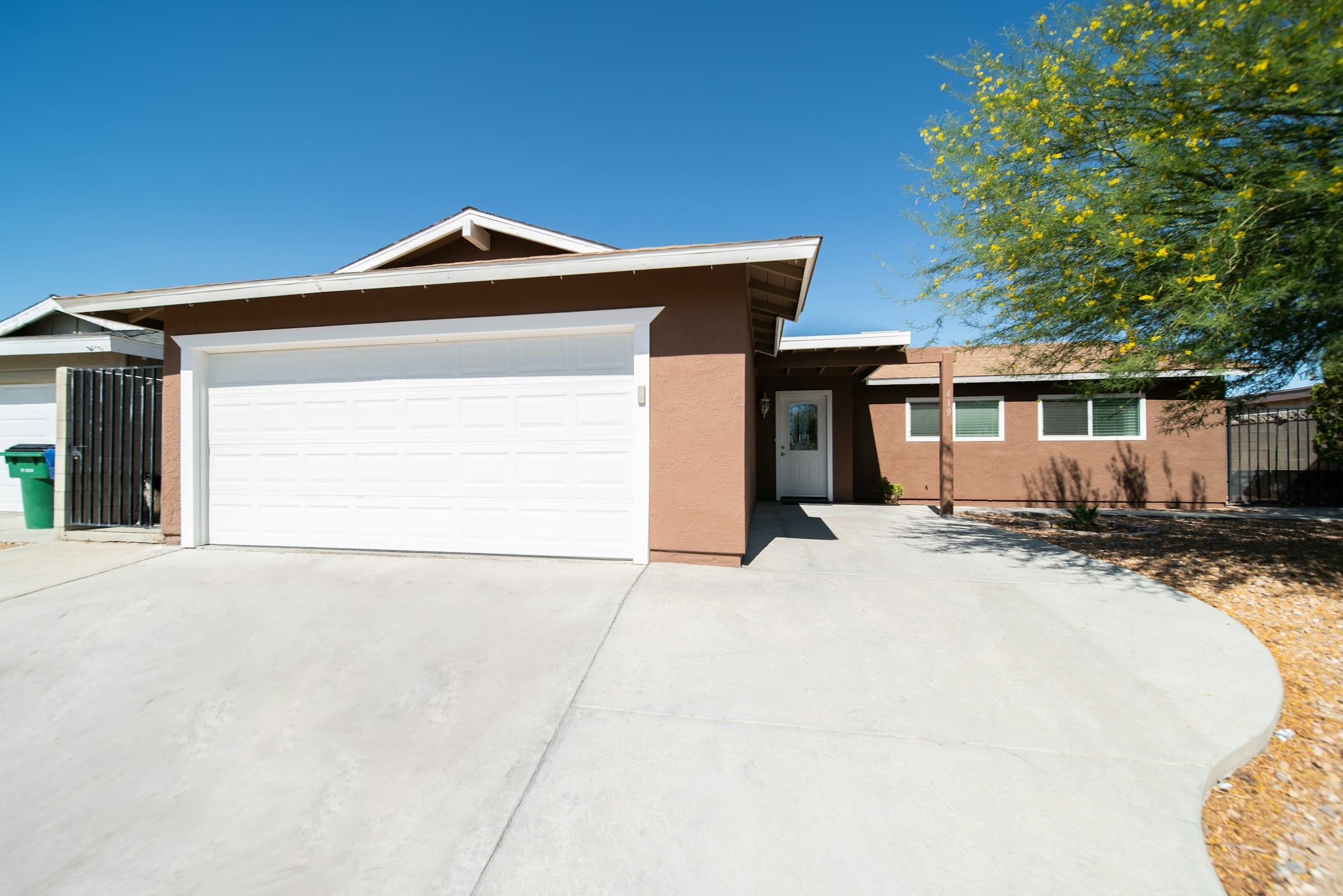
Check three things on any driveway before you offer: whether the surface is holding up, where the water goes when it rains and who has the legal right to use and maintain the strip of ground you drive on. The surface is the easy one. The legal right is the one that surprises buyers, because a shared driveway or a private road can come with an easement, a maintenance duty or both, and none of that shows up in a showing.
This guide covers asphalt, concrete and gravel, how to read slope and drainage, what Virginia’s home inspector rules cover for driveways and how shared driveways and easements work under the Code of Virginia. It is general information, not legal advice, and a Virginia real estate attorney or your title company should read the recorded documents for the home you are buying.
What a Virginia inspector looks at on a driveway
Under 18VAC15-40-130 (read on the Virginia Law site in November 2026), a home inspector inspects walkways, grade steps, patios and driveways. The same item excludes fences and privacy walls. The section also covers vegetation, trees, grading, drainage and retaining walls next to the building, and it limits the job to readily accessible components and readily observable defects.
That has limits you should plan around:
- The inspector looks at the surface and what the report says about its condition. A report is not a paving estimate.
- The inspection does not tell you who owns a shared driveway, whether an easement is recorded or who pays to fix it. Those answers sit in the deed, the plat and the title work.
- Snow, leaves or parked cars can hide the surface. The report should note what could not be seen.
Our Richmond home inspection guide explains the inspection window, and our guide to outbuildings, sheds, detached garages and carports is the next stop if the driveway leads to one.
Asphalt, concrete and gravel: what to look for on each
No cost or lifespan figures appear here, because we did not find a sourced Richmond-area figure to report. What you can do is read the surface for the failure signs each material shows.
- Asphalt. Look for web-like cracking, which points to a failing base, and for sunken patches, ruts at the wheel path and crumbling edges. Dark, fresh sealer can cover cracks, so look at the edges and the low spots as well as the center.
- Concrete. Look for panels that have shifted or tilted, cracks that run through a slab and surface flaking. Check whether the joints between panels are open, since open joints let water in. A tilted slab can be a drainage or soil problem, not only a surface one.
- Gravel. Look for bare ruts, loose stone washed into the road or the yard, and a crown that has flattened. Check the edge where gravel meets pavement or lawn. Gravel needs regrading and added stone from time to time, so ask who does that and how often.
If you are shopping in Powhatan, Goochland or Hanover, long gravel drives are common on larger lots. Our Richmond homes with acreage page is one place to see how often a long driveway comes with that kind of property, and the county pages for Powhatan, Goochland and Hanover show listings in each area.
Slope and drainage: where the rain goes
A driveway that holds water is a driveway that cracks, freezes and floods a garage. Stand at the top and the bottom in a dry spell and look at three things: which way the surface slopes, where a downspout empties and whether the water has somewhere to go that is not a neighbor’s yard or the house.
We did not find a Virginia rule for maximum driveway slope on a private lot in the sources we read, so we do not give one. One local number you can use is for the ground around the house. Henrico County’s Public Works Design Manual (version V4.2026.01, Section 3.09, read in November 2026) states that building permit lot grading requires at least 6 inches of fall over the first 10 feet from all sides of the house, then at least 1% fall to the property line. That is Henrico’s rule for permitted lot grading, not a rule for driveway slope, but it shows the direction water should move away from the foundation.
The same manual states a minimum roadside ditch depth of 18 inches, and calls for driveway pipes (culverts) to be installed in roadside ditches under VDOT standards. If a home sits along a ditch road, look at the culvert under the driveway. A crushed, buried or clogged pipe sends water over the drive or into the yard. Our guide to gutters, downspouts and lot grading covers the rest of the water path around the house.
Send us the address and we will walk through the plat and survey with you
If the home you are looking at has a shared driveway, a long private drive or a driveway that crosses a neighbor’s lot, send us the address. We will help you read the recorded plat and any survey for the driveway line, so you can ask the right questions before your contingency window ends.
Shared driveways, private roads and easements in Virginia
A shared driveway means two or more owners use the same strip of ground. The right to cross someone else’s land is usually an easement, recorded in a deed or on a plat. Several sections of the Code of Virginia, Title 55.1, Chapter 3, Article 1 (read on the Virginia Law site in November 2026) set basic rules. Here they are in plain words:
| Code section | What it says in plain words | Number to know |
|---|---|---|
| 55.1-304 | An easement can be moved or changed by written consent recorded with the clerk. Without consent, the landowner can petition the circuit court, which may approve it if it does not materially harm the easement holder | The landowner pays costs, except attorney fees |
| 55.1-305 | The person using an easement can only use it in ways that fit its purpose. The landowner cannot create unreasonable interference. Fences, gates and cattle guards are not treated as interference under this section | Violations may be treated as a private nuisance |
| 55.1-305.1 | The landowner whose property carries a private easement may set reasonable use rules, including a speed limit | Damages are the greater of actual damages or $500, plus fees |
| 55.1-308 | A private road serving a subdivision can be dedicated for public use, but only with written consent from every lot owner it serves and anyone with a covenant or easement over it, recorded with the circuit court clerk | Applies to subdivisions of 50 or fewer lots |
We read these through the Virginia Law page and summarize them in our own words, so have an attorney confirm how they apply to a specific property. The page did not address driveways by name. It addresses easements and private roads, which is what most shared driveways are built on.
Notice what is not in the table: a rule that says who pays to repair a shared driveway. The sections we read did not set one. That is usually written in a recorded road maintenance agreement, in the deed or in subdivision covenants, and if none exists, owners can end up in a dispute. Ask for the recorded document and read it for four things: the width and location of the easement, who maintains the surface, how costs are split and how a dispute is handled.
Driveways that meet a state road or a private road
A driveway that connects to a state-maintained road is a private entrance. The Virginia Department of Transportation’s land use permits page (read in November 2026) says work on a VDOT highway needs written permission through a land use permit, and lists construction of private and commercial entrances among the covered activities. Ask the seller whether the entrance was built under a permit and, if the entrance looks new, whether a permit was issued.
VDOT’s street rules in 24VAC30-91-110 (read in November 2026) state that private entrances must be designed and built according to the Subdivision Street Design Guide, and that VDOT maintains only the drainage system inside the street’s dedicated right-of-way. The section does not say who maintains a private entrance, so treat the apron and the pipe under it as the homeowner’s to check until you read otherwise. A road that is private, not state-maintained, falls back on the recorded agreements described above.
Questions to ask before you write an offer
- Is the driveway entirely on the lot, or does it cross a neighbor’s land? A current survey answers this.
- Is there a recorded easement or road maintenance agreement? Ask for a copy, and ask your title company to confirm it is recorded.
- Who has repaired or paved the drive in the past, and who paid? Written records beat memory.
- Where does the water leave the drive in a heavy rain? Ask the seller, then check yourself after the next storm if you can.
- Is there a gate, a cattle guard or a shared gate code? Those are covered by the easement rules above and are worth reading about.
- If the home has a long private drive, who plows or clears it? The answer affects winter access.
Ask your buyer agent to include these in your written requests during the contingency window. A saved search for homes that already have a clean, single-owner driveway can also narrow the list; the property search is a place to start. In Chesterfield County, the county hub lists the communities we cover.
Send us the address before you make an offer
If the driveway is shared, private or crosses another lot, send us the address and we will help you read the plat and survey for the driveway line before your contingency window ends.
Frequently asked questions
Do I need a permit to repave or widen a driveway?
It depends on the locality and on whether the work touches a public right-of-way. For an entrance onto a state-maintained road, VDOT’s land use permit page says work on a VDOT highway needs written permission. For work on your own lot, ask the building or public works office of the city or county where the home sits before you plan or sign a contractor.
Which documents show whether a shared driveway has an easement?
Look at the deed, the recorded plat and the title commitment your title company prepares. A recorded easement or road maintenance agreement will be referenced there by book and page. Ask your title company for copies and ask a Virginia real estate attorney to read them. This is general information, not legal advice.
What does Henrico’s lot grading rule look like in real life?
Henrico’s Public Works Design Manual (V4.2026.01, Section 3.09) calls for at least 6 inches of fall over the first 10 feet from the house on permitted lots. That works out to half an inch per foot, or 5%, then at least 1% to the property line. Use a level and a tape measure at a corner of the house to see whether the ground at least slopes away.
Where do I go for a private entrance permit on a state road?
VDOT’s land use permits page says most land use permits are available at local VDOT offices, and that its guidance manual has an appendix on permits for private entrances. Contact the VDOT office for the county where the home sits. The page did not list fees, so ask the office.
Should I get a survey for a home with a shared driveway?
A survey shows where the driveway sits against the lot lines and whether it crosses a neighbor’s land. Ask your title company and attorney whether the survey and the recorded easement match the driveway as used. If you send us the address, we can go through the recorded plat with you.
Who maintains a driveway culvert or pipe at the road?
VDOT’s 24VAC30-91-110 states that VDOT maintains only drainage inside the dedicated right-of-way of a street it takes over, and it does not say who maintains a private entrance. Ask the seller and the locality who has handled the pipe in the past, and have the inspector note its condition.