Relocating to Richmond VA from Greenville: Cost of Living, Neighborhoods & What to Expect
A larger metro and a deeper stock of old houses – and a downtown river park that runs actual whitewater
Moving to Richmond, Virginia from Greenville, South Carolina is an unusually gentle relocation, because you are not changing regions, climates or tax categories so much as changing scale. Greenville is one of the most admired small-city downtown revivals in the country, and anyone leaving it should know that going in. What Richmond adds is size: a significantly larger metro, the seat of Virginia’s state government, a broader and more diversified employment base, and a far deeper inventory of pre-1940 housing than the Upstate ever built. The two cities share something genuine, which is a celebrated river park in the middle of downtown, though Richmond’s James River runs actual whitewater rapids where Greenville’s Reedy runs a waterfall. Climate is broadly similar with Richmond marginally cooler in winter. Both South Carolina and Virginia levy an income tax, and both tax vehicles as personal property, so Virginia’s vehicle bill is a familiar concept arriving through a different mechanism. You trade a thirty-minute drive to the Blue Ridge escarpment for a two-hour drive to the Blue Ridge and a two-hour drive to the Atlantic. Buyers researching moving from Greenville to Richmond VA, Richmond vs Greenville cost of living and Richmond VA neighborhoods will find the practical detail below. The Mission Realty Team serves Richmond, Henrico, Chesterfield, Goochland, Hanover and Powhatan.
Table of Contents
- Why People Make the Greenville to Richmond Move
- Climate and Geography: The Upstate to the Fall Line
- Housing Stock: Craftsman and New Build to Bungalow and Rowhouse
- Neighborhood Analogues: The West End to Church Hill
- Commuting and Driving Culture
- Taxes, Registration and Inspection
- The Richmond Job Market
- Food, Culture and the Outdoors
- What to Do First: A Practical Relocation Sequence
- Frequently Asked Questions
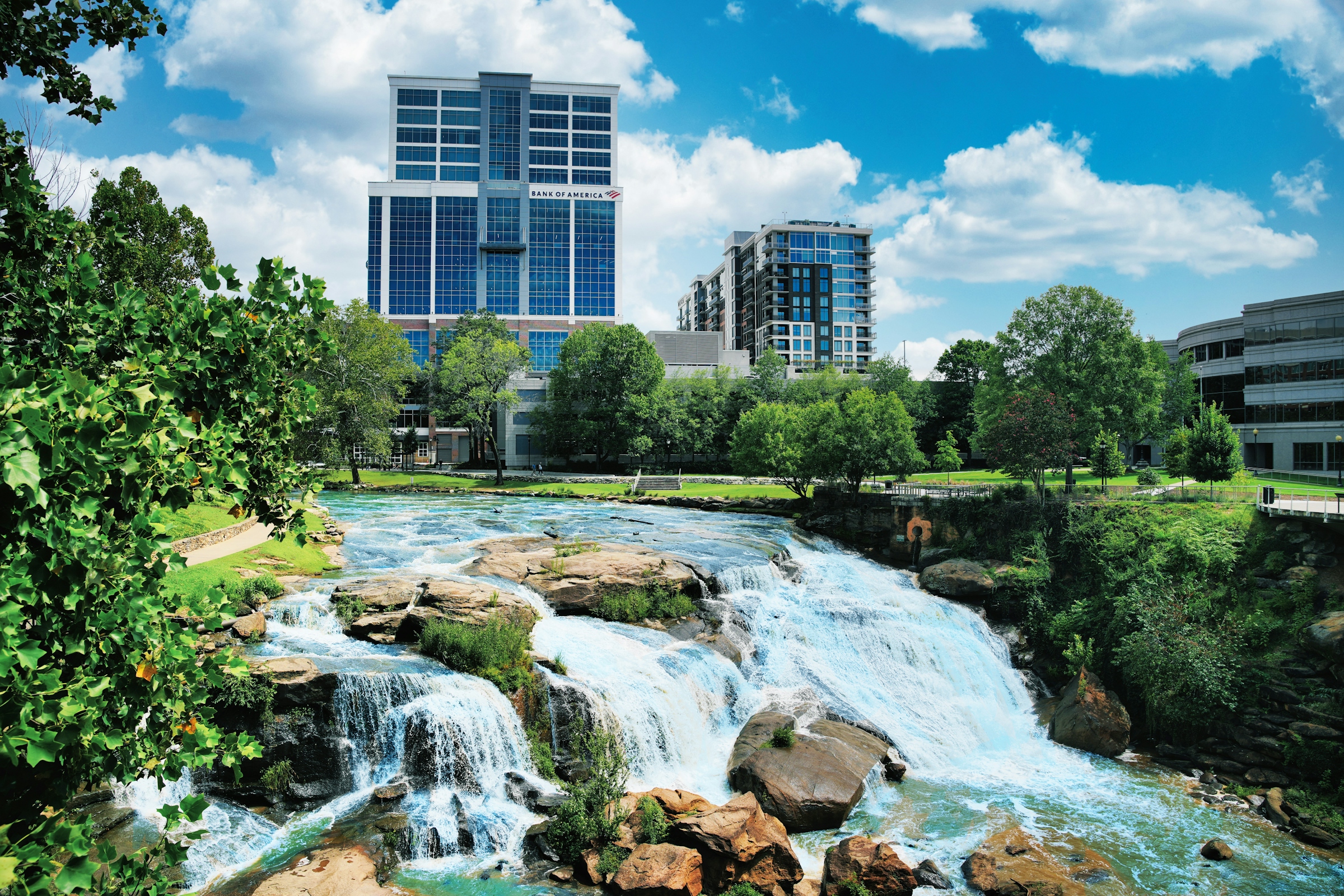
The Reedy River dropping over its falls in the middle of downtown Greenville, with glass towers behind the tree line and the Liberty Bridge curving overhead, is one of the best pieces of urban design in the Southeast. Greenville earned its reputation honestly, and if you are leaving it we will not pretend you are escaping somewhere. You are trading a small city that does a great many things unusually well for a mid-size one that does more things, at more scale, with two centuries of housing stock underneath it.
Richmond sits on the James River at the fall line, where the hard rock of the Piedmont steps down to the sandy coastal plain. That single fact explains most of the city: it is why the rapids are here, why the railroads followed, and why so many old neighborhoods are stacked around a river gorge. Washington, DC is roughly two hours north on I-95, the Atlantic roughly two hours east, and the Blue Ridge roughly two hours west.
We are a licensed brokerage, so you will not find median sale prices, days-on-market figures or cost-of-living percentages here. Those numbers move and we will not publish them as current fact. For a real picture of what your budget buys in any neighborhood below, call the Mission Realty Team at (804) 601-4960.
Why Do People Move From Greenville to Richmond?
Career reach is the reason we hear most often. Greenville’s economy is strong but concentrated around advanced manufacturing, automotive supply and engineering services. If your field sits inside that cluster, Greenville is excellent. If it does not, the local ladder can run out of rungs. Richmond’s base is broader – healthcare, finance and insurance, state government, corporate headquarters and logistics – so there are more places to go next without moving again.
The second reason is the housing. Greenville has lovely craftsman bungalows and a strong mid-century ranch belt, but the city was not large before the postwar era, so genuinely old houses are limited in supply. Richmond was a major nineteenth-century city and built like one, so brick rowhouses, 1915 Foursquares and whole neighborhoods of front porches are not confined to a few blocks.
The third is East Coast position. Richmond puts Washington about two hours north, with Amtrak service continuing to Philadelphia and New York. Greenville is oriented toward Atlanta and Charlotte; Richmond is oriented up the Northeast corridor.
Climate and Geography: The Upstate to the Fall Line
This is the easiest part of the move, because the two climates are close relatives. Both cities get hot, humid summers with fast afternoon thunderstorms, long and genuinely pleasant autumns, short winters, and an early spring with a heavy pollen load. If you already plan around July humidity and watch the radar in the afternoon, you are prepared. Richmond sits farther north, so winters run marginally cooler with a few more freezing nights. Snow arrives occasionally rather than reliably, and the characteristic hazard is freezing rain and sleet, which coats trees and power lines and brings down limbs, so plan for a possible short outage. Greenville has its own cold snaps and ice, so this is a familiar category rather than a new one.
Geography changes more than weather does. Greenville sits at the foot of the Blue Ridge escarpment, and Table Rock, Caesars Head, Jones Gap and Paris Mountain are close enough to be a Saturday morning decision. Richmond sits at the fall line, so the land is comparatively flat away from the river, with real relief only where neighborhoods drop toward the James. The Blue Ridge and Shenandoah National Park are roughly two hours west, a day trip rather than a morning one. The compensation is on the other side of the compass: Virginia Beach and the Atlantic are roughly two hours east, with the Chesapeake Bay, the Northern Neck rivers and the Eastern Shore closer still.
Housing Stock: Craftsman and New Build to Bungalow and Rowhouse
Greenville’s inventory clusters in three groups: craftsman bungalows close in, a very large mid-century ranch belt, and a heavy volume of newer construction pushing toward Simpsonville, Five Forks, Greer and Travelers Rest. Vinyl and fiber-cement siding are common on the new stock, foundations are frequently slab or shallow crawl space, and the median house is newer than most buyers assume.
Richmond’s inventory is older and stranger. The characteristic types are the bungalow, the American Foursquare, the Colonial Revival, the attached brick rowhouse of the Fan and Church Hill, and an enormous postwar belt of brick ranches and Cape Cods across inner Henrico and Chesterfield. Brick is the default exterior in a way it is not in the Upstate, for both historic and mid-century housing. Full basements exist but are not the norm; ventilated crawl spaces are, and they are the biggest single change to your inspection list.
Your bungalow instincts transfer well, since the Greenville craftsman and the Richmond bungalow are cousins with the same porch and the same original systems waiting to surprise you. Brick adds its own vocabulary of mortar repointing, spalling and masonry moisture. If you want the familiar, it exists: western Henrico around Short Pump and Wyndham, western Chesterfield along the Route 288 corridor, and the edges of Hanover and Goochland all read much like Simpsonville.
Neighborhood Analogues: Where Greenville Maps Onto Richmond
If you love the West End or North Main – walkable, central, older houses, restaurants within a few blocks – look at Church Hill, the Fan or Scott’s Addition. Church Hill sits on a bluff above the James with Libby Hill Park and one of the best views in the city, and it holds Richmond’s oldest housing. The Fan is the signature historic district, a large grid of Victorian and early-twentieth-century rowhouses beside VCU with bars and restaurants woven through it. Scott’s Addition is a former industrial district converted to breweries, apartments and new condominiums, still filling in.
If you love Augusta Road – established, leafy, family-oriented, a mix of house sizes, a walkable commercial node – look at the Museum District or Bellevue. The Museum District sits beside the Virginia Museum of Fine Arts and is a quieter version of the Fan with more families. Bellevue in Northside is a 1920s bungalow and Foursquare grid with a compact strip on MacArthur Avenue. Forest Hill on Southside works if you want a park at the end of the street.
If you live in Simpsonville or Five Forks, look at Short Pump and Wyndham in western Henrico, or Midlothian in Chesterfield, which offers a comparable profile south of the James with its own school division and tax rate. If you want acreage, look at Goochland, Powhatan and western Hanover, where larger parcels and some well and septic properties sit within a reasonable drive of the city.
Commuting and Driving Culture
Richmond is a larger metro, so expect somewhat more traffic, but it remains an easy driving city by East Coast standards. Getting from Northside, the Fan or Forest Hill to downtown or the VCU Health campus is typically well under twenty minutes outside peak hours.
The network is straightforward: I-95 north to south, I-64 east to west, I-195 and the Downtown Expressway through the center, and I-295 arcing around the north and east. The one real constraint is the James River, because crossings are limited and peak traffic funnels onto a handful of bridges. If your home and your office are on opposite banks, that fact will shape your day more than mileage will. Greenville’s I-85 and I-385 pattern is a reasonable mental model, with the river added as a complication the Upstate has no equivalent for.
Richmond has toll roads, specifically the Downtown Expressway and the Powhite Parkway, so get an E-ZPass in your first week. Transit is modest but real: GRTC operates the Pulse bus rapid transit line along Broad Street between Willow Lawn and Rocketts Landing plus a local bus network, genuinely useful along that corridor and thin elsewhere. Close-in neighborhoods are meaningfully walkable, and if you loved the Swamp Rabbit Trail, the Virginia Capital Trail is the direct analogue, running from downtown Richmond to Jamestown.
Taxes, Registration and Inspection
Good news first: you are not adding a category of tax you did not already have. South Carolina and Virginia both levy a state income tax, so the change is one of structure and rate rather than kind. Both states adjust brackets over time, so verify current rates with the Virginia Department of Taxation and have a tax professional model your actual Virginia take-home before you accept an offer.
Real estate tax runs on the same basic model in both states, with local assessment and locally set rates, but South Carolina’s assessment ratios treat owner-occupied primary residences very differently from other property and Virginia does not use that structure. Do not extrapolate from a Greenville County bill. Rates also differ meaningfully across the City of Richmond, Henrico, Chesterfield, Goochland, Hanover and Powhatan, and that spread is a real part of your monthly payment.
Now the vehicle tax, which ambushes most newcomers to Virginia but probably not you. Virginia cities and counties assess an annual personal property tax on vehicles, including cars, trucks, motorcycles, boats and trailers, based on assessed value and billed by the locality where the vehicle is normally kept. South Carolina already taxes vehicles through the county, so the concept is familiar. What changes is the mechanism: in South Carolina the county bill is tied to your registration renewal cycle, while in Virginia DMV registration and local personal property tax are two separate processes with separate bills, and failing to register with your new locality produces penalties even when your DMV registration is current. Rates, assessment methods and any relief programs differ by locality and change year to year, so verify current rates directly with the commissioner of the revenue where you land. Virginia also requires an annual vehicle safety inspection, which South Carolina has no general equivalent for.
The Richmond Job Market
Healthcare is the largest sector. VCU Health operates an academic medical center and Level I trauma center downtown, and Bon Secours and HCA Virginia both run multiple hospitals across the region. If you worked for Bon Secours St. Francis in Greenville, that is an unusually clean transfer since Bon Secours operates in both markets, and Prisma Health experience translates well into any of the three Richmond systems.
Finance and insurance is the second pillar and has no Greenville equivalent at this scale. Capital One has a very large presence in the western suburbs, the Federal Reserve Bank of Richmond is headquartered downtown, and a deep layer of banking, insurance, asset management, compliance and analytics work surrounds them. Corporate headquarters including CarMax and Dominion Energy support finance, legal, marketing and IT roles that in Greenville would often mean commuting to Charlotte or Atlanta. State government is the third pillar: Richmond is Virginia’s capital, so the General Assembly, the executive agencies and the surrounding policy and consulting ecosystem are downtown rather than two hours away in Columbia. Logistics rounds it out, driven by the I-95 and I-64 crossroads, the Port of Virginia’s inland connections and Richmond International Airport.
Be honest about the gap in the other direction. Richmond has no counterpart to Greenville’s automotive and advanced manufacturing cluster. BMW’s Spartanburg operations, Michelin’s North American headquarters and the dense supplier network around them do not exist here. Virginia has real manufacturing, including pharmaceutical production in the Richmond area, but if your career is specifically automotive, this move narrows your options rather than widening them.
Food, Culture and the Outdoors
Start with the parallel, because it is the best thing these two cities have in common. Greenville built its identity around Falls Park on the Reedy, a genuine waterfall in the middle of downtown with a pedestrian suspension bridge over it. Richmond has the James River Park System, running along both banks through the center of the city with hiking and mountain biking trails at Belle Isle, Pony Pasture, Buttermilk and North Bank. The difference is the water: because Richmond sits on the fall line, the James produces real whitewater inside the city limits, up to Class IV at higher water, and people run it in rafts and kayaks on ordinary weekday evenings.
The food scene is a step up in volume, though not necessarily in quality at the top end, since Greenville’s best restaurants are very good. What Richmond offers is breadth and neighborhood distribution: rather than one concentrated district, Church Hill, the Fan, Carytown, Scott’s Addition, Jackson Ward and Forest Hill each run their own cluster, and the craft brewery scene is dense in Scott’s Addition. Carytown is the closest thing to a continuous walkable eating and shopping strip, and it is where Greenville transplants tend to gravitate first. On institutions, the Virginia Museum of Fine Arts is free to enter and genuinely major, and Lewis Ginter Botanical Garden, Maymont, the Institute for Contemporary Art at VCU and the Science Museum of Virginia fill out the rest. Richmond also carries an enormous amount of American history in its streets, including difficult history, and it rewards engaging with that directly.
The clearest outdoor loss is mountain proximity: here the Blue Ridge is a two-hour drive rather than a thirty-minute one, offset by the Atlantic at comparable distance the other way. Both cities are minor league for spectator sports, with Richmond’s Flying Squirrels and Kickers plus Division I athletics at VCU and the University of Richmond, and Washington about two hours north for major league games.
What to Do First: A Practical Relocation Sequence
Decide your jurisdiction before your neighborhood. The City of Richmond, Henrico, Chesterfield, Goochland, Hanover and Powhatan have separate school divisions, separate real estate tax rates, separate vehicle tax rates and different service levels. Coming from a single county with one school district, this is the structural difference Greenville households most underestimate, and it is a bigger decision than choosing a street.
Model the full cost of ownership, not the mortgage. Include the local real estate tax rate, the annual vehicle personal property tax, homeowners insurance quoted by a Virginia agent, and a realistic exterior maintenance budget for lawn care, gutters and tree work in a city with a heavy canopy. Then have a tax professional compare your South Carolina and Virginia income tax position side by side.
Rebuild your inspection checklist around age. Termite and wood-destroying insect inspection, crawl space moisture and encapsulation, roof age, drainage and grading, HVAC humidity performance, and electrical service capacity on anything pre-1940. If your Greenville houses were newer, this list is close to entirely new.
Test the river crossing, then handle the paperwork. If your prospective home and job sit on opposite banks of the James, drive it at peak in both directions before you commit. Then contact your school division directly about enrollment documentation rather than relying on a website summary.
| Factor | Greenville, SC | Richmond, VA | What it means for you |
|---|---|---|---|
| Metro scale | Small city, concentrated downtown | Larger metro and state capital | More sectors, more traffic, less polish per block |
| Downtown river park | Falls Park on the Reedy, a waterfall | James River Park System, real whitewater | The genuine parallel; Richmond’s is wilder |
| Summer | Hot and humid with afternoon storms | Hot and humid with afternoon storms | Essentially no adjustment |
| Winter | Short and mild, occasional ice | Short and marginally cooler, occasional ice | A few more freezing nights, similar hazards |
| Mountains | Blue Ridge escarpment about 30 minutes | Blue Ridge about two hours west | The clearest loss in this move |
| Coast | A long drive to any beach | Atlantic about two hours east | A clear gain; salt water becomes a weekend |
| Housing age | Craftsman pockets, big ranch and new-build supply | Deep pre-1940 stock plus a large postwar belt | Far more old-house choice, and older systems |
| Exterior walls | Frequently vinyl or fiber cement on newer stock | Brick is the default, historic and mid-century | Repointing and masonry moisture enter your budget |
| Foundations | Slab and shallow crawl space common | Ventilated crawl spaces predominate | Moisture and termites move up your inspection list |
| Employment base | Manufacturing, automotive, BMW supplier network | Healthcare, finance, state government, logistics | Broader ladder, but weaker automotive options |
| Income tax | South Carolina levies one | Virginia levies one, different brackets | Not a new category; verify current rates |
| Vehicle tax | County personal property tax tied to renewal | Separate annual locality bill | Familiar concept, new process; register locally |
| Vehicle inspection | No general periodic safety inspection | Annual safety inspection required | A new recurring errand |
| Northeast access | Oriented toward Atlanta and Charlotte | DC about two hours, Amtrak to New York | Better if your people are up the coast |
Frequently Asked Questions About Moving to Richmond VA from Greenville
Is Richmond VA a good place to live compared to Greenville SC?
Richmond is a good fit if you want a larger metro with a broader job market and much deeper historic housing stock, while Greenville remains the better choice if mountain access and a compact, polished downtown matter most to you. Richmond gives you more employment sectors, the state capital, a bigger arts and restaurant scene spread across many neighborhoods, and a river park with genuine whitewater. Greenville gives you a continuous walkable Main Street and the Blue Ridge escarpment about thirty minutes away. Neither is objectively better, and households that are honest with themselves about which of those they actually use tend to be happy with the decision. The Mission Realty Team walks through this tradeoff with Upstate transplants regularly.
Is Richmond VA cheaper than Greenville SC?
We will not publish a cost-of-living percentage, because those figures shift and we are a licensed brokerage that will not present stale numbers as current fact. What we can tell you is which costs change in structure rather than in amount. Housing prices in both markets depend heavily on neighborhood and building era, and Richmond has a wider spread between its close-in historic neighborhoods and its outer counties than Greenville does. Virginia adds a separate local vehicle personal property tax bill and an annual safety inspection, and real estate tax rates differ across the City of Richmond, Henrico, Chesterfield, Goochland, Hanover and Powhatan. Call the Mission Realty Team at (804) 601-4960 for current pricing in a specific neighborhood.
How far is Richmond VA from Greenville SC?
Richmond is roughly a seven to eight hour drive northeast of Greenville, generally routed up I-85 and then I-95 or through central North Carolina. That makes it a long single day behind the wheel or a comfortable two-day move with an overnight stop. Both cities have commercial airports, with Richmond International on the east side of the metro and Greenville-Spartanburg between Greenville and Spartanburg, so connecting flights back for holidays are straightforward. Most families making this move drive it once with the household and fly thereafter.
What is the weather like in Richmond VA compared to Greenville?
The two climates are close relatives, so this is the easiest part of the move. Both cities get hot, humid summers with fast-moving afternoon thunderstorms, long and pleasant autumns, short winters and an early spring with a heavy pollen load. Richmond sits farther north, so its winters run marginally cooler with a few more freezing nights and a slightly higher chance of winter precipitation. Snow arrives occasionally rather than reliably, and freezing rain and sleet are the more characteristic hazard, which means plan for the possibility of a short power outage during an ice event.
Does Virginia have a vehicle property tax like South Carolina?
Yes, and this is one place where coming from South Carolina is an advantage, because the concept is already familiar to you. Virginia cities and counties assess an annual personal property tax on vehicles, including cars, trucks, motorcycles, boats and trailers, based on assessed value and billed by the locality where the vehicle is normally kept. The mechanism differs from South Carolina’s, where the county bill is tied to your registration renewal cycle. In Virginia, DMV registration and local personal property tax registration are two separate steps, and skipping the local one produces penalties even when your DMV registration is current. Verify current rates and assessment methods with the commissioner of the revenue in your locality, since they change year to year.
Does Virginia have a state income tax like South Carolina?
Yes, both South Carolina and Virginia levy a state income tax, so you are not adding a new category of tax. The two states set their brackets and rates differently, and both adjust them over time, which is why we do not publish specific figures here. Confirm current rates with the Virginia Department of Taxation rather than relying on any article. It is worth having a tax professional model your actual Virginia take-home pay before you accept a job offer, because the structural differences can matter more than the headline rate.
What are the best Richmond VA neighborhoods for someone moving from Greenville?
It depends on which part of Greenville you are leaving, because the analogues are fairly clean. If you love the West End or North Main, look at Church Hill, the Fan or Scott’s Addition for walkability, older housing and restaurants within a few blocks. If Augusta Road is your reference point, look at the Museum District, Bellevue in Northside or Forest Hill on Southside for leafy established streets with a mix of house sizes. If you are coming from Simpsonville or Five Forks, Short Pump and the Wyndham area in western Henrico or Midlothian in Chesterfield will feel closest. For acreage, look at Goochland, Powhatan or western Hanover.
Is Richmond VA bigger than Greenville SC?
Yes, Richmond is a significantly larger metropolitan area and it is also Virginia’s state capital. That size difference is the practical core of this move: more employment sectors, more hospitals, more corporate headquarters, a larger university presence and a deeper cultural infrastructure. The tradeoffs are more traffic than you are used to and a downtown whose energy is distributed across many neighborhood commercial strips rather than concentrated on one groomed main street. Greenville transplants often describe Richmond as less immediately impressive but more rewarding once you learn its neighborhoods.
What is the Richmond VA job market like compared to Greenville?
Richmond’s job market is broader and more diversified, built on healthcare, finance and insurance, state government and logistics rather than on manufacturing. VCU Health, Bon Secours and HCA Virginia anchor healthcare, and Bon Secours operating in both markets makes that a particularly clean transfer from Greenville. Capital One, CarMax, Dominion Energy and the Federal Reserve Bank of Richmond support a deep finance, legal and analytics layer that Greenville does not have at this scale, and being in the capital adds a large government and policy ecosystem. The honest gap runs the other way: Richmond has no counterpart to the BMW-anchored automotive and advanced manufacturing cluster around Greenville and Spartanburg.
Does Richmond VA have a river park like Falls Park on the Reedy?
Yes, and it is the most genuine parallel between the two cities. The James River Park System runs along both banks directly through the center of Richmond, with hiking and mountain biking trails at Belle Isle, Pony Pasture, Buttermilk and North Bank. The key difference is the water itself: because Richmond sits on the fall line, the James produces real whitewater rapids inside the city limits, up to Class IV at higher water, and people paddle it on ordinary weekday evenings. If the Swamp Rabbit Trail was part of your routine, the Virginia Capital Trail is the direct analogue and it runs considerably farther, from downtown Richmond to Jamestown.
How far is Richmond VA from the mountains and the beach?
The Blue Ridge and Shenandoah National Park are roughly two hours west of Richmond, and Virginia Beach and the Atlantic are roughly two hours east. That is a real change from Greenville, where the escarpment is close enough to be a morning decision and any coast is a long drive. In Richmond both directions become weekend trips at comparable distance rather than one being close and one being far. The Chesapeake Bay, the Northern Neck rivers and the Eastern Shore are additional options that the Upstate has no equivalent for.
What kind of houses are in Richmond VA?
Richmond’s characteristic types are the bungalow, the American Foursquare, the Colonial Revival, the attached brick rowhouse of the Fan and Church Hill, and an enormous postwar belt of brick ranches and Cape Cods across inner Henrico and Chesterfield. Brick is the default exterior here in a way it is not in the Upstate, for both historic and mid-century housing. Full basements exist but are not the norm, and ventilated crawl spaces are, which is the biggest single change to your inspection list. Your Greenville craftsman instincts transfer well, since the craftsman bungalow and the Richmond bungalow are close cousins with the same porches, proportions and original systems.
Do I need a vehicle safety inspection in Virginia?
Yes, Virginia requires an annual safety inspection on registered vehicles, and this will be a new recurring errand for you. South Carolina does not have a general periodic safety inspection program, so most Upstate transplants have never scheduled one. The inspection is separate from emissions testing, which applies in certain Northern Virginia localities rather than in the Richmond area. Plan on handling it in your first month along with your license, title, registration and local personal property tax registration.
Is there public transportation in Richmond VA?
There is, though it is modest and most households here still drive. GRTC operates the Pulse bus rapid transit line along Broad Street between Willow Lawn and Rocketts Landing, plus a local bus network across the city and into parts of the counties. Along the Pulse corridor transit is genuinely useful for commuting; outside it, plan on a car. Richmond’s close-in neighborhoods are meaningfully walkable and the flat fall-line terrain makes cycling practical for most of the year, and Amtrak service from Staples Mill Road and Main Street Station connects north to Washington, Philadelphia and New York.
What should I do first when moving to Richmond VA from Greenville?
Decide your jurisdiction before you pick a neighborhood, because that single choice drives your school division, your real estate tax rate and your vehicle tax rate. The City of Richmond, Henrico, Chesterfield, Goochland, Hanover and Powhatan all operate separately, which is the structural difference households from a single South Carolina county most often underestimate. Next, model the full cost of ownership including local real estate tax, the annual vehicle personal property tax, insurance quoted by a Virginia agent and a real exterior maintenance budget. Then drive your prospective commute at peak in both directions, especially if it crosses the James, and handle the license, DMV, locality registration, safety inspection and E-ZPass block in your first month. The Mission Realty Team can help you sequence all of it.
Planning a Move From Greenville to Richmond?
The Mission Realty Team works with relocating buyers every week across Richmond, Henrico, Chesterfield, Goochland, Hanover and Powhatan, and we will tell you honestly which neighborhoods fit your commute and your budget and which do not. Call us at (804) 601-4960 or stop by 3701 Cox Rd, Richmond VA 23233 for a current list of homes in any neighborhood on this page.