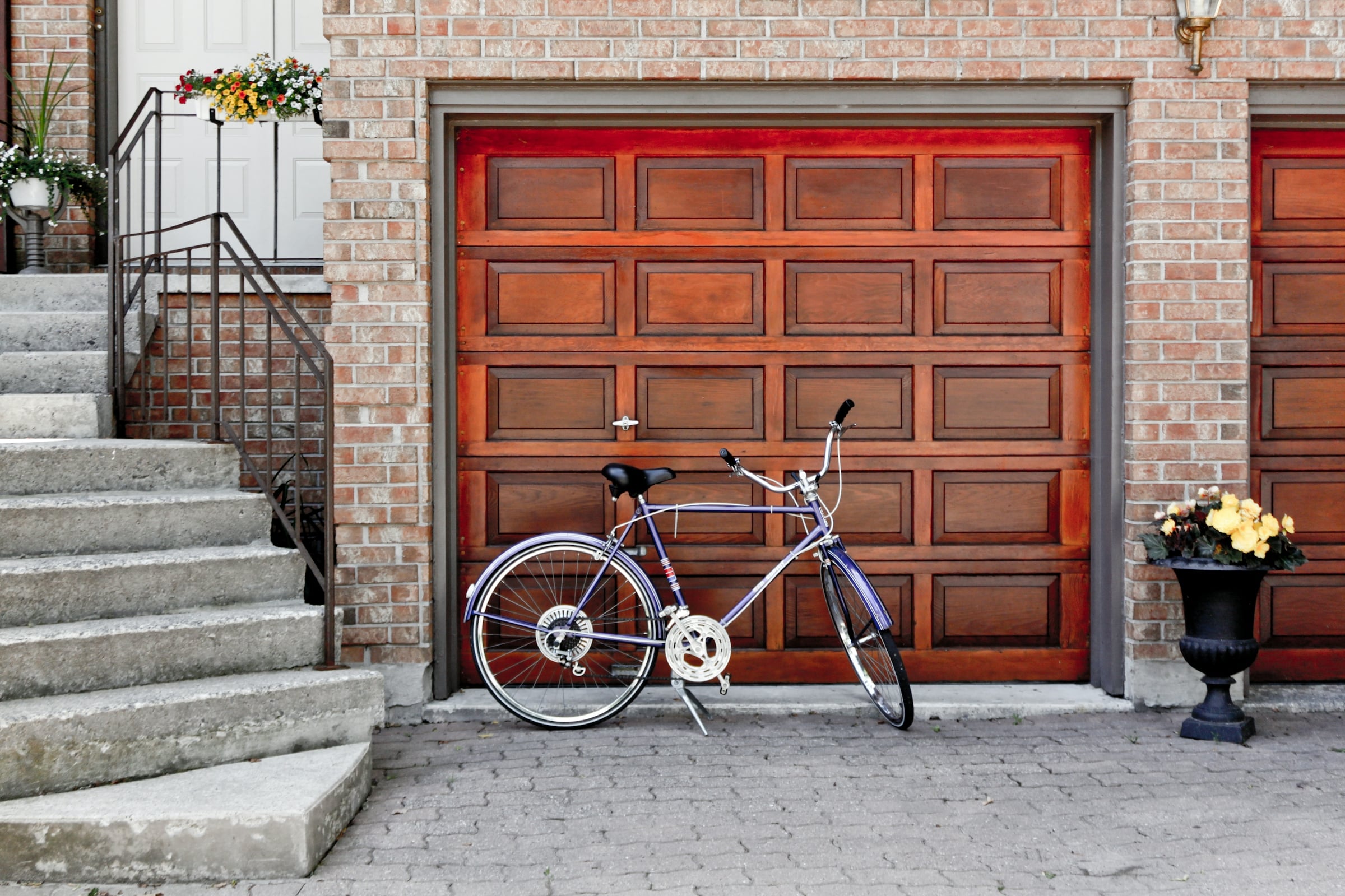
The fastest garage door check at a showing is the auto-reverse test: put a 2×4 flat on the floor in the door’s path and close the door. According to the U.S. Consumer Product Safety Commission (CPSC) guidance on non-reversing garage door openers, if the door does not reverse when it hits the board, stop using the opener until it is adjusted, repaired or replaced.
Ask the owner or listing agent before you run any test, and book the full check with your home inspector. Here is what to look at, in the order you will see it.
The five checks, with numbers
This table pulls the checks and measurements from the CPSC guidance, so you can carry it to a showing.
| Check | What to do | Number to know |
|---|---|---|
| Auto-reverse | Lay a 2×4 on the floor under the door and close it | The door must reverse on contact |
| Photo eyes | Look at both sensors at the bottom of the door tracks | Mounted 4 to 6 inches above the floor |
| Manual release | With the door closed, pull the release and lift the door by hand | It should lift and lower smoothly with the springs working |
| Balance | Stop the door partway open and let go | A balanced door stays put |
| Routine testing | Ask the owner how often the door is tested | CPSC advises every 30 days |
If a door binds, sticks or drifts, CPSC says a professional should service it. Springs and cables carry high tension, so this is not a buyer’s weekend project. Put it in your inspection report and in your negotiation instead.
Set up a saved search for the areas you are touring
Tell us where you are looking and we will set up a saved search, so new listings reach you while you plan your showings and checklist.
What the law requires, and by what year
The age of the opener tells you what it should have. CPSC says openers made or imported for U.S. sale on or after January 1, 1991 must have reversing systems under the 1990 Consumer Product Safety Improvement Act, which tied the requirement to the UL 325 standard. A CPSC 1993 announcement of final rules covers openers made on or after January 1, 1993, and says they must have one of two entrapment protections. One is an external sensor, such as a photoelectric eye or a door-edge sensor, that detects an obstruction without touching it. The other is a wall button that must be held down to close the door, and releasing it makes the door reverse. All new openers must also carry a warning label near the wall button.
The standard has been updated since. A July 13, 2018 Federal Register direct final rule aligned the CPSC garage door operator standard with changes UL made in the Seventh Edition of UL 325, including expanded edge sensor testing. It took effect September 11, 2018, unless significant adverse comments were received.
What this means at a showing: a door with no photo eyes and no hold-to-close wall button is a sign to ask about the opener’s age and get a replacement quote. Ask the seller for the install date or read the manufacturer label.
What to look at when you walk the garage
- The photo eyes: two small units, one on each side of the door opening. Look for a blinking light, tidy wiring, and a height near that 4 to 6 inch range. If they are missing, the opener may be a hold-to-close model, so find out which.
- The wall button: a label near it suggests a newer opener. Press it and watch the door’s travel.
- The door itself: dents, gaps at the bottom seal, rollers that wobble, or panels out of line.
- The opener unit: brand label, model, and any date stamp. Ask for the manual if it is there.
- The remotes and keypad: count them and test each one. These are cheap to replace, but they are a closing question.
The garage may be attached or detached, and a detached building has its own door. Our guides to outbuildings, sheds, detached garages and carports and driveways and shared driveway easements cover those pieces. If you are searching in Midlothian, Short Pump or the Fan, the garage test is the same, and you can also browse City of Richmond, Henrico and Chesterfield community pages for the full list of areas.
Questions to ask the seller or listing agent
- When was the opener installed, and has the door ever been serviced?
- Has anything been replaced, such as springs, rollers, sensors or the motor unit?
- Do you have the opener manual and every remote?
- Has the door ever reversed on its own, stuck or drifted?
Write the answers down next to your photos. If you later ask for a repair, those notes show what you saw on the day. If you are still working out a budget for fixes, the mortgage calculator shows how a repair fund or a seller concession would change monthly payments, and our buyer guide explains how we work with buyers from search to closing.
What to do if the opener fails the test
You have three practical paths. First, ask for a repair or replacement through your inspection process. Do it before your contract deadline for inspection requests passes, and ask your agent which date that is. Second, ask for a credit and get your own quote after closing. Third, accept it and budget for replacement. The right pick depends on the age of the opener, how the door moves, and what a technician finds. A newer opener that only needs sensor alignment is a different conversation from an old unit with no sensors at all. Whichever you choose, put the failed test and your agreed remedy in writing.
A safety item is also a fair reason to ask a licensed pro to look at a door in person before you commit. We would rather you know before closing than find out the first time a child, pet or bicycle is in the doorway.
Next step
Print the table, bring a 2×4 only if the owner agrees, and note every result.
Set up a saved search for the areas you are touring
Tell us the areas you are comparing and we will set up your saved search, so you can line up showings and bring the garage checklist.
Frequently asked questions
Do I have to replace an older opener?
We did not find a rule that forces a buyer to replace one at closing. The CPSC guidance says only that if the door does not reverse on the 2×4 test, you should stop using the opener until it is adjusted, repaired or replaced.
Why does CPSC stress this test?
The CPSC guidance notes that children between the ages of 2 and 14 have been trapped under closing garage doors, which is why it asks owners to test the reverse function and to inspect the door and opener regularly. Knowing the opener’s condition before you move in is a simple way to act on that.
Is there a label I can look for?
The 1993 CPSC announcement says all newly made openers must carry a warning label near the wall button. Its presence suggests a newer unit, but it does not replace the reverse test.
Does the CPSC say how often to test the door?
Yes. The CPSC guidance advises inspecting the door and opener every 30 days to confirm they work properly.
How high should the photo eyes sit?
CPSC recommends 4 to 6 inches above the floor for an electric eye sensor.
What is a hold-to-close opener?
It is one of two entrapment protection options named in CPSC’s 1993 announcement. The wall button must be held down to close the door, and if it is released the door reverses fully, and the remote cannot close the door in this mode.
Can I test the door during a showing?
Only with the owner’s permission, since you would be operating their equipment. Your inspector can run the full test during the inspection period.
Is a door that stays up when I stop it halfway balanced?
According to CPSC, a properly balanced door stays put when stopped partway open. If it does not, or it binds or sticks, CPSC says a professional should service it.
How do I check the manual release?
With the door fully closed, CPSC says to pull the quick-release to disconnect the door from the opener, then lift and lower it by hand. Check that the springs work and the hardware keeps it on its track.
Who made the rules on garage door opener safety?
The CPSC enforces a mandatory safety standard for automatic residential garage door operators (16 CFR part 1211), which it updated by direct final rule in July 2018.